AI Model Monitoring Checklist: Detect Drift and Guard Against Attacks
Model behaviour degrades silently after deployment, making continuous monitoring the only way to ensure outputs remain aligned with training intentions and security boundaries.

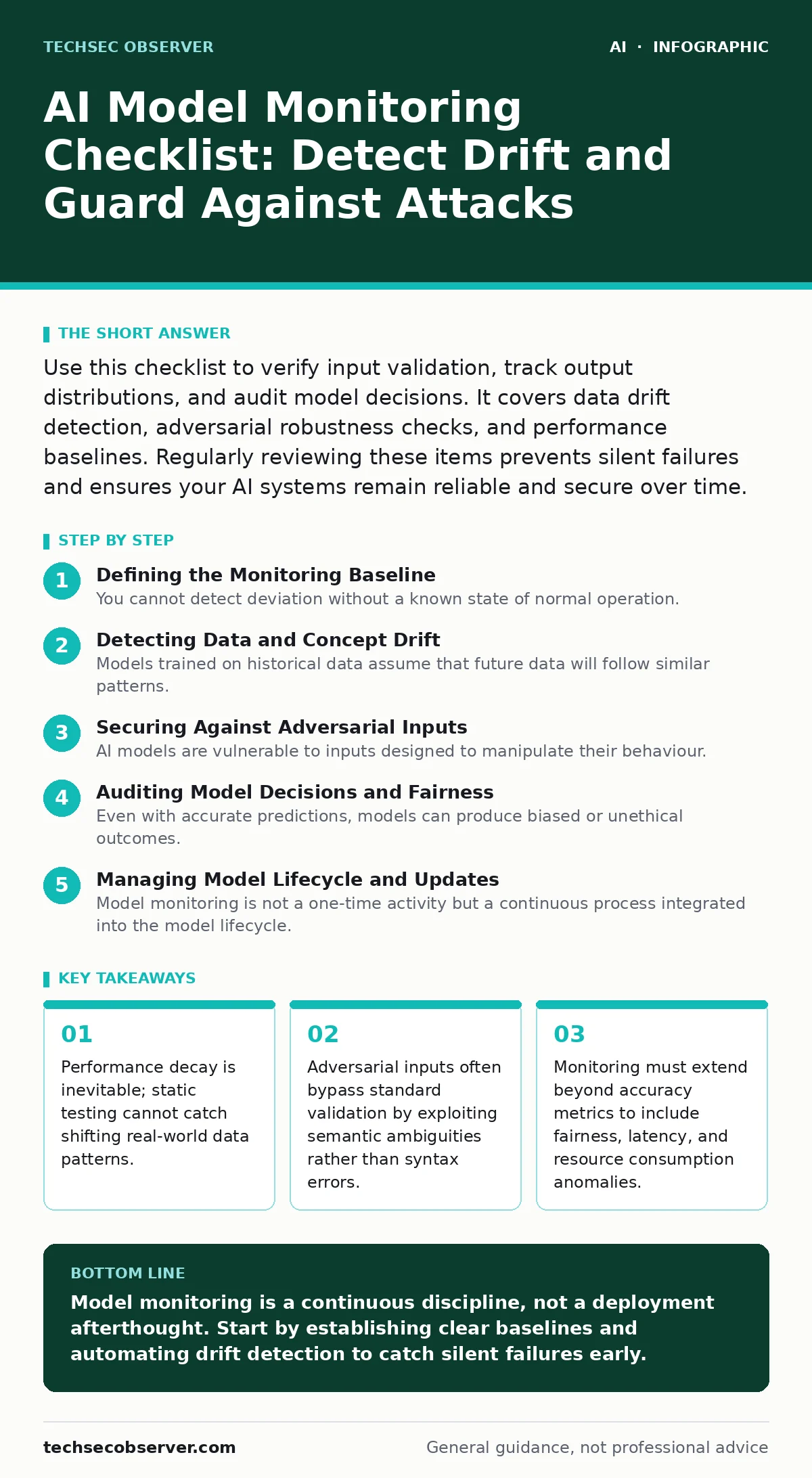
Use this checklist to verify input validation, track output distributions, and audit model decisions. It covers data drift detection, adversarial robustness checks, and performance baselines. Regularly reviewing these items prevents silent failures and ensures your AI systems remain reliable and secure over time.
Defining the Monitoring Baseline
You cannot detect deviation without a known state of normal operation. Before deploying a model, you must establish what constitutes acceptable behaviour under standard conditions. This baseline serves as the reference point for all subsequent monitoring activities. Without it, alerts become noise, and genuine threats remain invisible amidst routine fluctuations.
- Establish performance baselines: Define acceptable accuracy, precision, and recall thresholds for your specific use case to distinguish normal variance from degradation.
- Document expected input distributions: Record the statistical properties of your training data, such as mean, variance, and feature correlations, to identify when live data diverges.
- Set latency and throughput limits: Determine the maximum acceptable response time and request volume to ensure the model meets service level agreements under load.
- Define fairness metrics: Specify equality of opportunity or demographic parity thresholds to ensure the model does not disproportionately disadvantage specific groups.
Detecting Data and Concept Drift
Models trained on historical data assume that future data will follow similar patterns. This assumption often fails as user behaviour, market conditions, or language usage evolves. Data drift occurs when the input distribution changes, while concept drift happens when the relationship between inputs and outputs shifts. Both types of drift erode model accuracy silently, leading to increasingly poor decisions.
- Monitor input feature distributions: Track statistical shifts in key features to detect data drift before it impacts model predictions significantly.
- Track output label distributions: Observe changes in prediction frequencies to identify concept drift where the model’s underlying logic no longer applies.
- Implement drift detection algorithms: Use statistical tests, such as Kolmogorov-Smirnov or Page-Hinkley, to automatically flag significant deviations from the baseline.
- Schedule periodic re-evaluation: Regularly compare current model performance against the original baseline to quantify the cumulative impact of drift.
Securing Against Adversarial Inputs
AI models are vulnerable to inputs designed to manipulate their behaviour. These attacks exploit the mathematical nature of neural networks, often using subtle perturbations that are imperceptible to humans but cause misclassification. Standard input validation may not catch these sophisticated attacks, requiring specialised monitoring for adversarial robustness.
- Validate input formats strictly: Enforce schema validation to reject malformed or unexpected input structures that could trigger parsing errors or exploits.
- Monitor for adversarial patterns: Detect unusual input sequences or character combinations that resemble known attack vectors, such as those described in guides on prompt injection attacks.
- Track confidence score anomalies: Flag predictions with unusually low confidence or high uncertainty, which may indicate the model is processing adversarial examples.
- Implement rate limiting: Restrict the number of requests from single sources to mitigate brute-force attempts to reverse-engineer model behaviour.
Auditing Model Decisions and Fairness
Even with accurate predictions, models can produce biased or unethical outcomes. Monitoring must include auditing for fairness and explainability to ensure decisions align with ethical standards and regulatory requirements. This is particularly critical in high-stakes applications where model outputs influence human lives or significant financial outcomes.
- Log model decisions and rationale: Record the input, output, and reasoning path for each prediction to facilitate audits and explainability reviews.
- Monitor for bias across demographics: Regularly analyse prediction outcomes across different demographic groups to detect and address disparities.
- Validate against ground truth: Periodically compare model predictions with verified human assessments to ensure ongoing accuracy and relevance.
- Review false positive and negative rates: Analyse error patterns to identify specific scenarios where the model consistently fails, indicating potential bias or blind spots.
Managing Model Lifecycle and Updates
Model monitoring is not a one-time activity but a continuous process integrated into the model lifecycle. As models are updated, retrained, or replaced, monitoring configurations must evolve to reflect new baselines and risks. Effective lifecycle management ensures that monitoring remains relevant and effective throughout the model’s existence.
- Version control monitoring configurations: Track changes to monitoring rules, thresholds, and baselines alongside model versions to ensure reproducibility.
- Automate alerting and escalation: Configure automated alerts for critical deviations and define clear escalation paths for incident response.
- Document model lineage: Maintain records of training data, hyperparameters, and model architecture to support debugging and compliance audits.
- Plan for model retirement: Define criteria for decommissioning models that no longer meet performance or security standards, including data archiving procedures.
Key takeaways
- Performance decay is inevitable; static testing cannot catch shifting real-world data patterns.
- Adversarial inputs often bypass standard validation by exploiting semantic ambiguities rather than syntax errors.
- Monitoring must extend beyond accuracy metrics to include fairness, latency, and resource consumption anomalies.
Model monitoring is a continuous discipline, not a deployment afterthought. Start by establishing clear baselines and automating drift detection to catch silent failures early.
Frequently asked questions
How often should I review my model monitoring alerts?
Review critical alerts immediately, but conduct a comprehensive review of all monitoring data at least weekly to identify trends and adjust thresholds.
What is the difference between data drift and concept drift?
Data drift occurs when input data distributions change, while concept drift happens when the relationship between inputs and outputs shifts, requiring model retraining.
Can monitoring prevent all AI security breaches?
No, monitoring detects anomalies and potential threats but cannot prevent all attacks. It must be combined with robust input validation, access controls, and regular security testing.
How do I handle false positives in model monitoring?
Tune alert thresholds based on historical data and use contextual information, such as user behaviour patterns, to distinguish genuine threats from benign anomalies.
How this guide was produced: written by the TechSec Observer editorial team with AI assistance, checked against the public references listed below, and reviewed when the facts change. See our editorial policy or report an error.