Private file sharing services: secure transfer workflows
True confidentiality requires managing metadata exposure long before the encrypted payload ever reaches the remote recipient.

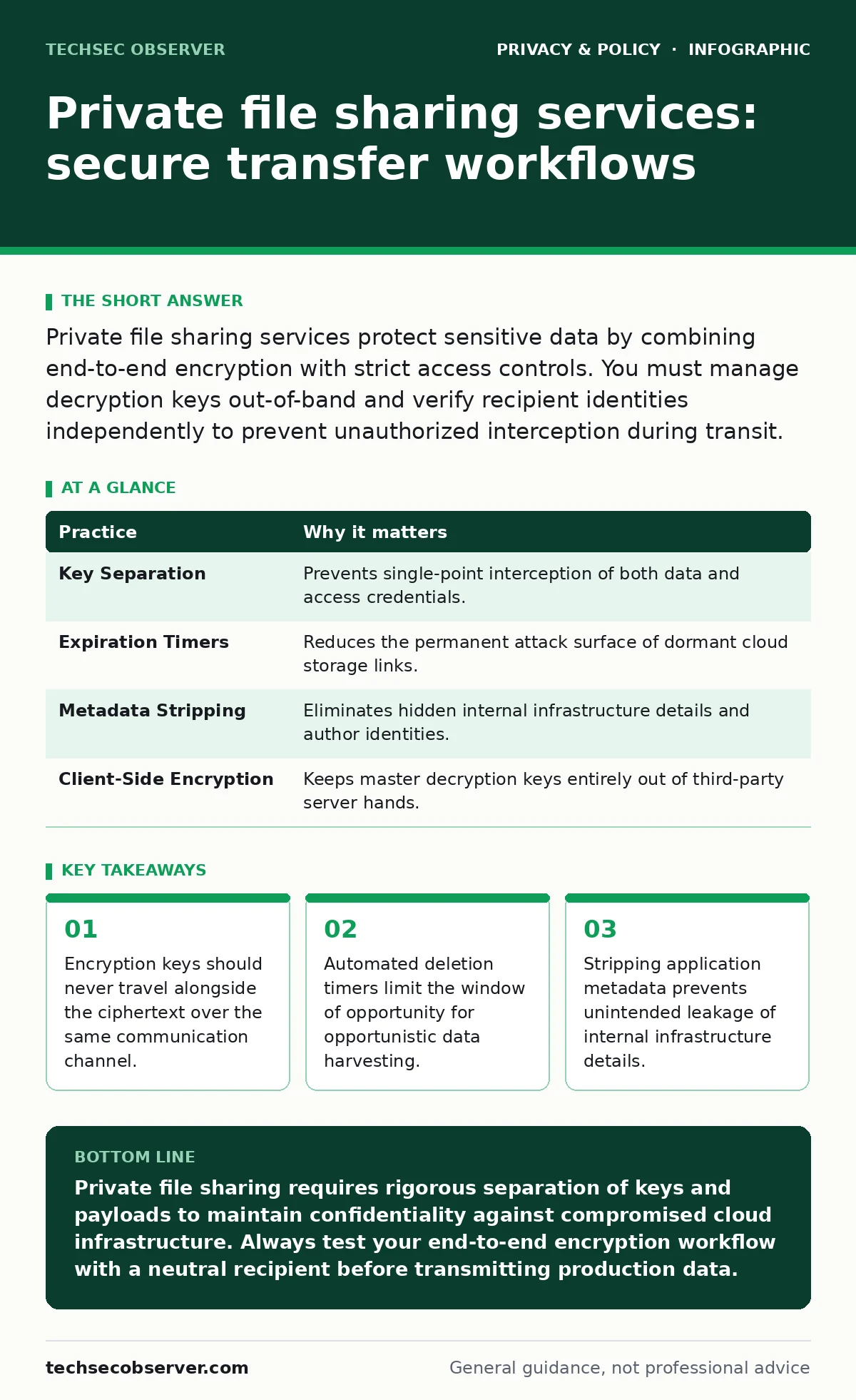
Private file sharing services protect sensitive data by combining end-to-end encryption with strict access controls. You must manage decryption keys out-of-band and verify recipient identities independently to prevent unauthorized interception during transit.
How private file sharing services operate
Private file sharing services rely on cryptographic protocols to keep data unreadable during transit and storage. End-to-end encryption ensures that only the intended recipient possesses the mathematical key required to reverse the transformation of plaintext into ciphertext. Cloud infrastructure providers hosting the storage nodes cannot inspect the contents because they lack the decryption material.
Transport layer security protects data while moving across networks, but end-to-end encryption secures data even if the storage server itself suffers a total compromise. Understanding metadata exposure helps you realize that file names, upload timestamps, and file sizes often leak more intelligence than the actual payload inside the archive.
1. Separate transport channels for keys
Cryptographic keys must travel through a distinct communication path away from the encrypted payload. Transmitting the key and the file through the same messaging application defeats the architectural separation designed to thwart interception.
- Send the encrypted archive via the primary platform.
- Deliver the decryption key through an independent channel.
- Revoke access immediately if delivery confirmation fails.
2. Enforce strict expiration policies
Permanent links sitting dormant on cloud servers invite unauthorized access long after the original business need expires. Ephemeral storage implements automatic deletion routines that purge files after a specific time window or download count.
- Set maximum download limits to restrict access strictly to the intended recipient.
- Configure absolute expiration timers measured in hours rather than weeks.
- Verify receipt promptly to enable immediate manual removal of the payload.
3. Strip internal metadata before upload
Files generated by office suites and image editors contain hidden author names, internal network paths, and revision histories. Metadata sanitization removes these properties before packaging files for transmission to external parties.
- Inspect document properties using built-in inspection tools.
- Export proprietary formats into flat formats that discard editing histories.
- Verify that compressed archives do not retain hidden operating system directory structures.
4. Implement client-side encryption routines
Relying on server-side encryption means the hosting provider holds the master keys and can theoretically read your files. Client-side encryption transforms data locally on your machine before the upload process even begins.
- Encrypt archives using open standards with strong passphrase requirements.
- Confirm that temporary plaintext copies are wiped from local swap memory.
- Test the decryption process on a separate machine before sending the link.
5. Verify recipient identity through challenges
Blindly sending links into public chat rooms or unverified addresses leaves data vulnerable to misdirection and interception. Authentication challenges require the recipient to prove identity before the decryption key is released.
- Require secondary verification factors such as a pre-shared passphrase.
- Confirm recipient contact details through an established communication line.
- Monitor access logs to detect unusual geographic login attempts.
| Practice | Why it matters |
|---|---|
| Key Separation | Prevents single-point interception of both data and access credentials. |
| Expiration Timers | Reduces the permanent attack surface of dormant cloud storage links. |
| Metadata Stripping | Eliminates hidden internal infrastructure details and author identities. |
| Client-Side Encryption | Keeps master decryption keys entirely out of third-party server hands. |
6. Audit download access logs
Visibility into who accessed your files and when allows you to detect anomalous behavior early. Access logging records telemetry data every time a retrieval attempt occurs against your shared link.
- Review IP addresses and user agent strings associated with downloads.
- Set up automated alerts for unexpected download spikes or foreign geolocations.
- Disable links immediately if unauthorized access patterns emerge.
7. Combine downloads with secure networks
Retrieving sensitive files over unencrypted public infrastructure exposes the communication metadata to local network observers. Network hardening ensures that even the act of downloading remains confidential from third parties peering at the local connection.
- Avoid untrusted network hot spots when downloading confidential assets.
- Utilize virtual private networks to tunnel traffic away from local inspection.
- Verify cryptographic checksums after download to confirm file integrity.
Key takeaways
- Encryption keys should never travel alongside the ciphertext over the same communication channel.
- Automated deletion timers limit the window of opportunity for opportunistic data harvesting.
- Stripping application metadata prevents unintended leakage of internal infrastructure details.
Private file sharing requires rigorous separation of keys and payloads to maintain confidentiality against compromised cloud infrastructure. Always test your end-to-end encryption workflow with a neutral recipient before transmitting production data.
Frequently asked questions
Can cloud storage providers read end-to-end encrypted files?
Cloud storage providers cannot read end-to-end encrypted files because the encryption and decryption happen exclusively on client devices using keys the provider never sees.
Why is file metadata dangerous to leave intact?
File metadata often contains internal usernames, local directory paths, and software version numbers that attackers use to map internal networks.
How do ephemeral links improve security?
Ephemeral links limit the time window that an unauthorized person has to discover and download a shared file.
What happens if a decryption key is sent through the same channel as the file?
Sending the key through the same channel allows anyone who intercepts that single communication path to access both the payload and the means to open it.
How this guide was produced: written by the TechSec Observer editorial team with AI assistance, checked against the public references listed below, and reviewed when the facts change. See our editorial policy or report an error.