How public key infrastructure works behind digital trust
Public key infrastructure relies on mathematical hierarchies where a single compromised root can silently invalidate millions of secure connections.

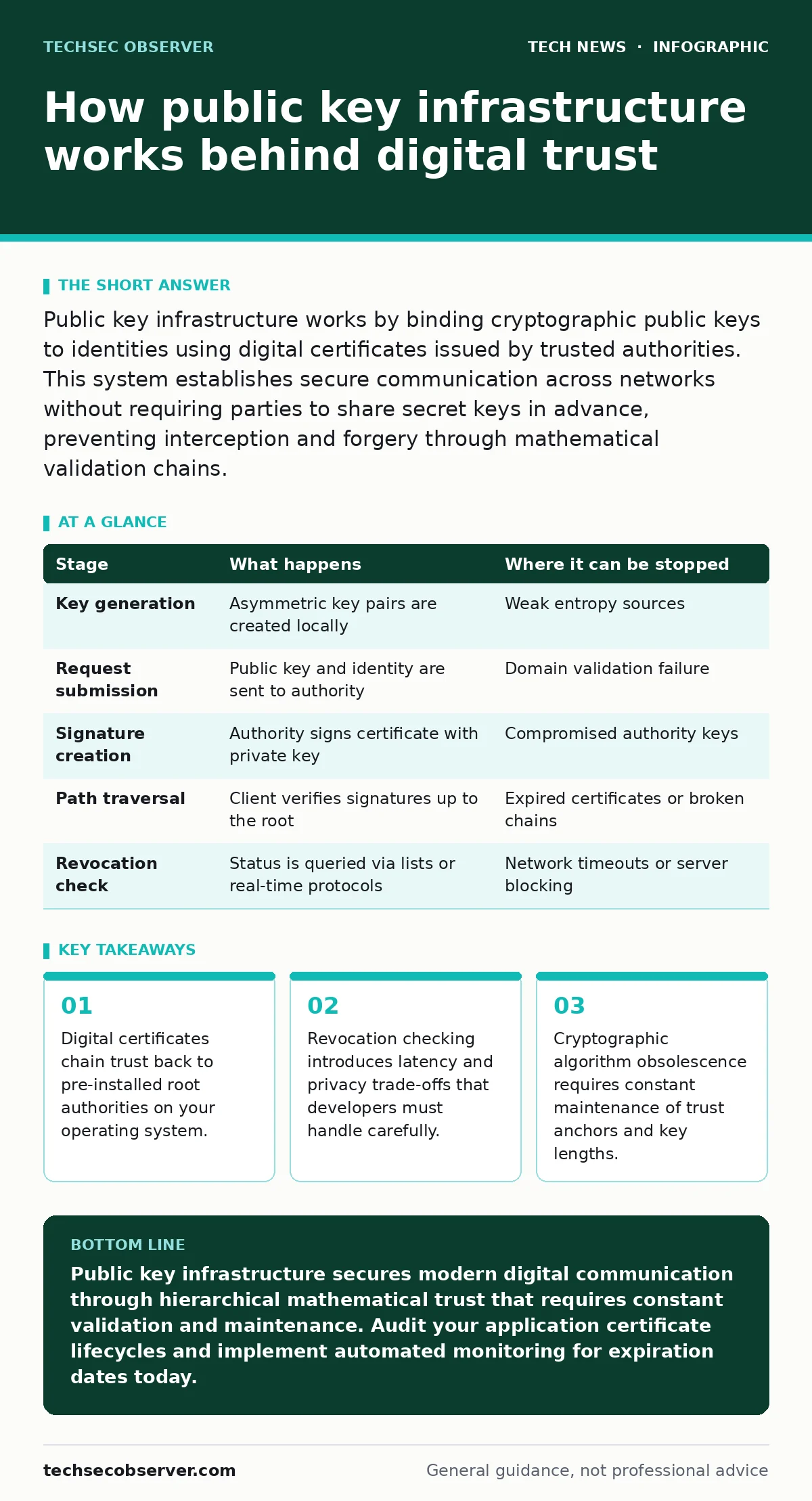
Public key infrastructure works by binding cryptographic public keys to identities using digital certificates issued by trusted authorities. This system establishes secure communication across networks without requiring parties to share secret keys in advance, preventing interception and forgery through mathematical validation chains.
How public key infrastructure works from root to leaf
Public key infrastructure establishes trust across open networks by pairing asymmetric cryptography with hierarchical validation. Understanding how public key infrastructure works requires examining the mathematical relationships between public and private keys. Every participant generates a key pair where data encrypted with one key requires the other for decryption.
Trust anchors called root certificates form the bedrock of this architecture. Operating systems and browsers ship with a curated store of pre-installed root certificates from trusted organizations. These root authorities sign intermediate certificates, which in turn sign the leaf certificates issued to individual servers or users.
The mechanics of certificate issuance and binding
Certificate generation begins when a server creates a key pair and submits a certificate signing request containing the public key and identity details. The issuing authority verifies organizational ownership through automated domain validation or manual vetting. Once satisfied, the authority creates a digital certificate containing the identity, the public key, and validity periods.
Mathematical signatures protect the integrity of this issued certificate. The issuing authority hashes the certificate contents and encrypts that hash using its own private key. When a client receives the certificate, it decrypts the signature using the authority's public key and compares it to a locally calculated hash. A match proves the certificate has not been tampered with since issuance.
Validating trust paths during a handshake
Clients validate a received certificate by traversing the entire trust path back to a recognized root. This process involves checking expiration dates, verifying signature chains, and ensuring no intermediate authority has exceeded its mandate. Modern applications often pair this logic with robust digital certificates to manage complex trust relationships efficiently.
Path validation fails immediately if any link in the chain lacks a valid signature or if a certificate has expired. Developers often overlook the hidden cost of network latency during this traversal. Applications must fetch missing intermediate certificates or query revocation status over the network, introducing delays before a secure session opens.
Detecting revocation through lists and protocols
Certificates occasionally require invalidation before their scheduled expiration due to key compromise or administrative changes. Authorities publish revocation status using certificate revocation lists, which are large files containing serial numbers of invalid certificates. Downloading these bulky files strains mobile devices and slow networks, prompting the use of online status protocols.
Online status protocols allow clients to query the issuing authority in real time for a specific certificate validity check. This real-time query introduces a privacy trade-off because the authority learns which websites a user visits. To mitigate tracking, stapling techniques allow servers to bundle the signed revocation response directly into the initial handshake.
Where the validation chain breaks down
Public key infrastructure can fail or be stopped when intermediate authorities misbehave or get compromised by attackers. If an unauthorized entity obtains a signing key for an intermediate authority, they can mint fraudulent certificates for any domain. Clients will trust these fraudulent credentials because the signature traces back to a valid root.
Algorithm obsolescence represents another critical point of failure for long-term deployments. Cryptographic primitives degrade over time as computing power increases and mathematical weaknesses emerge. When a hashing algorithm becomes vulnerable to collision attacks, the entire validation chain collapses, requiring sudden migration to stronger standards like those found in modern public key cryptography.
See also: How Bluetooth Security Works: The Hidden Handshake Mechanics
Stages of cryptographic validation
| Stage | What happens | Where it can be stopped |
|---|---|---|
| Key generation | Asymmetric key pairs are created locally | Weak entropy sources |
| Request submission | Public key and identity are sent to authority | Domain validation failure |
| Signature creation | Authority signs certificate with private key | Compromised authority keys |
| Path traversal | Client verifies signatures up to the root | Expired certificates or broken chains |
| Revocation check | Status is queried via lists or real-time protocols | Network timeouts or server blocking |
Managing trust in distributed systems
Distributed systems demand rigorous certificate management to prevent outages caused by expired credentials. Automated rotation tools now handle the rapid lifecycle of short-lived certificates without human intervention. Neglecting this automation often leads to sudden service disruptions when validation credentials lapse silently in production environments.
Network boundaries also interact with trust models in unexpected ways. Developers configuring internal microservices sometimes misjudge how routing rules affect certificate validation. Ensuring proper network segmentation using VLANs prevents internal sniffing, but it does not substitute for valid cryptographic trust paths between internal services.
Key takeaways
- Digital certificates chain trust back to pre-installed root authorities on your operating system.
- Revocation checking introduces latency and privacy trade-offs that developers must handle carefully.
- Cryptographic algorithm obsolescence requires constant maintenance of trust anchors and key lengths.
Public key infrastructure secures modern digital communication through hierarchical mathematical trust that requires constant validation and maintenance. Audit your application certificate lifecycles and implement automated monitoring for expiration dates today.
Frequently asked questions
What happens if a root certificate expires?
Applications will reject any certificate chained to that root, causing widespread connection failures across systems relying on that trust anchor.
Why do clients check revocation status during a handshake?
Clients check revocation to ensure the presented certificate has not been compromised or revoked before its scheduled expiration date.
Can an attacker forge a valid digital certificate without the private key?
No, because the cryptographic binding relies on asymmetric signatures that cannot be reverse-engineered without the corresponding private key.
How do short-lived certificates change deployment practices?
Short-lived certificates reduce the window of vulnerability for compromised keys and eliminate the need for traditional revocation checking mechanisms.
How this guide was produced: written by the TechSec Observer editorial team with AI assistance, checked against the public references listed below, and reviewed when the facts change. See our editorial policy or report an error.