What is public key encryption: how asymmetric cryptography secures your data
Public key encryption relies on mathematical asymmetry, allowing anyone to lock data with a public key while only the holder of a private key can unlock it, without sharing secrets.

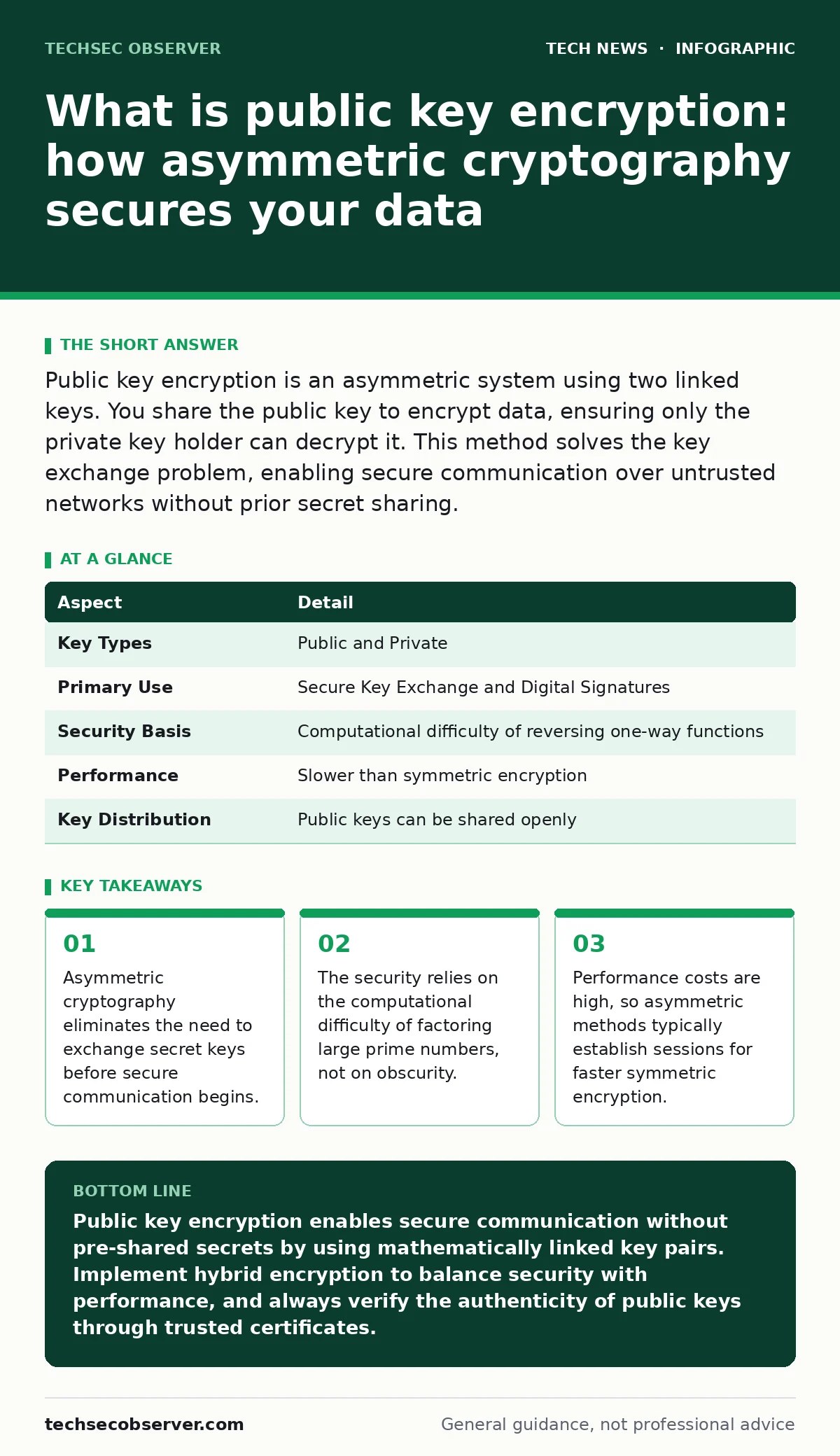
Public key encryption is an asymmetric system using two linked keys. You share the public key to encrypt data, ensuring only the private key holder can decrypt it. This method solves the key exchange problem, enabling secure communication over untrusted networks without prior secret sharing.
The Envelope Analogy for Asymmetric Systems
Imagine you want to send a confidential document to a colleague who lives in another country. You cannot meet to exchange a physical lock and key. Instead, your colleague posts an open padlock on their office door. You take this padlock, lock your document inside a box, and mail it. Only your colleague holds the key to open that specific padlock.
This analogy illustrates the core mechanism of public key encryption. The open padlock represents the public key, which anyone can use to encrypt data. The key in your colleague's pocket represents the private key, which remains secret and is the only tool capable of decrypting the information. This separation of functions allows secure communication without the parties ever needing to share a secret beforehand.
What Is Public Key Encryption
Public key encryption is a cryptographic method that uses two mathematically related keys: one public and one private. The public key encrypts data, while the private key decrypts it. This asymmetry means that the act of locking data does not reveal how to unlock it.
This system differs fundamentally from symmetric encryption, where the same key locks and unlocks data. In symmetric systems, you must securely share the key first. Public key encryption solves this distribution problem. You can distribute your public key freely, even over insecure channels, because it cannot decrypt the data it encrypts. The private key stays with you, ensuring that only you can read messages intended for you.
How the Mathematics Protects Data
The security of public key encryption relies on one-way functions. These are mathematical operations that are easy to perform in one direction but computationally infeasible to reverse without specific knowledge. Most modern systems use the difficulty of factoring large prime numbers or solving discrete logarithm problems.
When a key pair is generated, the algorithm creates two numbers linked by complex mathematics. Deriving the private key from the public key requires solving this problem. Current computing power cannot solve these problems in a reasonable timeframe for sufficiently large keys. This computational hardness ensures that even if an attacker intercepts the public key and the encrypted data, they cannot derive the private key or the original message.
| Aspect | Detail |
|---|---|
| Key Types | Public and Private |
| Primary Use | Secure Key Exchange and Digital Signatures |
| Security Basis | Computational difficulty of reversing one-way functions |
| Performance | Slower than symmetric encryption |
| Key Distribution | Public keys can be shared openly |
Who Relies on Asymmetric Cryptography
Developers, system administrators, and end users interact with public key encryption daily, often without noticing it. When you visit a website using HTTPS, your browser uses asymmetric cryptography to establish a secure session. The server presents a certificate containing its public key. Your browser verifies this key and uses it to encrypt a session key.
This mechanism underpins secure email, virtual private networks, and software updates. Developers use it to sign code, proving the origin and integrity of their applications. System administrators manage certificate lifecycles to ensure services remain trusted. Understanding certificate management is vital for maintaining these trust chains. Without proper management, expired or revoked certificates can disrupt services or create vulnerabilities.
Common Misconceptions About Key Pairs
Many assume that public key encryption encrypts all data during a session. This is incorrect due to performance constraints. Asymmetric algorithms are computationally expensive. Encrypting large files or video streams with RSA or ECC would cause significant latency.
Instead, systems use hybrid encryption. The public key encrypts a small, random symmetric key. This symmetric key then encrypts the bulk of the data. This combines the security of asymmetric key exchange with the speed of symmetric encryption. Another misconception is that public keys are inherently trusted. A public key is just a number. You must verify its authenticity through a certificate authority or a web of trust to ensure it belongs to the intended recipient.
See also: Email security issues explained with fix mechanics · Why is WPA3 more secure and how it stops offline dictionary attacks
Implementation Trade-offs and Risks
Using public key encryption introduces specific operational complexities. Key size matters. Larger keys offer greater security against brute-force attacks but increase processing time. Developers must balance security requirements with performance needs. Choosing an inappropriate key size can degrade user experience or leave systems vulnerable.
Key storage is another critical factor. Private keys must be protected from unauthorized access. If a private key is compromised, the attacker can decrypt past intercepted messages or impersonate the owner. Hardware security modules or secure enclaves provide better protection than software-only storage. Additionally, users must be aware that public key encryption does not protect data at rest on an unsecured device if the private key is also stored there unprotected.
Integrating with Modern Security Frameworks
Public key encryption works within broader security architectures. It integrates with digital certificates to bind identities to keys. These certificates are issued by trusted authorities, creating a chain of trust. This system allows your browser to verify that a website is who it claims to be.
Developers must also consider interoperability. Different systems may support different algorithms. Ensuring your application supports standard, widely accepted algorithms prevents compatibility issues. Furthermore, as quantum computing advances, current asymmetric algorithms may become vulnerable. Researchers are developing post-quantum cryptography to address this future threat. Staying informed about these shifts is necessary for long-term security planning. Related concepts like biometric authentication often work alongside these cryptographic methods to verify user identity before granting access to private keys.
Key takeaways
- Asymmetric cryptography eliminates the need to exchange secret keys before secure communication begins.
- The security relies on the computational difficulty of factoring large prime numbers, not on obscurity.
- Performance costs are high, so asymmetric methods typically establish sessions for faster symmetric encryption.
Public key encryption enables secure communication without pre-shared secrets by using mathematically linked key pairs. Implement hybrid encryption to balance security with performance, and always verify the authenticity of public keys through trusted certificates.
Frequently asked questions
Can I use public key encryption for bulk data storage?
No, public key encryption is computationally slow. Use it to encrypt a symmetric key, then use that symmetric key to encrypt bulk data for efficiency.
What happens if I lose my private key?
You lose access to any data encrypted with the corresponding public key. There is no recovery mechanism; the data is permanently inaccessible unless you have a backup.
Is public key encryption secure against future computers?
Current algorithms rely on mathematical problems that classical computers find hard to solve. Quantum computers may eventually break these, so monitor developments in post-quantum cryptography.
How do I know a public key belongs to the right person?
You verify the key using a digital certificate issued by a trusted certificate authority. This certificate binds the public key to an identity and is signed by the authority.
How this guide was produced: written by the TechSec Observer editorial team with AI assistance, checked against the public references listed below, and reviewed when the facts change. See our editorial policy or report an error.