Why is WPA3 more secure and how it stops offline dictionary attacks
Modern wireless encryption replaces vulnerable handshakes with a system that prevents passive eavesdroppers from cracking your passphrase offline.
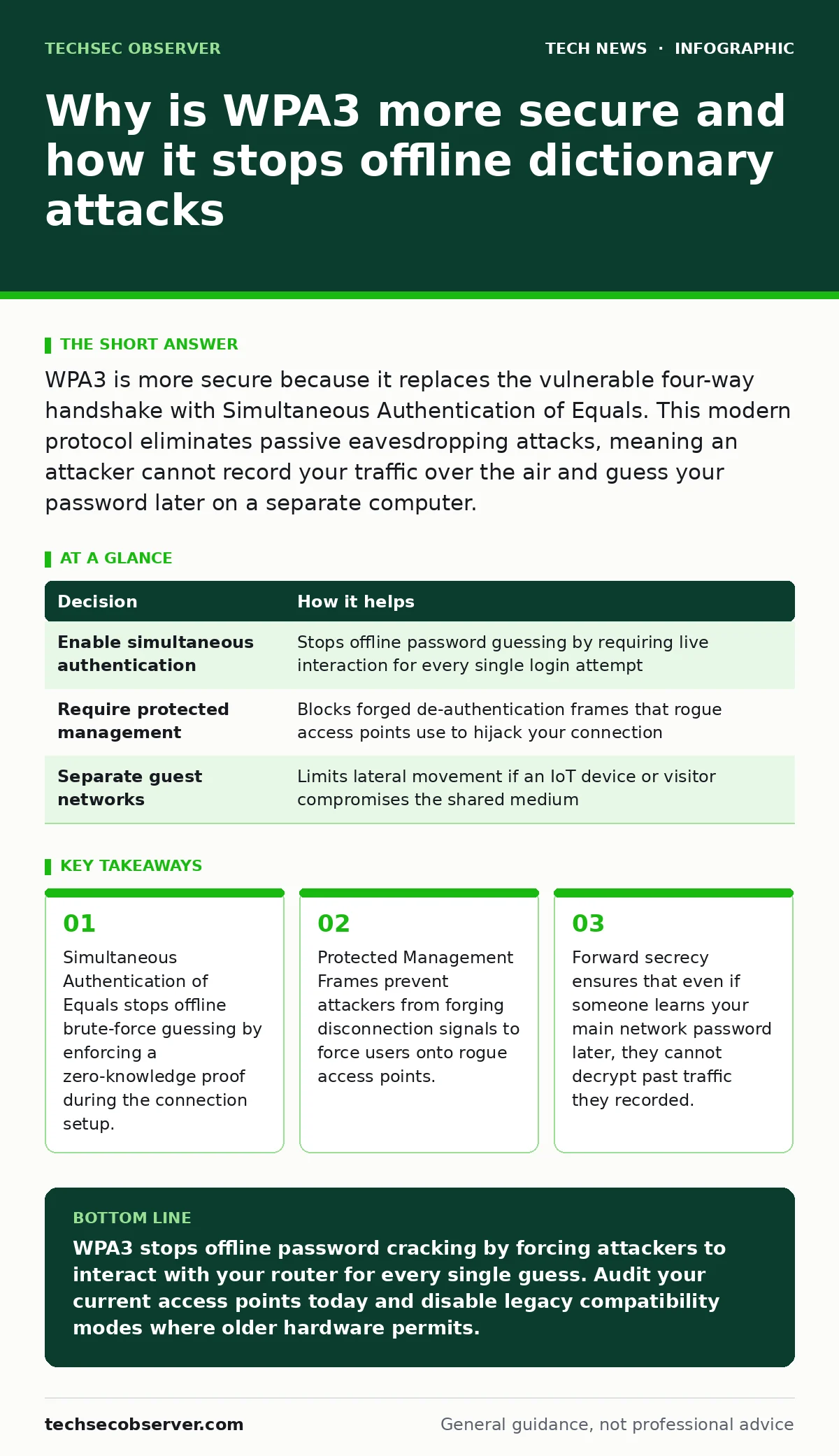
WPA3 is more secure because it replaces the vulnerable four-way handshake with Simultaneous Authentication of Equals. This modern protocol eliminates passive eavesdropping attacks, meaning an attacker cannot record your traffic over the air and guess your password later on a separate computer.
Why is WPA3 more secure than older wireless standards?
WPA3 is more secure because it fundamentally changes how devices establish trust with a wireless router. Older protocols relied on a shared secret to derive encryption keys through a mathematical process that attackers could record and replay. Once captured, an adversary could test millions of password combinations on their own hardware without interacting with your network again. Modern wireless security relies on a protocol exchange that prevents this offline guessing entirely.
Eliminating offline dictionary attacks through modern cryptography
Simultaneous Authentication of Equals is a secure key establishment protocol that allows two parties to create a strong shared secret using a weak password. This mechanism uses a cryptographic discrete logarithm technique to ensure that every connection attempt requires an active, live interaction with the access point. If an attacker records the wireless handshake over the air, they gain no useful data to test passwords offline. Each failed guess requires a new, live exchange, which introduces rate limiting and makes mass guessing impractical.
Understanding forward secrecy in wireless sessions
Forward secrecy ensures that a compromised long-term credential does not automatically compromise past session traffic you already recorded. Older wireless protocols derived all traffic encryption keys directly from the master password and connection identifiers. If an adversary eventually guessed your Wi-Fi password through brute-force methods or social engineering, they could decrypt all the historical traffic they had saved on their hard drives for months. Modern protocol designs ensure that session keys depend on ephemeral values exchanged during the connection handshake.
| Decision | How it helps |
|---|---|
| Enable simultaneous authentication | Stops offline password guessing by requiring live interaction for every single login attempt |
| Require protected management | Blocks forged de-authentication frames that rogue access points use to hijack your connection |
| Separate guest networks | Limits lateral movement if an IoT device or visitor compromises the shared medium |
Defending against rogue access points and de-authentication frames
Wireless management traffic historically travelled unencrypted in the clear, allowing malicious actors to spoof frames from your router. Attackers frequently exploited this weakness by sending forged disconnection commands that forced your laptop or phone to drop its secure link. Once disconnected, your device would automatically connect to a rogue access point broadcasting the same network name. Protected management frames encrypt these administrative signals, preventing malicious de-authentication tricks and keeping your devices tethered to the legitimate hardware.
Transitioning legacy hardware without breaking network segmentation
Deploying modern security standards often introduces friction when older Internet of Things appliances refuse to connect to a purely contemporary network. Many legacy devices lack the firmware updates necessary to understand advanced cryptographic handshakes. Network administrators often resolve this by running mixed-mode configurations or isolating older devices into separate network segments using VLANs. This containment ensures that legacy hardware vulnerabilities cannot serve as a stepping stone into your primary administrative systems.
See also: What is public key encryption: how asymmetric cryptography secures your data
What goes wrong when you skip modern wireless upgrades
Failing to adopt modern wireless protocols leaves your organization vulnerable to passive sniffing and automated credential cracking tools. Attackers routinely harvest handshake traffic in public spaces and parking lots, waiting for computational power to catch up with weak passwords. Furthermore, ignoring these updates leaves your airspace open to fake access point attacks that steal user credentials through captive portals. Effective defense requires aligning your wireless configuration with broader internal security controls like smart home security and strict access policies.
Key takeaways
- Simultaneous Authentication of Equals stops offline brute-force guessing by enforcing a zero-knowledge proof during the connection setup.
- Protected Management Frames prevent attackers from forging disconnection signals to force users onto rogue access points.
- Forward secrecy ensures that even if someone learns your main network password later, they cannot decrypt past traffic they recorded.
WPA3 stops offline password cracking by forcing attackers to interact with your router for every single guess. Audit your current access points today and disable legacy compatibility modes where older hardware permits.
Frequently asked questions
Can I use WPA3 with a weak password?
While the protocol prevents offline guessing, a short or predictable password remains susceptible to online brute-force attacks if an adversary targets your network continuously.
Will old printers and smart devices stop working?
Many legacy appliances lack firmware updates for modern protocols, which often requires you to isolate them on a separate guest network or legacy SSID.
Does this protocol protect my traffic on public Wi-Fi?
Encryption protects your local radio link from nearby eavesdroppers, but you still need end-to-end encryption like HTTPS to keep your data safe from the network operator.
How do I check if my router supports the newer standard?
Check your router administration panel for wireless security settings and look for the option specifying simultaneous authentication or the modern standard designation.
How this guide was produced: written by the TechSec Observer editorial team with AI assistance, checked against the public references listed below, and reviewed when the facts change. See our editorial policy or report an error.