Email security issues explained with fix mechanics
Postal delivery protocols were designed for mutual trust rather than verification, leaving modern messaging inherently vulnerable to forgery.

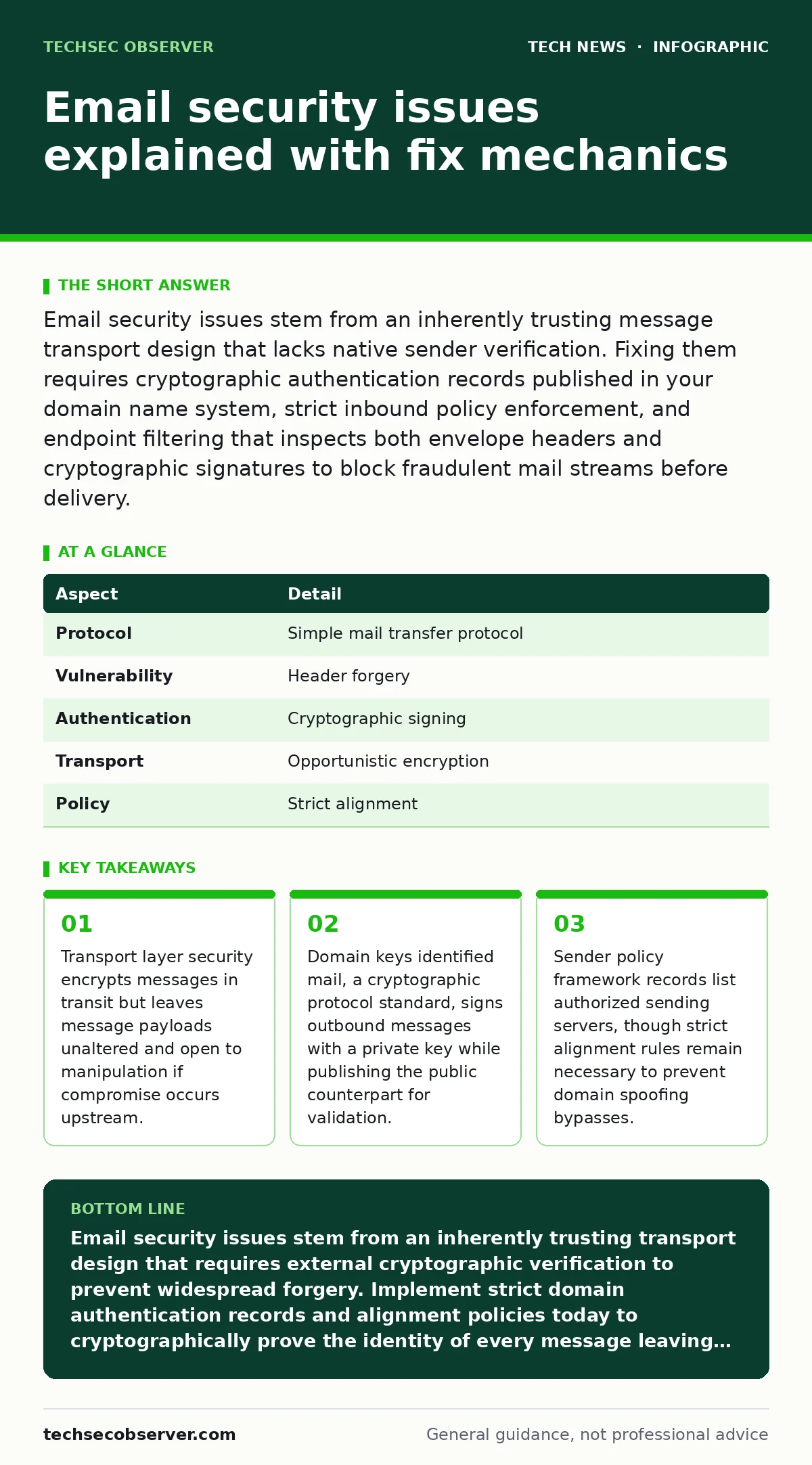
Email security issues stem from an inherently trusting message transport design that lacks native sender verification. Fixing them requires cryptographic authentication records published in your domain name system, strict inbound policy enforcement, and endpoint filtering that inspects both envelope headers and cryptographic signatures to block fraudulent mail streams before delivery.
Postal origins of modern messaging flaws
Imagine posting an open postcard through a letterbox with any name written in the return address field. Digital mail inherits this exact architectural flaw from early networking assumptions built on mutual cooperation rather than hostility. Postal workers historically delivered mail based solely on the written return address without verifying identity credentials or checking if the sender actually owned the property of origin.
Internet message delivery relies on simple mail transfer protocol, a plain text transmission standard created when networks were small and closed. Simple mail transfer protocol lacks native handshake verification for human senders, allowing any connected machine to claim ownership of any domain name during the envelope handshake phase. Fixing these structural defects requires overlaying modern cryptographic mechanisms onto an ancient transport layer that never anticipated malicious forgery at scale.
| Aspect | Detail |
|---|---|
| Protocol | Simple mail transfer protocol |
| Vulnerability | Header forgery |
| Authentication | Cryptographic signing |
| Transport | Opportunistic encryption |
| Policy | Strict alignment |
How cryptographic validation stops domain spoofing
Domain keys identified mail, known as DKIM, attaches a cryptographic hash to outgoing message headers using a private key stored on the sending mail server. Receiving mail servers fetch the corresponding public key from the sender's public records to verify that the message content remained unmodified during transit. This mathematical proof guarantees integrity, yet it does not automatically prove that the author intended to send that specific message content to that specific recipient.
Sender policy framework, known as SPF, defines an authorized list of internet protocol addresses permitted to send mail on behalf of a specific domain. Receiving systems check this published list against the connecting server address during the initial network handshake. Domain-based message authentication, reporting, and conformance, known as DMARC, ties these two mechanisms together by enforcing strict alignment rules and instructing receiving servers on how to handle failures.
Hidden costs and edge cases in policy enforcement
Enforcing strict domain policies carries operational risks that often break legitimate business workflows. Third-party vendors, customer relationship management tools, and automated invoicing platforms frequently send mail on your behalf using their own infrastructure. If these external services fail to align their sending envelopes with your authentication records, legitimate customer notifications bounce back and disappear into delivery failure queues.
Mail routing through cloud forwarders and internal routing proxies alters header metadata in ways that frequently break cryptographic validation chains. When a message hops across multiple internal relays before final delivery, intermediate systems can inadvertently strip or reorder signed headers, causing valid messages to fail authenticity checks. Balancing strict security enforcement against uninterrupted message delivery requires meticulous inventory mapping of every service touching your outbound mail stream.
Who email security issues affect across modern infrastructure
Every organization operating a custom domain name faces direct exposure to impersonation attacks targeting clients, partners, and internal staff. Financial loss occurs when automated invoicing systems or human operators fall victim to forged payment instructions sent from seemingly trusted internal addresses. Marketing departments also suffer reputation damage when malicious actors abuse unauthenticated domains to blast spam, resulting in blacklisting that blocks legitimate customer communications.
Software developers building communication features inside custom applications frequently misconfigure automated notification services, creating wide-open relay vulnerabilities. When internal applications send alerts without proper transport encryption or cryptographic signing, those message streams become prime targets for interception on corporate networks. Securing these pathways often requires coordination with operating system hardening routines to ensure local relay daemons reject unauthenticated submission attempts.
What people usually get wrong about threat mitigation
Many administrators believe that enabling transport layer security guarantees absolute message privacy across the entire delivery path. Transport layer security only encrypts the connection between the immediate sending and receiving hops, leaving messages completely unencrypted and readable in plain text if they traverse intermediate unencrypted relays. Relying solely on transport encryption provides zero protection against mailbox compromise or server-side data theft once the message lands in storage.
Another common misconception assumes that installing basic spam filters solves domain spoofing entirely without requiring domain-level cryptographic records. Filtering incoming mail based on content heuristics catches obvious phishing attempts, but it leaves your actual domain name completely unprotected against sophisticated impersonation attacks targeting external partners. True protection requires publishing public cryptographic records and enforcing strict alignment policies rather than trusting local inbox filters to spot every forgery.
See also: Biometric Authentication FAQs: How It Works and Its Hidden Risks
Correct implementation steps for robust defense
- Audit all internal applications, third-party vendors, and marketing platforms currently authorized to send mail using your organizational domain name.
- Publish an accurate sender policy framework record listing every legitimate internet protocol address block and authorized relay service.
- Generate strong cryptographic keys for domain keys identified mail signing on your outbound mail transfer agents and publish the public counterparts.
- Implement domain-based message authentication, reporting, and conformance policies starting in a monitoring mode before escalating to strict rejection rules.
Key takeaways
- Transport layer security encrypts messages in transit but leaves message payloads unaltered and open to manipulation if compromise occurs upstream.
- Domain keys identified mail, a cryptographic protocol standard, signs outbound messages with a private key while publishing the public counterpart for validation.
- Sender policy framework records list authorized sending servers, though strict alignment rules remain necessary to prevent domain spoofing bypasses.
Email security issues stem from an inherently trusting transport design that requires external cryptographic verification to prevent widespread forgery. Implement strict domain authentication records and alignment policies today to cryptographically prove the identity of every message leaving your organization.
Frequently asked questions
Why do spam filters still miss sophisticated phishing messages?
Sophisticated phishing messages often originate from compromised legitimate accounts or freshly registered domains that lack historical reputation data, allowing them to bypass content-based heuristics and reputation scoring systems.
Does internal email require cryptographic signing if it never leaves the local network?
Internal mail crossing local network boundaries remains vulnerable to internal sniffing and lateral movement if unauthorized devices connect to the same segments, making internal transport encryption and signing a worthwhile defensive layer.
How do third-party marketing services affect domain authentication policies?
Third-party marketing services send mail using their own infrastructure, which requires you to delegate subdomain authority or configure specialized inclusion rules so their servers pass your strict validation checks.
What happens when a domain policy is set to reject instead of quarantine?
Messages failing cryptographic alignment checks are permanently dropped by the receiving server without generating a notification to the intended recipient, eliminating fraudulent delivery but risking the loss of legitimate misconfigured mail.
How this guide was produced: written by the TechSec Observer editorial team with AI assistance, checked against the public references listed below, and reviewed when the facts change. See our editorial policy or report an error.