Phishing vs Vishing: How Audio Bypasses Your Defences
Voice attacks exploit human trust faster than text, rendering standard email filters useless against social engineering that targets your ears.

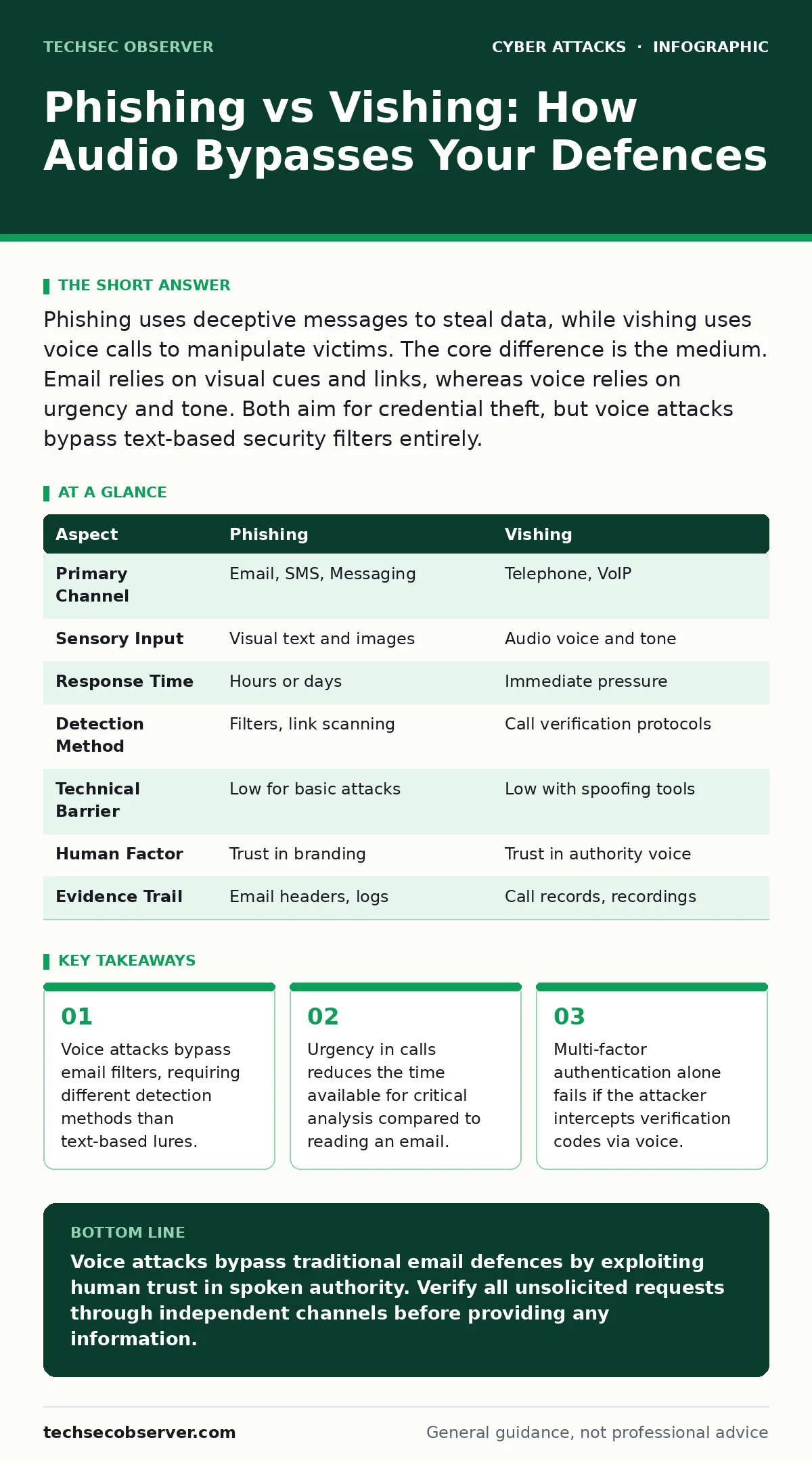
Phishing uses deceptive messages to steal data, while vishing uses voice calls to manipulate victims. The core difference is the medium. Email relies on visual cues and links, whereas voice relies on urgency and tone. Both aim for credential theft, but voice attacks bypass text-based security filters entirely.
The Core Difference Between Phishing vs Vishing
Phishing and vishing share the same objective: extracting sensitive information through deception. The distinction lies in the delivery mechanism. Phishing operates through written channels, primarily email, but also messaging apps and fake websites. Vishing, short for voice phishing, operates through telephone calls, including Voice over IP. This medium shift changes the attack surface. Email defences rely on header analysis and link scanning. Phone systems lack equivalent automated scrutiny for social engineering content. You face a different adversary when the threat speaks rather than writes.
Understanding Phishing Mechanisms
Phishing attempts trick you into clicking malicious links or downloading infected attachments. Attackers craft messages that appear to originate from trusted entities. They use logos, familiar language and urgent deadlines to create a sense of legitimacy. The goal is often to harvest login credentials or install malware. You might receive an email claiming your account is locked. The message directs you to a replica login page. This page captures your username and password before redirecting you to the real site. Endpoint protection can detect known malware signatures. It cannot always stop a user from willingly entering credentials into a convincing fake site.
Understanding Vishing Tactics
Vishing attacks use the telephone to establish immediate contact. The caller often poses as IT support, a bank representative or a government official. They claim to have detected suspicious activity on your account. The caller asks for verification details to "resolve" the issue. This might include your password, security questions or one-time codes. The pressure to act quickly prevents you from verifying the caller's identity. Voice attacks exploit the natural human tendency to trust spoken authority. They bypass the visual checks you apply to emails. The attacker listens to your responses in real time, adjusting their script to maintain control.
Point-by-Point Comparison
| Aspect | Phishing | Vishing |
|---|---|---|
| Primary Channel | Email, SMS, Messaging | Telephone, VoIP |
| Sensory Input | Visual text and images | Audio voice and tone |
| Response Time | Hours or days | Immediate pressure |
| Detection Method | Filters, link scanning | Call verification protocols |
| Technical Barrier | Low for basic attacks | Low with spoofing tools |
| Human Factor | Trust in branding | Trust in authority voice |
| Evidence Trail | Email headers, logs | Call records, recordings |
When Phishing Prevails
Phishing remains effective because it scales easily. Attackers can send thousands of messages with minimal effort. You should expect phishing when dealing with bulk communications. It thrives on volume. This method works well against users who skim emails. It also succeeds when organisations lack proper security awareness training. Users may not notice subtle domain spoofing. They might trust a message because it arrives from a colleague's compromised account. The visual nature of phishing allows attackers to use sophisticated branding to mimic legitimate services.
See also: Social Engineering Response: Containment and Recovery Steps
When Vishing Succeeds
Vishing excels in high-stakes scenarios requiring immediate action. Attackers choose voice when they need real-time interaction. They use it to bypass multi-factor authentication. The caller might ask you to read out a code sent to your phone. This intercepts the second factor of authentication. Vishing works best when you are already stressed or distracted. The human voice carries emotional weight that text lacks. A calm, authoritative tone can override your suspicion. This method is particularly dangerous when combined with pretexting. The attacker builds a fictional scenario to justify their request.
Overlapping Threats and Mitigation
Both methods rely on social engineering principles. They exploit curiosity, fear and helpfulness. You cannot rely on technical controls alone to stop either. Phishing-resistant authentication helps, but it is not a silver bullet. If an attacker convinces you to share a code, MFA fails. You must verify the context of any request. If you receive an unexpected call, hang up. Contact the organisation through official channels. Do not use the number provided by the caller. This breaks the attack chain. Combining endpoint protection with strict verification policies reduces risk.
Strategic Defences for Both
Protecting against phishing requires filtering and user education. Protecting against vishing requires call handling protocols. You must treat unsolicited calls with the same suspicion as unsolicited emails. Implement strict policies for sharing credentials. No legitimate organisation will ask for your password over the phone. Train staff to recognise the signs of urgency. Encourage them to pause and verify. This pause is your strongest defence. It allows time for rational thought to override emotional reaction. Regular drills help ingraining this behaviour.
Key takeaways
- Voice attacks bypass email filters, requiring different detection methods than text-based lures.
- Urgency in calls reduces the time available for critical analysis compared to reading an email.
- Multi-factor authentication alone fails if the attacker intercepts verification codes via voice.
Voice attacks bypass traditional email defences by exploiting human trust in spoken authority. Verify all unsolicited requests through independent channels before providing any information.
Frequently asked questions
Can call blocking stop vishing attacks?
Call blocking removes known spam numbers, but attackers constantly change their source numbers using spoofing techniques.
Is vishing more dangerous than phishing?
Vishing can be more immediate and personal, making it harder to detect without prior warning or strict verification protocols.
How do attackers get my phone number for vishing?
They often obtain numbers from data breaches, public directories or by purchasing lists from third-party data brokers.
What should I do if I accidentally share info?
Change your passwords immediately, contact your bank to freeze accounts and report the incident to your IT security team.
How this guide was produced: written by the TechSec Observer editorial team with AI assistance, checked against the public references listed below, and reviewed when the facts change. See our editorial policy or report an error.