Security Awareness Training for Small Teams That Actually Works
Human error remains the primary vector for breaches, yet structured training reduces successful phishing clicks by half without requiring dedicated staff.

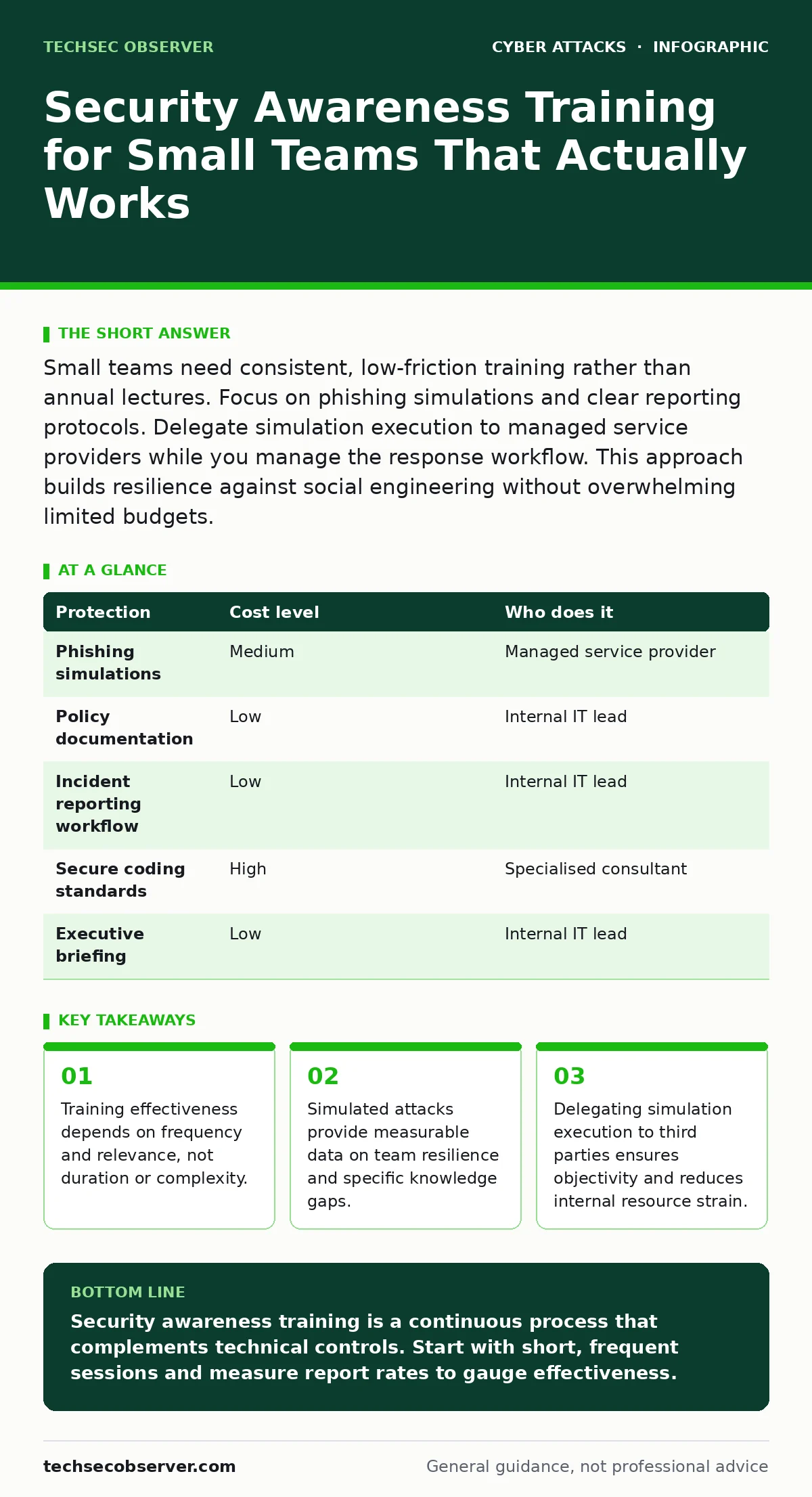
Small teams need consistent, low-friction training rather than annual lectures. Focus on phishing simulations and clear reporting protocols. Delegate simulation execution to managed service providers while you manage the response workflow. This approach builds resilience against social engineering without overwhelming limited budgets.
Why Training Scales Differently at Small Size
Small organisations lack the redundancy of large enterprises. In a team of ten, every member holds high-value credentials. A single compromised account often grants access to the entire infrastructure. Large corporations can isolate breaches; small teams cannot. The margin for error is zero. This reality dictates that security awareness training must be continuous and practical. It cannot be a yearly compliance checkbox. The goal is to create a culture where questioning unexpected requests becomes instinctive. This behavioural shift protects the entire organisation from a single slip-up.
The Mechanics of Effective Behaviour Change
Human memory fades quickly. A one-hour seminar delivers information that evaporates within weeks. Retention requires spaced repetition and active engagement. Short, frequent interactions reinforce learning pathways in the brain. Micro-learning modules lasting five minutes are more effective than hour-long webinars. These modules should focus on specific threats relevant to the team’s daily workflow. For instance, a development team needs to understand secure coding practices. A sales team needs to recognise malicious email headers. Tailoring content to role-specific risks increases engagement and practical application.
| Protection | Cost level | Who does it |
|---|---|---|
| Phishing simulations | Medium | Managed service provider |
| Policy documentation | Low | Internal IT lead |
| Incident reporting workflow | Low | Internal IT lead |
| Secure coding standards | High | Specialised consultant |
| Executive briefing | Low | Internal IT lead |
Affordable Implementation Strategies
Budget constraints do not preclude effective security training. Open-source frameworks provide structured guidance without licensing fees. The National Institute of Standards and Technology publishes free guidelines on workforce security. These documents outline risk-based approaches suitable for small entities. Internal resources can handle policy creation and communication. The IT lead can draft clear guidelines on password management and data handling. Regular team meetings can include brief security updates. This approach keeps costs minimal while maintaining visibility. The key is consistency. Regular, short updates prevent security from becoming an afterthought.
What to Delegate to External Providers
Not all security tasks require internal expertise. Phishing simulation platforms offer automated testing and reporting. These tools send safe, fake phishing emails to staff. They track click rates and report submissions. This data identifies individuals who need additional support. Outsourcing this function provides objectivity. Internal staff may hesitate to test colleagues. Third-party providers operate independently. They also manage the technical complexity of simulation infrastructure. This allows the internal team to focus on response and remediation. Delegating simulation execution frees up valuable internal resources. It also provides benchmarking against industry averages.
Integrating Technical and Human Defences
Awareness training complements technical controls. It does not replace them. Endpoint protection detects malicious software on devices. Phishing-resistant authentication prevents account takeover even if credentials are stolen. These technologies form the first line of defence. Training forms the second. When technology fails, human judgement intervenes.
A well-trained employee recognises a deepfake scam attempt. They verify the request through an alternate channel. This verification step stops the attack. The integration of technical and human defences creates a layered security model. Each layer addresses different failure modes. This redundancy is critical for small teams with limited recovery options.
See also: Content Security Policy Implementation for Small Business Security · People-Search Sites: Risks and Protection for Small Businesses
Measuring Success Beyond Click Rates
Click rates on phishing simulations provide a basic metric. They indicate initial susceptibility. However, they do not measure long-term behaviour change. Report rates are a more meaningful indicator. When employees report suspicious emails, they actively participate in defence. This action reduces the window of opportunity for attackers. Track the volume and quality of reports. High report volumes indicate a vigilant workforce. Low volumes may indicate apathy or lack of trust. Analyse the reasons behind non-reporting. Is the reporting process too complex? Is there fear of blame? Address these barriers immediately. A blame-free reporting culture encourages proactive security participation.
Maintaining Momentum Without Burnout
Security fatigue is a real risk. Constant alerts and training can lead to desensitisation. Employees may stop paying attention to warnings. To prevent this, vary the training methods. Use real-world examples relevant to their work. Discuss recent social engineering trends. Explain how credential stuffing attacks work.
This context helps employees understand the "why" behind the rules. Rotate topics regularly. Avoid repeating the same messages. Keep content fresh and engaging. Celebrate successes publicly. Recognise employees who report threats. Positive reinforcement builds a stronger security culture than fear-based tactics. Balance is key. Maintain awareness without creating anxiety.
Building a Resilient Security Culture
A resilient security culture empowers every team member. It shifts responsibility from the IT department to the entire organisation. Each employee becomes a sensor in the security network. They notice anomalies and report them promptly. This collective vigilance creates a robust defence mechanism. Leadership must model desired behaviours. Executives should follow the same protocols as staff. They should report suspicious activity openly. This signals that security is a shared priority. It removes barriers to communication. A culture of trust and transparency enables rapid response to incidents. This resilience is the ultimate goal of security awareness training.
Key takeaways
- Training effectiveness depends on frequency and relevance, not duration or complexity.
- Simulated attacks provide measurable data on team resilience and specific knowledge gaps.
- Delegating simulation execution to third parties ensures objectivity and reduces internal resource strain.
Security awareness training is a continuous process that complements technical controls. Start with short, frequent sessions and measure report rates to gauge effectiveness.
Frequently asked questions
How often should small teams conduct phishing simulations?
Monthly simulations provide regular feedback without causing fatigue. Adjust frequency based on team performance and risk appetite. Quarterly reviews of results help refine the approach.
What if an employee refuses to participate in training?
Explain the personal and organisational risks. Link participation to employment policies. Offer flexible formats to accommodate different learning styles. Persistent refusal may require HR intervention.
Can free tools replace paid security training platforms?
Free tools can provide basic training content. They often lack advanced analytics and simulation features. Paid platforms offer more granular insights and automated workflows. Choose based on budget and scale.
How do you measure the ROI of awareness training?
Track reduction in successful phishing incidents. Monitor decrease in incident response time. Calculate cost savings from avoided breaches. Compare these metrics against training expenses.
How this guide was produced: written by the TechSec Observer editorial team with AI assistance, checked against the public references listed below, and reviewed when the facts change. See our editorial policy or report an error.