People-Search Sites: Risks and Protection for Small Businesses
Aggregators compile public records into searchable profiles, exposing staff details to social engineers without any consent or notification from the individuals involved.

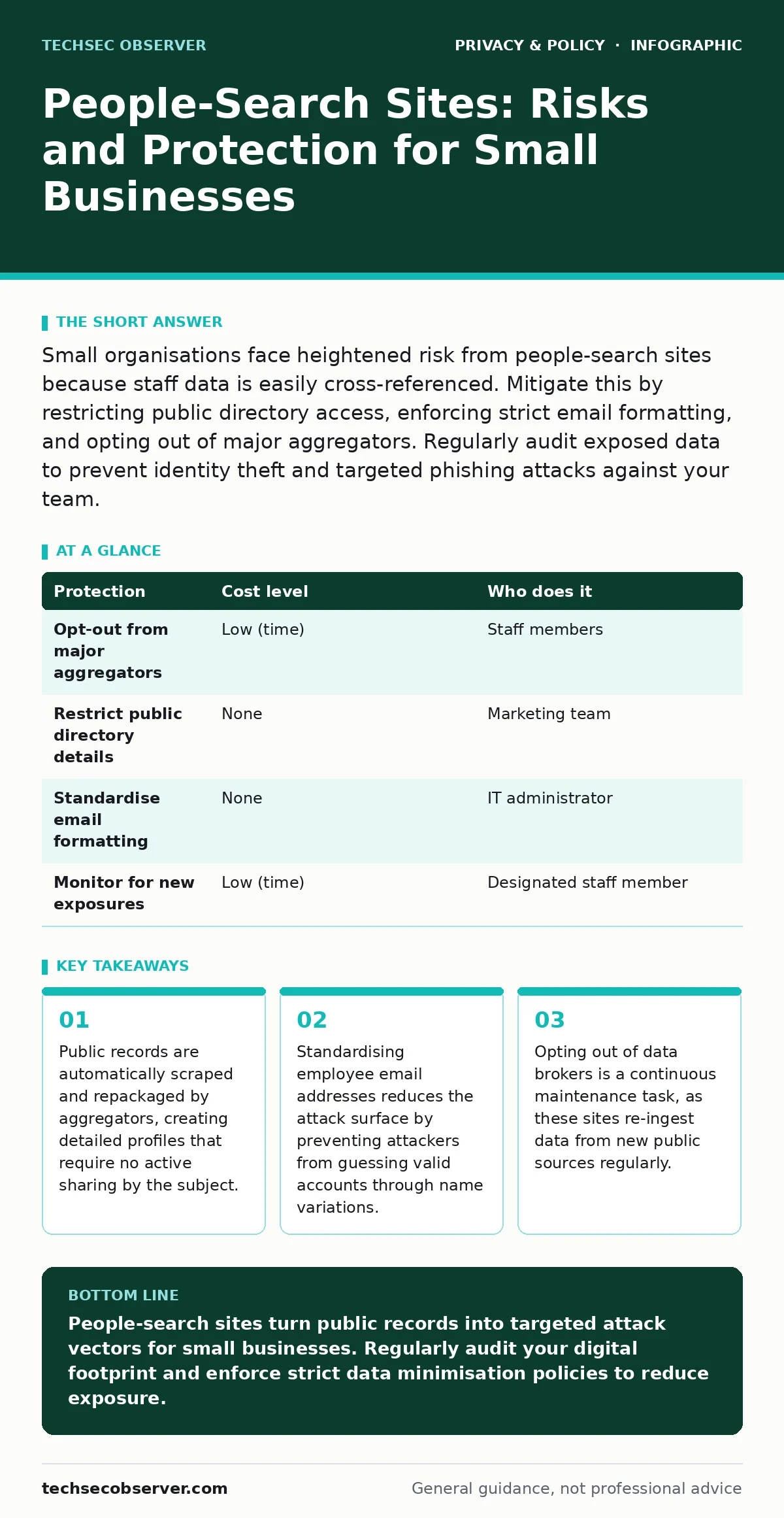
Small organisations face heightened risk from people-search sites because staff data is easily cross-referenced. Mitigate this by restricting public directory access, enforcing strict email formatting, and opting out of major aggregators. Regularly audit exposed data to prevent identity theft and targeted phishing attacks against your team.
The Mechanics of Data Aggregation
People-search sites do not hack your computer. Instead, they harvest data that is already public. This includes court records, property deeds, voter registrations and business filings. Algorithms combine these disparate sources to build a single profile for each individual. For small organisations, this process is particularly dangerous because the staff often serve as both public-facing representatives and administrative decision-makers.
The aggregation creates a link between professional identity and private life. An attacker needs only a name and a company to find a home address or a relative’s name. This information allows for highly personalised social engineering. The attacker can bypass automated security filters by answering security questions that rely on personal history. You must understand that your employees’ private data is effectively public property once it enters this ecosystem.
Why Small Organisations Are Exposed
Small teams often operate with a flat structure where roles overlap. The same person might handle client communications, finance and human resources. This concentration of responsibility makes them high-value targets. If an attacker compromises the email account of a staff member who handles payments, the financial impact is immediate and severe.
Furthermore, small businesses rarely have dedicated security teams to monitor exposure. Data brokers update their databases continuously. A new public record, such as a trademark application or a local business licence, can refresh an old profile. This means exposure is not a one-time event but a recurring condition. Without active management, the digital footprint of your staff grows larger and more detailed over time.
The Hidden Cost of Convenience
Listing staff profiles on your corporate website is standard practice. It builds trust with clients and partners. However, this convenience feeds the aggregators. When you publish a name and role, you provide the anchor point for other data. The aggregator matches that name to public records, filling in gaps with addresses, phone numbers and employment history.
This creates a secondary risk: credential stuffing. Attackers use leaked credentials from other breaches to test accounts on your systems. If they know a staff member’s likely email format, they can automate these attempts. Even if your passwords are strong, the sheer volume of guesses can trigger account lockouts or fatigue your security monitoring. The exposure is not just about privacy; it is about the integrity of your access controls.
Low-Cost Protections
You can reduce exposure without significant investment. The first step is to audit your own digital presence. Search for your company name and key staff members on major search engines. Note which aggregators appear and what data they display. This baseline helps you measure the effectiveness of future mitigation steps.
Restrict the amount of personal data you publish. Use first names and last initials instead of full names where possible. Avoid listing direct phone numbers or personal email addresses. For contact forms, use generic addresses like info@ or support@ rather than individual inboxes. This limits the information available for cross-referencing.
| Protection | Cost level | Who does it |
|---|---|---|
| Opt-out from major aggregators | Low (time) | Staff members |
| Restrict public directory details | None | Marketing team |
| Standardise email formatting | None | IT administrator |
| Monitor for new exposures | Low (time) | Designated staff member |
Managing Email Address Formats
Email address guessing is a common preliminary step in attacks. If your format is [email protected], an attacker who knows a staff member’s name can generate valid-looking addresses. Even if the address does not exist, the attempt may reveal patterns.
Standardise your email formats to something less predictable. Use unique identifiers or complex combinations that do not directly mirror the user’s name. Ensure that your email server does not reveal whether an address exists. A generic "user not found" response for all invalid addresses prevents attackers from confirming valid targets. This small configuration change adds a layer of obscurity that disrupts automated tools.
See also: Pseudonymization of Data: How to Reduce Risk Without Losing Utility · How Data Exfiltration Works: The Silent Stages of Theft
Opting Out of Data Brokers
Removing data from people-search sites is a manual process. Each site has its own opt-out procedure, often buried in their terms of service. You must submit a request for each profile you wish to remove. This process can be tedious and repetitive, as sites may require proof of identity.
Consider the trade-off here. Opting out reduces the accuracy of the data available to attackers. It does not eliminate the risk entirely, as other sources may exist. However, it significantly raises the effort required for an attacker to build a complete profile. For small teams, assigning this task to a specific staff member ensures consistency.
What to Ask an IT Provider
When engaging an IT provider, you need to ensure they understand the specific risks of data aggregation. Do not assume that standard security packages include this aspect of privacy. Ask specific questions about their approach to digital footprint management.
- Do you monitor for new data broker listings involving our staff?
- How do you configure email servers to prevent address enumeration?
- What is your policy on publishing staff details in public directories?
- Can you assist with the technical aspects of opting out from major aggregators?
Maintaining Long-Term Security
Security is not a destination but a process. The landscape of data aggregation changes as new sources of public data emerge. You must stay informed about these changes. Regularly review the data that appears when you search for your company and staff.
Encourage your staff to be cautious about what they share on social media. Public profiles on professional networks can feed aggregators. While we discuss social media privacy risks in other sections, the principle remains: less public data means less fuel for attackers. Combine this awareness with technical controls to create a layered defence.
Also, consider metadata exposure in documents you share publicly. PDFs and images often contain hidden data, such as author names or location information. Stripping this metadata before publication reduces the amount of personal data available for scraping. This simple step adds another layer of protection without significant effort.
Key takeaways
- Public records are automatically scraped and repackaged by aggregators, creating detailed profiles that require no active sharing by the subject.
- Standardising employee email addresses reduces the attack surface by preventing attackers from guessing valid accounts through name variations.
- Opting out of data brokers is a continuous maintenance task, as these sites re-ingest data from new public sources regularly.
People-search sites turn public records into targeted attack vectors for small businesses. Regularly audit your digital footprint and enforce strict data minimisation policies to reduce exposure.
Frequently asked questions
Can I stop people-search sites from collecting my data?
You can request removal from most major aggregators, but you cannot prevent them from collecting public records. The process requires ongoing maintenance as data is re-ingested.
Does deleting my social media profiles help?
It reduces the amount of personal data available for cross-referencing. However, aggregators rely heavily on public records like court filings, which are not affected by social media activity.
Should I use fake names on public records?
No, this can cause legal and administrative complications. Instead, focus on limiting the accessibility of these records and opting out of secondary aggregation sites.
How often should I check for new exposures?
Quarterly checks are sufficient for most small organisations. Increase frequency if you have recently filed new public records or changed staff structures.
How this guide was produced: written by the TechSec Observer editorial team with AI assistance, checked against the public references listed below, and reviewed when the facts change. See our editorial policy or report an error.