Pseudonymization of Data: How to Reduce Risk Without Losing Utility
Pseudonymization separates identity from utility by replacing direct identifiers with reversible tokens, lowering breach impact while retaining analytical value for research and development.

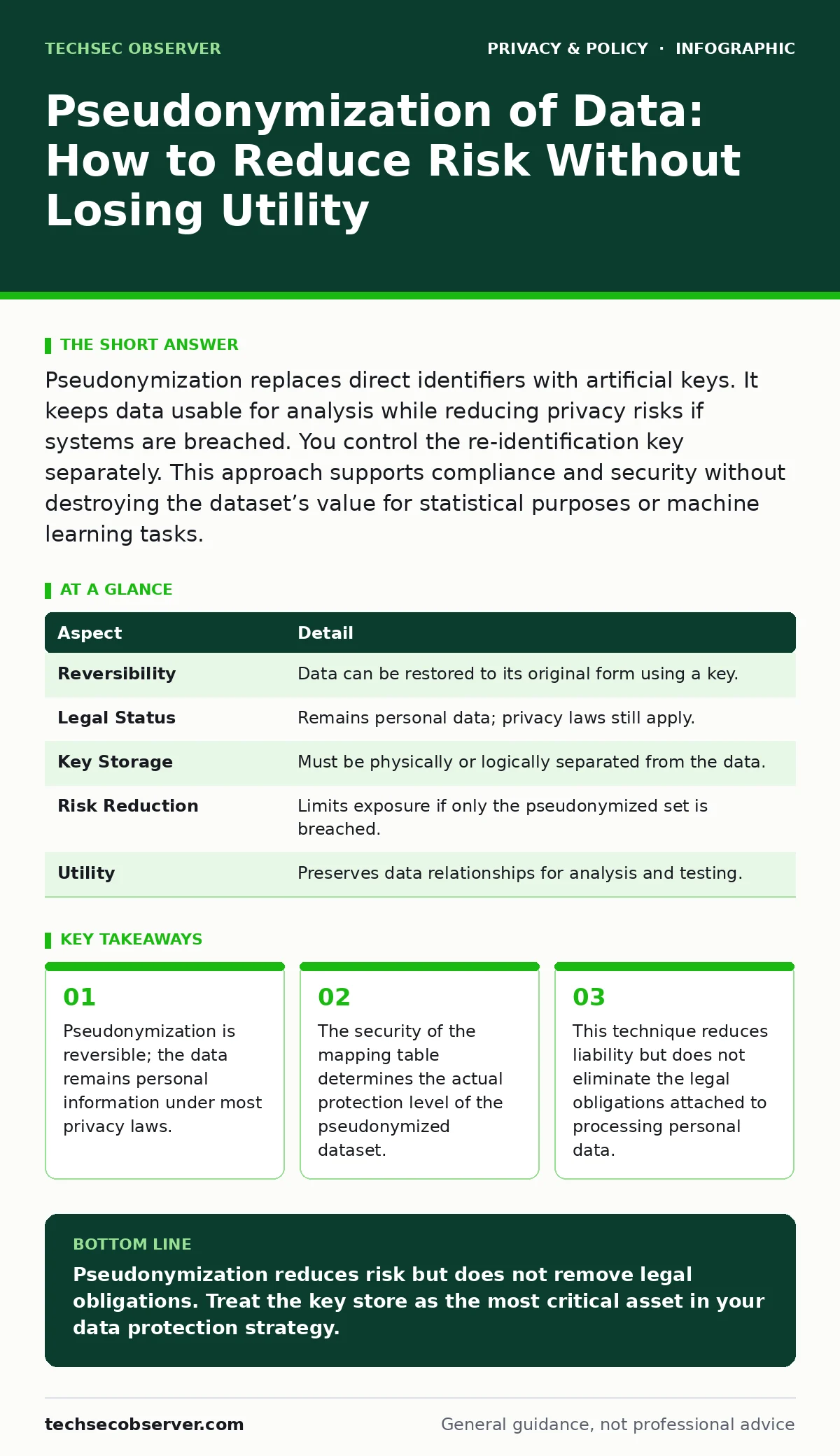
Pseudonymization replaces direct identifiers with artificial keys. It keeps data usable for analysis while reducing privacy risks if systems are breached. You control the re-identification key separately. This approach supports compliance and security without destroying the dataset’s value for statistical purposes or machine learning tasks.
What is pseudonymization in practice?
Pseudonymization replaces direct identifiers like names or email addresses with artificial identifiers or pseudonyms. The original data remains recoverable if you possess the additional information required for re-identification. This additional information, often called the key, must be kept separate from the pseudonymized dataset. Unlike anonymization, which destroys the link to an individual permanently, pseudonymization maintains a reversible link. This distinction matters because regulators still treat pseudonymized data as personal data. You must protect it with the same legal safeguards as the original records. The goal is to reduce risk, not to remove legal responsibility.
Imagine a hospital wants to analyze patient outcomes for a new drug. Researchers need age and diagnosis codes but not names. The system replaces each patient’s name with a random string like "XJ92". The hospital stores the link between "XJ92" and "John Smith" in a separate, encrypted database. If the research database is stolen, the thieves see "XJ92" but cannot identify the patient without the key. This separation limits the harm caused by the breach.
| Aspect | Detail |
|---|---|
| Reversibility | Data can be restored to its original form using a key. |
| Legal Status | Remains personal data; privacy laws still apply. |
| Key Storage | Must be physically or logically separated from the data. |
| Risk Reduction | Limits exposure if only the pseudonymized set is breached. |
| Utility | Preserves data relationships for analysis and testing. |
How pseudonymization works technically
The process involves two main components: the transformation algorithm and the key management system. The algorithm maps each direct identifier to a pseudonym. Simple substitution, such as replacing names with numbers, is weak because patterns remain obvious. For example, if "John" always becomes "1" and "Jane" becomes "2", an attacker can guess identities by frequency.
You should use cryptographic hashing with a salt or a tokenization service. Salting adds random data to the input before hashing, ensuring that identical inputs produce different outputs each time. This prevents rainbow table attacks where precomputed hashes are used to reverse the process.
Tokenization replaces sensitive data with a non-sensitive equivalent. The token has no mathematical relationship to the original value. This is stronger than hashing for many use cases. The tokenization system maintains a database that maps tokens back to original values. This database is the single point of failure. If an attacker compromises the tokenization database, they can reverse all pseudonymization. Therefore, the security of the key store is more critical than the algorithm itself. You must implement strict access controls and encryption for the key store.
Who is affected by pseudonymization requirements
Organizations that process large volumes of personal data benefit most from pseudonymization. Data scientists, application developers, and security engineers interact with this data daily. They need realistic data for testing and analysis but cannot use production data due to privacy risks. Pseudonymization allows them to work with data that behaves like production data without exposing real identities. Regulatory bodies view pseudonymization as a security measure. It can reduce the severity of data breaches and may lower fines under privacy laws. However, it does not exempt organizations from notifying authorities of breaches.
Individuals are affected indirectly. Their data remains protected, but the organization still holds the means to identify them. This creates a trust dynamic. Users should understand that pseudonymization is a risk reduction tool, not a privacy guarantee. If the organization fails to protect the key, the pseudonymization fails. This is why transparency about data handling practices matters. Users can make better choices when they know how their data is protected.
Common mistakes in pseudonymization implementation
Many organizations confuse pseudonymization with anonymization. They believe that removing names is enough. This is a critical error. If other data points can be combined to re-identify an individual, the data is not anonymized. This is known as the mosaic effect. For instance, combining a pseudonymized zip code, birth date, and gender can identify a unique person in many datasets. You must assess the risk of re-identification through linkage attacks. This involves checking if the pseudonymized data can be joined with other public datasets to reveal identities.
Another mistake is storing the key in the same environment as the data. If a database server is compromised, the attacker gets both the pseudonyms and the key. This defeats the purpose of pseudonymization. The key must be stored in a separate system, preferably in a different network segment or cloud account. Access to the key should be restricted to a minimal number of personnel. Logging and monitoring access to the key is mandatory. Without these controls, pseudonymization provides a false sense of security.
Balancing utility and privacy
The tension between data utility and privacy is central to pseudonymization. High privacy often means low utility. If you generalize data too much, it becomes useless for analysis. For example, replacing exact ages with age ranges like "20-30" reduces re-identification risk but loses precision. You must find the right balance. This depends on the intended use. Machine learning models may need more precise data than statistical reports. Techniques like differential privacy add noise to data to protect individuals while preserving statistical accuracy. This is a more advanced form of privacy protection.
Pseudonymization supports privacy by design principles. It allows organizations to build systems that minimize data exposure from the start. By pseudonymizing data at rest and in transit, you reduce the attack surface. Developers can test applications with realistic data without risking privacy breaches. This improves software quality and security. However, you must continuously review the pseudonymization strategy. As new data sources become available, the risk of re-identification increases. Regular audits are necessary to ensure the strategy remains effective.
See also: People-Search Sites: Risks and Protection for Small Businesses · AI governance checklist for production systems
What to do about pseudonymization now
Start by identifying where personal data is used for non-production purposes. This includes testing, development, and analytics. Determine if pseudonymization is appropriate. If the data needs to be linked back to individuals, pseudonymization is suitable. If not, consider anonymization or aggregation. Implement a robust key management system. Use industry-standard algorithms and avoid custom cryptographic solutions. Train your team on the difference between pseudonymization and anonymization. Ensure they understand the legal implications.
Monitor access to the key store. Implement alerts for unauthorized access attempts. Review your pseudonymization strategy regularly. Check for new re-identification risks. Consider the impact of metadata exposure. Even if the content is pseudonymized, metadata like timestamps or file sizes can reveal patterns. Secure this metadata as well. By taking these steps, you reduce risk while maintaining data utility. This approach builds trust with users and regulators.
Key takeaways
- Pseudonymization is reversible; the data remains personal information under most privacy laws.
- The security of the mapping table determines the actual protection level of the pseudonymized dataset.
- This technique reduces liability but does not eliminate the legal obligations attached to processing personal data.
Pseudonymization reduces risk but does not remove legal obligations. Treat the key store as the most critical asset in your data protection strategy.
Frequently asked questions
Is pseudonymized data considered personal data under GDPR?
Yes, pseudonymized data remains personal data because it can be linked back to an individual using additional information. You must apply standard privacy protections.
How is pseudonymization different from encryption?
Encryption scrambles data using a key, making it unreadable without decryption. Pseudonymization replaces identifiers with tokens. Encryption protects confidentiality; pseudonymization protects identity while preserving data structure for analysis.
Can pseudonymization prevent re-identification completely?
No, pseudonymization reduces the risk of re-identification but does not eliminate it. If an attacker gains access to the key or can link the data with other sources, re-identification is possible.
Does pseudonymization require user consent?
Pseudonymization is a security measure. It does not change the legal basis for processing data. If you needed consent before, you still need it. Pseudonymization helps comply with security requirements but does not replace the need for a lawful basis.
How this guide was produced: written by the TechSec Observer editorial team with AI assistance, checked against the public references listed below, and reviewed when the facts change. See our editorial policy or report an error.