AI governance checklist for production systems
Governance fails when teams treat model outputs as static facts rather than probabilistic guesses that require constant validation and boundary enforcement.

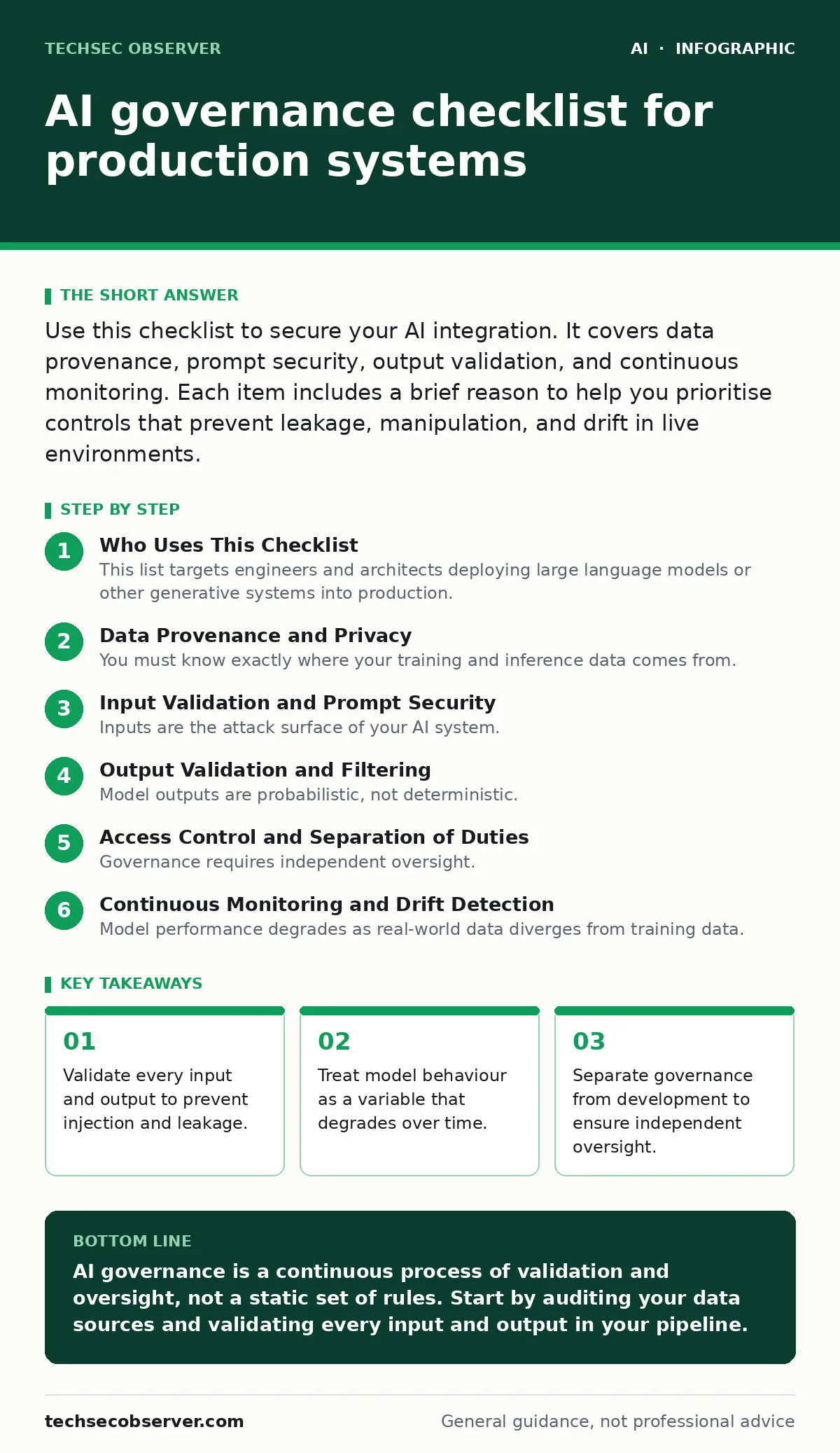
Use this checklist to secure your AI integration. It covers data provenance, prompt security, output validation, and continuous monitoring. Each item includes a brief reason to help you prioritise controls that prevent leakage, manipulation, and drift in live environments.
Who Uses This Checklist
This list targets engineers and architects deploying large language models or other generative systems into production. It is not a compliance document for legal teams. It is a technical verification tool for those building the pipeline. Use it before deploying a new model version and after any significant change to the input schema.
Data Provenance and Privacy
You must know exactly where your training and inference data comes from. If you cannot trace the origin of a data point, you cannot assess its legal or security risk.
- Audit training data sources: Prevents copyright violations and hidden bias from unvetted public datasets.
- Encrypt data at rest and in transit: Protects sensitive inputs from interception or storage breaches.
- Implement data retention policies: Ensures ephemeral data is deleted after processing to reduce liability.
- Classify data sensitivity levels: Dictates the strictness of access controls required for each dataset.
- Verify consent for personal data: Mitigates regulatory risk and reputational damage from privacy violations.
Refer to our guide on training data leakage for deeper techniques on preventing sensitive information from appearing in model outputs.
Input Validation and Prompt Security
Inputs are the attack surface of your AI system. Adversaries often try to manipulate the model’s behaviour through carefully crafted text. You must treat all user input as untrusted, regardless of its source.
- Sanitize all user inputs: Removes malicious payloads before they reach the model context.
- Implement strict prompt templates: Constrains model behaviour to expected operational boundaries.
- Detect and block injection attempts: Prevents attackers from overriding system instructions.
- Limit context window size: Reduces the attack surface available for complex manipulation.
- Log and review prompt patterns: Helps identify novel attack vectors before they cause harm.
See our analysis of prompt injection attacks to understand how attackers bypass standard validation layers.
Output Validation and Filtering
Model outputs are probabilistic, not deterministic. They can contain hallucinations, biased statements, or leaked secrets. You must never trust the model to self-correct without external verification.
- Validate output format: Ensures downstream systems can parse the response without crashing.
- Filter sensitive information: Prevents accidental exposure of proprietary or personal data.
- Check for factual consistency: Reduces the risk of acting on hallucinated or incorrect information.
- Implement rate limiting: Prevents abuse and excessive computational resource consumption.
- Log all outputs for audit: Creates a traceable record for incident response and debugging.
Read about AI model monitoring to learn how to track output quality over time.
Access Control and Separation of Duties
Governance requires independent oversight. The team building the model should not be the only team approving its release. Separation of duties prevents blind spots and ensures objective review.
- Restrict model access by role: Ensures only authorised personnel can modify or query the model.
- Require peer review for prompts: Catches logical flaws and security risks before deployment.
- Separate development and production environments: Prevents accidental changes to live systems.
- Implement least privilege access: Limits the damage potential of compromised accounts.
- Audit access logs regularly: Detects unauthorised access attempts and policy violations.
See also: Pseudonymization of Data: How to Reduce Risk Without Losing Utility
Continuous Monitoring and Drift Detection
Model performance degrades as real-world data diverges from training data. This phenomenon, known as concept drift, can silently erode the quality and security of your system.
- Monitor input distribution shifts: Detects when user behaviour changes significantly from training data.
- Track output quality metrics: Identifies declines in accuracy or relevance over time.
- Alert on anomalous behaviour: Flags potential attacks or system failures in real time.
- Review model performance monthly: Ensures the model remains fit for its intended purpose.
- Plan for model retraining: Prepares for inevitable performance degradation and data drift.
Explore AI agents to understand how autonomous systems compound these drift risks.
Incident Response and Recovery
When governance fails, you need a plan. Assume that someone will eventually bypass your controls. Your response capability determines the extent of the damage.
- Define incident severity levels: Ensures appropriate response resources are allocated quickly.
- Document rollback procedures: Allows rapid reversion to a previous stable model version.
- Conduct tabletop exercises: Tests your team’s ability to respond under pressure.
- Communicate with stakeholders: Keeps users and management informed during an incident.
- Post-incident review: Identifies root causes and prevents recurrence.
See our guide on AI-assisted threat detection for tools that can automate parts of this process.
Key takeaways
- Validate every input and output to prevent injection and leakage.
- Treat model behaviour as a variable that degrades over time.
- Separate governance from development to ensure independent oversight.
AI governance is a continuous process of validation and oversight, not a static set of rules. Start by auditing your data sources and validating every input and output in your pipeline.
Frequently asked questions
How often should I update my AI governance checklist?
Update it after every major model release, significant data source change, or new security threat discovery.
Can automated tools replace human governance?
No. Automated tools can detect anomalies, but humans must interpret context and make final decisions on risk.
What is the first step in implementing AI governance?
Audit your data sources and classify the sensitivity of all inputs and outputs.
How do I handle model hallucinations in production?
Implement strict output validation and filtering to catch and correct hallucinations before they reach users.
How this guide was produced: written by the TechSec Observer editorial team with AI assistance, checked against the public references listed below, and reviewed when the facts change. See our editorial policy or report an error.