Training Data Leakage: How Private Information Escapes AI Models
Models memorise rare data points during training, allowing attackers to reconstruct sensitive records through carefully crafted queries.

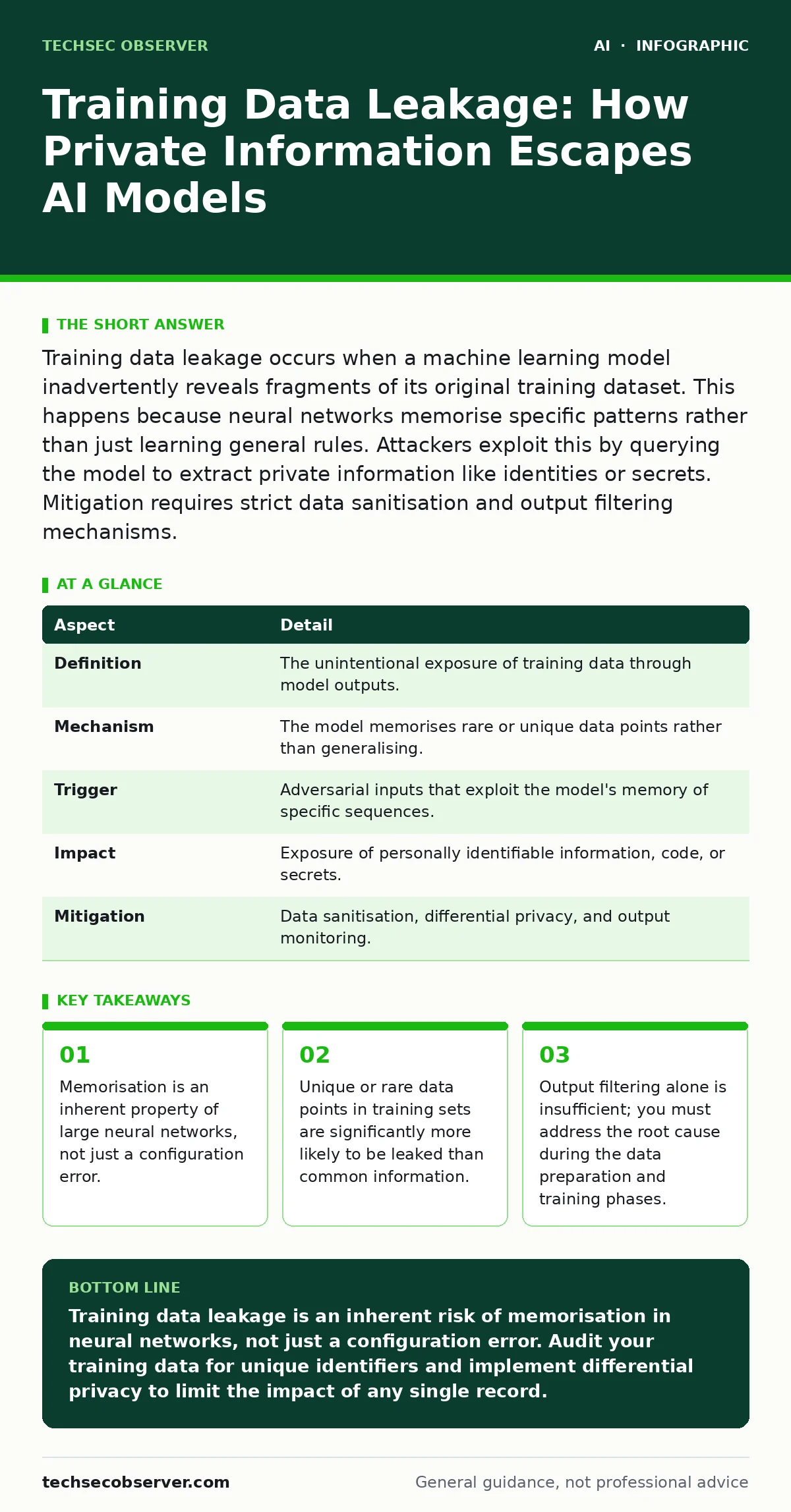
Training data leakage occurs when a machine learning model inadvertently reveals fragments of its original training dataset. This happens because neural networks memorise specific patterns rather than just learning general rules. Attackers exploit this by querying the model to extract private information like identities or secrets. Mitigation requires strict data sanitisation and output filtering mechanisms.
The Library That Never Forgets
Imagine a librarian who has read every book in a vast archive. Instead of simply understanding the themes, this librarian memorises the exact phrasing of every obscure footnote. If you ask a very specific question about a rare event, the librarian recites the text word-for-word. In artificial intelligence, this librarian is the model. The archive is your training data. When the model reproduces that specific footnote, you have a training data leakage incident.
This phenomenon occurs because large language models and other deep learning systems operate by identifying statistical patterns. To function effectively, they must internalise the structure of the language or data they process. Sometimes, this internalisation crosses the line from understanding general rules to retaining specific instances. The model does not distinguish between a public fact and a private credential if both appear in the input stream.
| Aspect | Detail |
|---|---|
| Definition | The unintentional exposure of training data through model outputs. |
| Mechanism | The model memorises rare or unique data points rather than generalising. |
| Trigger | Adversarial inputs that exploit the model's memory of specific sequences. |
| Impact | Exposure of personally identifiable information, code, or secrets. |
| Mitigation | Data sanitisation, differential privacy, and output monitoring. |
How Memorisation Happens
Neural networks learn by adjusting internal weights to minimise prediction errors. This process, known as gradient descent, pushes the model to fit the training data as closely as possible. When the dataset contains noise, outliers, or highly unique strings, the model may treat these anomalies as important features. It prioritises memorising these exact sequences to reduce error on those specific examples.
This is particularly common in large language models. These models are trained on massive corpora of text, including public websites, forums, and code repositories. If a private email address or a unique API key appears in that text, the model sees it as just another pattern. It does not have an inherent concept of privacy. It simply learns that certain tokens often follow others. If a sequence is rare, the model's memory of that specific sequence becomes stronger relative to general linguistic rules.
Forms of Data Leakage
Leakage rarely looks like a model dumping its entire database. It usually manifests in subtle ways that require specific triggers. One common form is direct regurgitation. An attacker provides a prompt that closely matches a rare sequence in the training data. The model completes the sequence, revealing the rest of the original text. This is often called a membership inference attack, where the goal is to confirm if a specific record was in the training set.
Another form involves partial reconstruction. The model might not reveal an entire document, but it could leak fragments. For example, it might reveal the last four digits of a card number or a username paired with a partial email address. These fragments can be combined with other publicly available information to identify individuals. This is dangerous because it bypasses traditional anonymisation techniques. If the anonymisation only removed obvious identifiers, the model may still link the remaining data to a specific person through contextual clues.
Who Is Affected
Developers who train models on proprietary or sensitive data are at immediate risk. If your organisation builds custom models using internal documents, customer records, or source code, you are responsible for any leakage. The damage is not just financial; it includes reputational harm and regulatory penalties. Trust in your AI systems evaporates when users realise their data can be extracted.
End users are also affected, even if they do not train the model. When you use a third-party AI service, your inputs may become part of the training data for future versions. If that data is not properly isolated or sanitised, it could be leaked to other users. This creates a secondary risk where one user's private information becomes accessible to another. The boundary between your input and the model's public knowledge becomes blurred.
What People Get Wrong
Many teams believe that anonymising data before training is sufficient. They remove names and addresses, assuming the model cannot connect the dots. This is a critical misunderstanding. Models learn from context, structure, and relationships. A unique combination of job title, location, and specific project details can identify an individual as effectively as a name. This is known as re-identification risk. The model may not know the name, but it can reveal enough context for an attacker to deduce it.
Another common mistake is relying solely on output filters. Teams often deploy keyword scanners to block sensitive terms in the model's response. While this helps, it is a reactive measure. It does not prevent the model from learning the data in the first place. If the model has memorised the data, a sophisticated attacker can bypass simple filters by using indirect queries or obfuscated prompts. You must address the problem at the source, not just the symptom.
Reducing the Risk
The most effective defence starts with data hygiene. Before training, you must audit your datasets for sensitive information. This goes beyond simple keyword searches. You need to identify unique identifiers and rare patterns. Removing or generalising these outliers reduces the model's incentive to memorise them. If the data is common, the model learns the pattern without retaining the specific instance.
Differential privacy is a mathematical framework designed to limit how much any single data point influences the model. By adding controlled noise to the training process, you ensure that the model's output does not change significantly if one record is added or removed. This makes it statistically difficult for an attacker to determine if a specific record was in the training set. It is not a perfect shield, but it raises the cost of extraction significantly.
Monitoring is also required. You cannot assume that once the model is deployed, the risk is over. You must implement continuous monitoring to detect anomalous queries. Look for patterns that suggest an attacker is probing the model's memory. This aligns with broader practices in AI model monitoring, where you track the behaviour of the model over time to catch drift or abuse.
Technical Controls for Developers
For those building models, consider the architecture. Smaller models are less prone to memorisation than massive ones, but they may lack capability. You must balance performance with privacy. Using techniques like regularisation can help prevent the model from fitting too closely to the training data. Regularisation penalises complex weights, encouraging the model to learn simpler, more general rules.
Input and output processing are critical. Validate all inputs to prevent injection attacks that might trigger leakage. This is related to prompt injection attacks, where malicious inputs manipulate the model's behaviour. Similarly, filter outputs, but do so intelligently. Use semantic analysis rather than just keyword matching. Understand the context of the response. If the model is revealing structured data that looks like a database record, block it.
You should also consider AI supply chain risks. If you are using pre-trained models or third-party data, you inherit their leakage risks. You cannot audit data you do not control. Vet your providers carefully. Ensure they have clear policies on data retention and privacy. If the supplier is not transparent, assume the worst.
Key takeaways
- Memorisation is an inherent property of large neural networks, not just a configuration error.
- Unique or rare data points in training sets are significantly more likely to be leaked than common information.
- Output filtering alone is insufficient; you must address the root cause during the data preparation and training phases.
Training data leakage is an inherent risk of memorisation in neural networks, not just a configuration error. Audit your training data for unique identifiers and implement differential privacy to limit the impact of any single record.
Frequently asked questions
Can differential privacy completely stop training data leakage?
No, differential privacy reduces the probability of leakage but does not eliminate it. It adds noise to the training process, making it harder to extract specific records, but some residual risk remains.
Is removing names and emails enough to prevent leakage?
No, models learn from context and structure. Unique combinations of other data points can still identify individuals, a risk known as re-identification. You must also address rare patterns and contextual clues.
How do I detect if my model is leaking data?
Use **AI red teaming** techniques to probe the model with adversarial inputs. Additionally, implement **AI model monitoring** to track unusual query patterns and outputs that resemble sensitive data structures.
Does using open-source models reduce the risk of leakage?
It depends on the training data. Open-source models may have been trained on public data that contains sensitive information. You must still evaluate the data provenance and potential leakage risks.
How this guide was produced: written by the TechSec Observer editorial team with AI assistance, checked against the public references listed below, and reviewed when the facts change. See our editorial policy or report an error.