AI Supply Chain Incident Response: Stabilise and Recover
Most AI breaches fail not from code errors, but because teams rebuild trust in compromised models without verifying the integrity of their training data lineage.

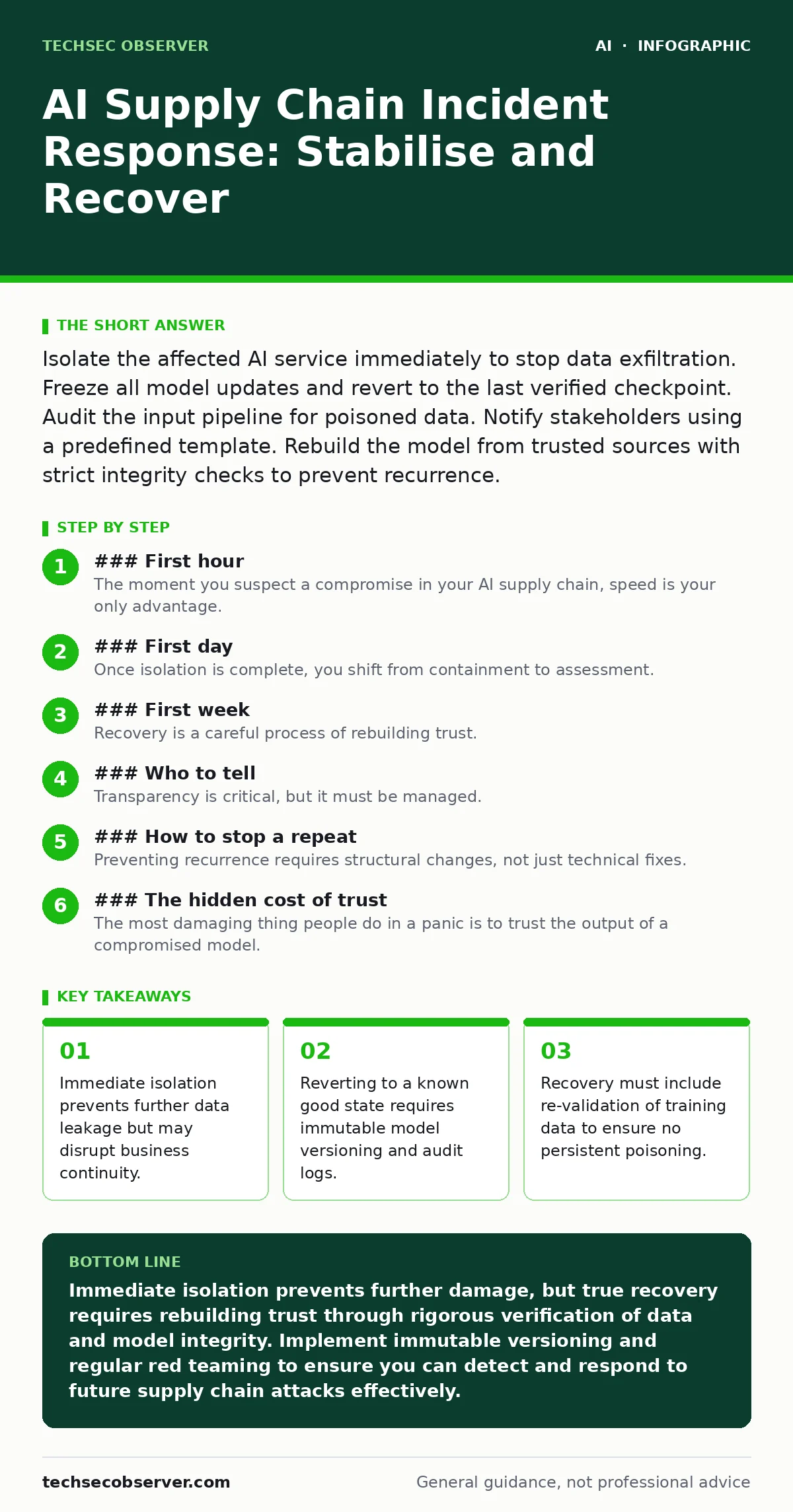
Isolate the affected AI service immediately to stop data exfiltration. Freeze all model updates and revert to the last verified checkpoint. Audit the input pipeline for poisoned data. Notify stakeholders using a predefined template. Rebuild the model from trusted sources with strict integrity checks to prevent recurrence.
### First hour
The moment you suspect a compromise in your AI supply chain, speed is your only advantage. Do not attempt to debug the model in place. The primary goal is to stop the bleed. You must assume the adversary has access to your inference endpoints and potentially your training data pipelines.
- Isolate the affected AI service from the network.
- Freeze all model updates and deployments.
- Capture current system logs and memory dumps.
- Notify the incident response team lead.
- Document the initial detection method and timestamp.
Imagine you notice anomalous output from your customer support bot. It is suggesting actions that violate company policy. This is not a glitch. It is a signal. The model may have been influenced by poisoned data or a modified inference layer. Your first action is to cut the connection between this bot and your internal data stores. This prevents the adversary from using the bot as a bridge to your core systems.
### First day
Once isolation is complete, you shift from containment to assessment. You need to understand the scope of the breach. Did the adversary only modify the model weights? Did they inject malicious prompts into the input stream? Or did they compromise the training data itself?
Start by reviewing the model’s input and output logs. Look for patterns that deviate from normal behaviour. Check for unexpected data transfers. If you use AI model monitoring tools, examine the alerts for anomalies in latency or error rates. These metrics often reveal hidden manipulation before the output becomes obviously wrong.
You must also secure the data pipeline. If the attack involved data poisoning attacks, the poison may still be present in your raw data stores. You need to identify which datasets were used in the last training cycle. Quarantine these datasets for inspection. Do not trust any data that has passed through the compromised pipeline since the suspected breach time.
### First week
Recovery is a careful process of rebuilding trust. You cannot simply retrain the model with the same data. You must verify the integrity of every component in the supply chain. This includes the code, the data, and the infrastructure.
Begin by reverting to the last known good model checkpoint. This checkpoint must have been stored in an immutable repository. If you do not have such a repository, you are at risk of rebuilding on compromised foundations. Use AI governance frameworks to define what "good" means for your model. This includes performance metrics and safety constraints.
Next, audit the training data. Remove any data points that are suspected of being poisoned. This may require manual review or the use of AI-assisted threat detection to flag outliers. Once the data is clean, retrain the model from scratch. Do not fine-tune the compromised model. Fine-tuning propagates the damage.
### Who to tell
Transparency is critical, but it must be managed. You need to inform your internal stakeholders, legal team, and potentially external partners. The message must be clear, concise, and accurate. Avoid speculation. Stick to the facts you have verified.
Your legal team will guide you on regulatory requirements. Depending on the nature of the data involved, you may have obligations to notify users or regulators. Prepare a communication template before the incident occurs. This template should include placeholders for the scope, impact, and remediation steps.
External partners who rely on your AI services need to know if their data was exposed. If you use third-party AI models or services, notify their security teams. They may need to adjust their own defences. This is part of maintaining a healthy AI supply chain.
### How to stop a repeat
Preventing recurrence requires structural changes, not just technical fixes. You must address the root cause of the breach. If the attack vector was a compromised library, you need to improve your dependency management. If it was poisoned data, you need to strengthen your data validation processes.
Implement AI red teaming to regularly test your models for vulnerabilities. This involves simulated attacks to identify weaknesses before adversaries do it. Focus on edge cases and unusual inputs. These are often the entry points for sophisticated attacks.
Consider the use of AI agents for automated monitoring. These agents can detect anomalies in real-time and trigger automated responses. However, ensure these agents are themselves secure. A compromised monitoring agent is worse than no monitoring at all.
### The hidden cost of trust
The most damaging thing people do in a panic is to trust the output of a compromised model. They assume that if the model looks like it is working, it is safe. This is a fatal error. Adversaries can craft models that appear normal while performing malicious actions.
You must verify the integrity of the model itself. This includes checking the model weights, the architecture, and the inference code. Use cryptographic hashes to verify that the model has not been altered. Store these hashes in a secure, immutable ledger.
This process is tedious and slow. But it is necessary. Trust in AI is fragile. Once broken, it is difficult to rebuild. You must earn it back through rigorous verification and transparency.
### Checklist for the first hour
Use this checklist to ensure you do not miss critical steps in the initial response.
- Identify the compromised component.
- Isolate the component from the network.
- Freeze all model updates.
- Capture logs and evidence.
- Notify the incident response team.
- Document the timeline of events.
- Begin initial assessment of scope.
### Final thoughts on recovery
Recovery is not just about restoring service. It is about restoring confidence. You must demonstrate to your users and stakeholders that you have learned from the incident. This means sharing what you found, how you fixed it, and what you are doing to prevent it from happening again.
This transparency builds trust. It shows that you take security seriously. It also helps the broader community learn from your experience. Security is a collective effort. Every incident is an opportunity to improve the defences of everyone.
Key takeaways
- Immediate isolation prevents further data leakage but may disrupt business continuity.
- Reverting to a known good state requires immutable model versioning and audit logs.
- Recovery must include re-validation of training data to ensure no persistent poisoning.
Immediate isolation prevents further damage, but true recovery requires rebuilding trust through rigorous verification of data and model integrity. Implement immutable versioning and regular red teaming to ensure you can detect and respond to future supply chain attacks effectively.
Frequently asked questions
How do I know if my AI model has been poisoned?
Look for anomalous outputs, unexpected performance drops, or deviations from expected behaviour. Use AI model monitoring tools to detect these anomalies in real-time.
Should I shut down my AI services immediately?
No. Shutting down destroys forensic evidence. Instead, isolate the compromised component to contain the breach while preserving logs for analysis.
What is the role of AI governance in incident response?
AI governance provides the framework for defining acceptable model behaviour and safety constraints. It guides the assessment and recovery process, ensuring compliance and consistency.
Can I reuse the training data after a breach?
Only if you have thoroughly audited and cleaned it. Remove any suspected poisoned data points. Rebuild the dataset from trusted sources if necessary to ensure integrity.
How this guide was produced: written by the TechSec Observer editorial team with AI assistance, checked against the public references listed below, and reviewed when the facts change. See our editorial policy or report an error.