Data Poisoning Response: Contain, Recover and Rebuild Trust
Erasing poisoned data rarely works because the model retains statistical correlations, requiring full retraining from verified sources.

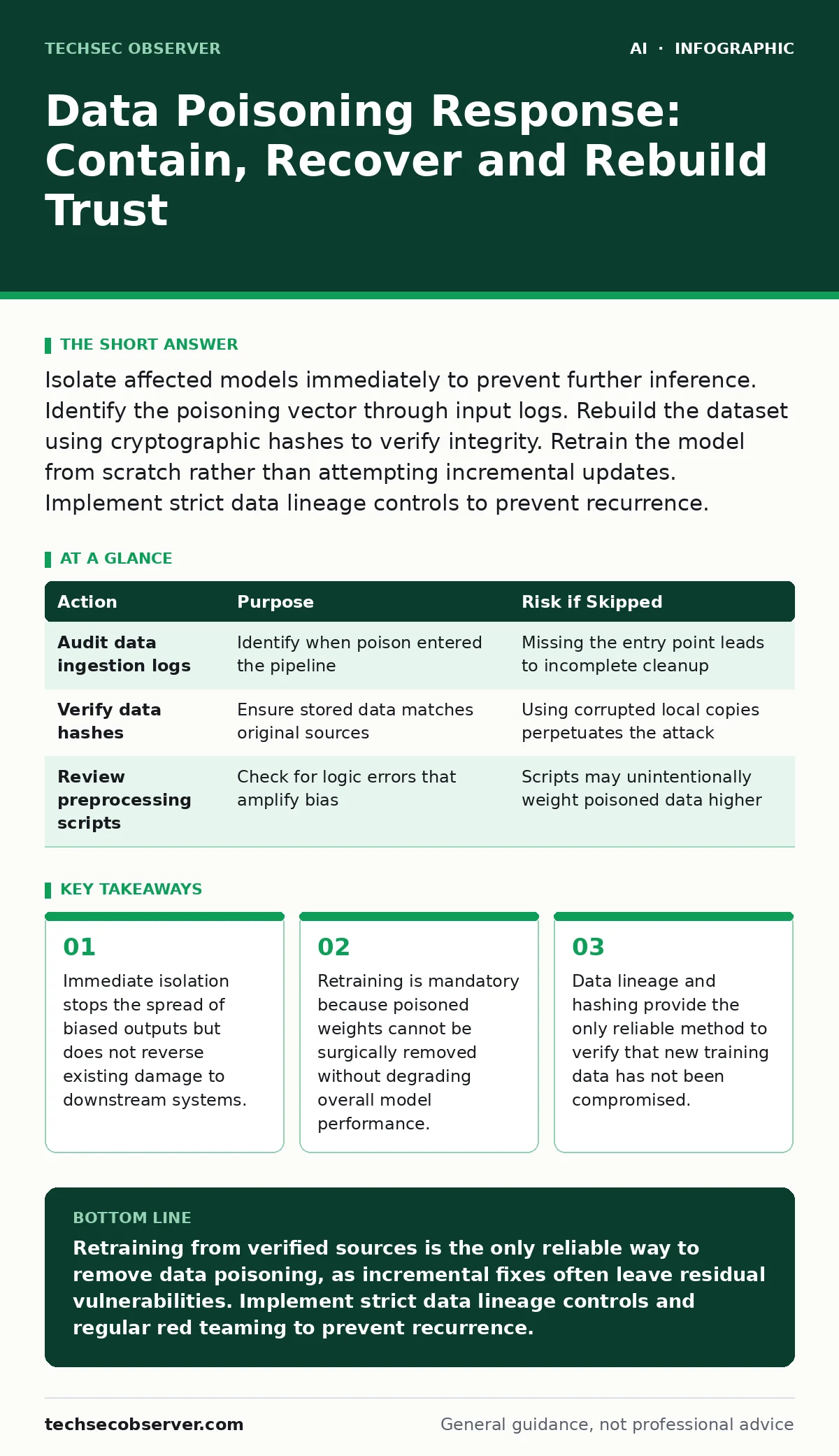
Isolate affected models immediately to prevent further inference. Identify the poisoning vector through input logs. Rebuild the dataset using cryptographic hashes to verify integrity. Retrain the model from scratch rather than attempting incremental updates. Implement strict data lineage controls to prevent recurrence.
First hour
Detecting a data poisoning attack requires recognising that the model’s behaviour has shifted in ways that normal drift does not explain. You must act before the compromised model influences critical business decisions or external users. The priority is containment, not investigation. You cannot debug a system that is actively serving corrupted predictions.
- Disable inference endpoints for the suspected model immediately.
- Freeze all data ingestion pipelines connected to the training environment.
- Preserve current model weights and configuration files as forensic artifacts.
- Notify the incident response team and legal counsel.
- Check AI model monitoring dashboards for anomalous confidence scores or drift metrics.
The model weights are now evidence. Do not delete them. You will need to analyse the latent space to understand how the poison altered the decision boundaries. If you continue serving the model, you risk amplifying the attack, especially if the poison targets safety filters or bias mitigation layers.
First day
Once containment is achieved, you must determine the scope of the contamination. Data poisoning can occur at various stages: during initial data collection, during preprocessing, or even through adversarial inputs that update the model online. You need to trace the lineage of every data point used in the last training cycle.
Suppose an attacker injected malicious samples into a public dataset you mirror. You must verify whether those samples entered your training pipeline. Check your data versioning system. If you use AI supply chain risks management tools, review the integrity of all third-party datasets.
| Action | Purpose | Risk if Skipped |
|---|---|---|
| Audit data ingestion logs | Identify when poison entered the pipeline | Missing the entry point leads to incomplete cleanup |
| Verify data hashes | Ensure stored data matches original sources | Using corrupted local copies perpetuates the attack |
| Review preprocessing scripts | Check for logic errors that amplify bias | Scripts may unintentionally weight poisoned data higher |
You must also assess whether the attack was targeted or broad. Targeted poisoning aims to create a specific backdoor, such as misclassifying a specific image. Broad poisoning degrades overall accuracy. The recovery path differs significantly. Targeted attacks may require specific input filtering, while broad attacks demand a full dataset audit.
First week
Recovery involves rebuilding the trust chain. You cannot simply retrain the model on the same data with minor adjustments. The statistical correlations induced by the poison are embedded in the model’s weights. You must start with a verified, clean dataset.
This is where training data leakage prevention becomes critical. Ensure that no test data or production data has contaminated your new training set. Use cryptographic hashes to verify the integrity of every file. If a hash mismatches, discard the file. Do not attempt to repair it.
- Reconstruct the training dataset from trusted, original sources.
- Validate the dataset using statistical profiling to detect outliers.
- Retrain the model from scratch, avoiding incremental updates.
- Evaluate the new model against a hold-out set that was never exposed to the training pipeline.
Retraining is computationally expensive, but it is the only reliable method to remove the poison. Fine-tuning or pruning may leave residual vulnerabilities. An attacker who understands your model architecture can craft poison that survives these lighter recovery methods.
Who to tell
Transparency is difficult but necessary. You must inform stakeholders who rely on the model’s outputs. This includes internal teams, customers, and potentially regulators, depending on the domain. The message should be factual and avoid speculation.
Do not blame external factors unless you have proof. Admit the failure in your defence-in-depth strategy. Explain what was compromised, what was not, and what steps you are taking. If the model influenced safety-critical decisions, you must disclose the potential for incorrect outputs during the compromised period.
Refer to your AI governance framework for communication protocols. This ensures consistency and legal compliance. Do not silence the issue. Hidden vulnerabilities tend to resurface with greater severity.
How to stop a repeat
Prevention requires shifting from reactive monitoring to proactive verification. You must assume that your data sources are untrusted until proven otherwise. Implement strict data lineage controls. Every data point should have a verifiable origin.
Use AI red teaming to test your model against known poisoning techniques. Red teams can simulate attacks to identify weaknesses in your data ingestion and preprocessing pipelines. This helps you find gaps before an adversary does.
Additionally, consider prompt injection attacks as a related vector. If your model accepts user input that influences its behaviour, you must sanitise that input. Poisoning is not just about training data; it can also occur through runtime manipulation.
The hidden cost of recovery
Many teams underestimate the time required for recovery. Retraining a large model can take days or weeks. During this time, you may need to revert to a previous, less capable model or manual processes. This operational downtime is a significant cost.
Furthermore, trust is harder to rebuild than code. Users who experience inconsistent or biased outputs may lose confidence in your platform. You must communicate the steps you are taking to restore integrity. Transparency builds long-term trust, even if the short-term impact is negative.
Moving forward
Data poisoning is a persistent threat. As models become more complex, the attack surface expands. You must integrate security into every stage of the machine learning lifecycle. This includes data collection, preprocessing, training, and deployment.
Regularly review your AI-assisted threat detection capabilities. Ensure they can identify anomalies in data distributions. Combine automated monitoring with human oversight. No single tool can catch all poisoning attempts.
Imagine a future where data provenance is standard. Until then, you must manually verify the integrity of your training data. This is tedious but necessary. The cost of prevention is far lower than the cost of recovery.
Key takeaways
- Immediate isolation stops the spread of biased outputs but does not reverse existing damage to downstream systems.
- Retraining is mandatory because poisoned weights cannot be surgically removed without degrading overall model performance.
- Data lineage and hashing provide the only reliable method to verify that new training data has not been compromised.
Retraining from verified sources is the only reliable way to remove data poisoning, as incremental fixes often leave residual vulnerabilities. Implement strict data lineage controls and regular red teaming to prevent recurrence.
Frequently asked questions
Can I use differential privacy to stop data poisoning?
Differential privacy adds noise to protect individual data points, but it does not prevent an attacker from injecting many noisy samples that collectively shift the model. It reduces the impact of single-point failures but is not a complete defence against coordinated poisoning.
How do I know if my model has been poisoned?
Look for sudden drops in accuracy, unexpected behaviour on specific inputs, or anomalies in confidence scores. Monitoring tools can help, but human review of edge cases is often required to confirm suspicion.
Is retraining always necessary after a suspected attack?
If the poison is confirmed or highly suspected, yes. Retraining ensures that the statistical correlations induced by the attack are removed. Fine-tuning may leave the model vulnerable to the same attack vector.
What if I don't have the original clean data?
You must acquire new, verified data from trusted sources. Do not reuse data that may have been compromised. Verify the integrity of new data using cryptographic hashes and statistical profiling before training.
How this guide was produced: written by the TechSec Observer editorial team with AI assistance, checked against the public references listed below, and reviewed when the facts change. See our editorial policy or report an error.