Implementing AI-Assisted Threat Detection: A Practical Rollout
Machine learning models detect anomalies by recognising deviations from established baselines, yet they require rigorous data hygiene to avoid amplifying noise into false alarms.

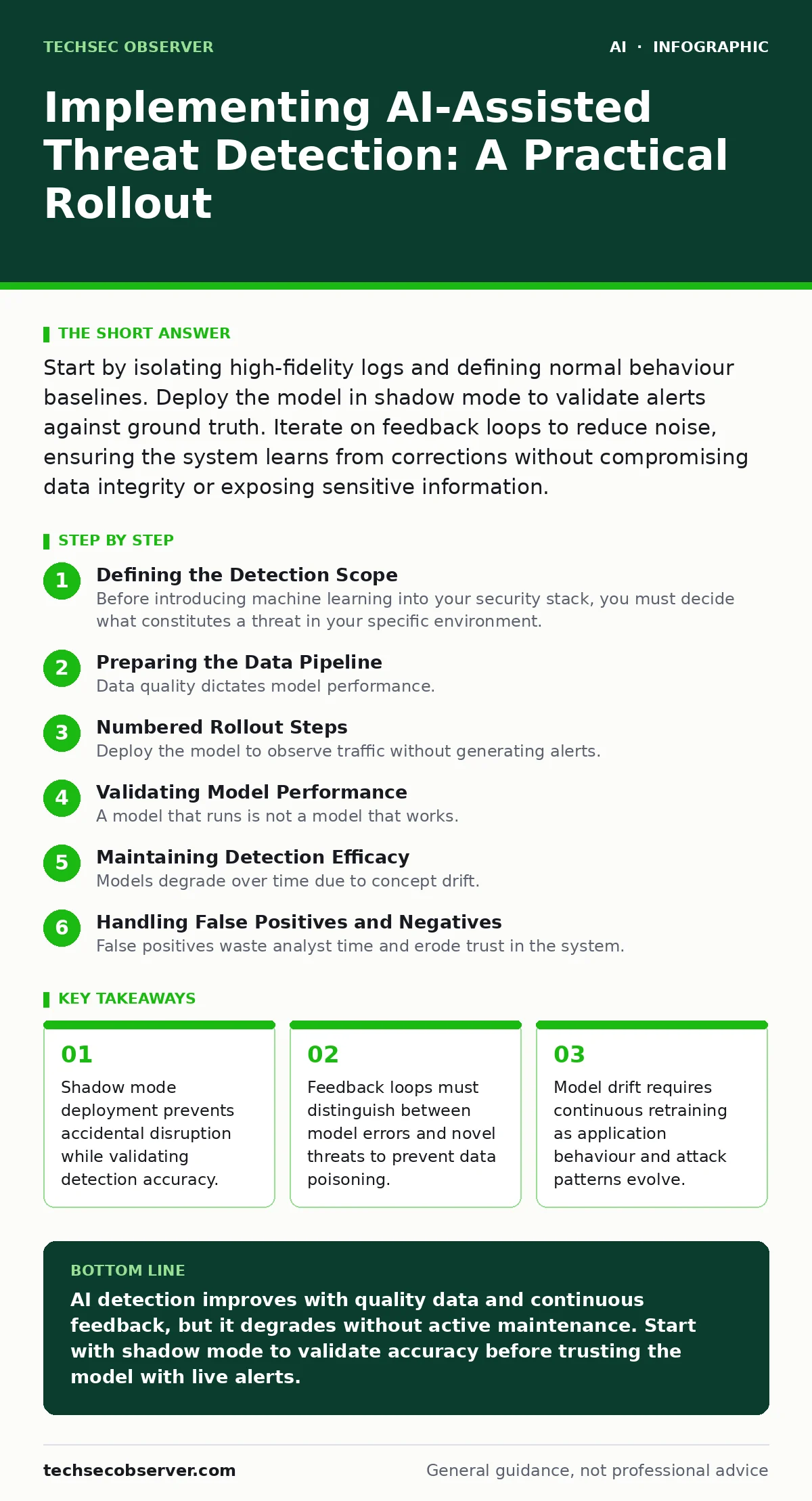
Start by isolating high-fidelity logs and defining normal behaviour baselines. Deploy the model in shadow mode to validate alerts against ground truth. Iterate on feedback loops to reduce noise, ensuring the system learns from corrections without compromising data integrity or exposing sensitive information.
Defining the Detection Scope
Before introducing machine learning into your security stack, you must decide what constitutes a threat in your specific environment. AI-assisted threat detection relies on pattern recognition rather than static signatures. It identifies anomalies by comparing current activity against a learned baseline of normal behaviour. If your baseline is noisy, the model will learn noise.
You cannot detect what you do not measure. Select data sources that offer high signal-to-noise ratios. Application logs, network flow records, and user entity behaviour analytics provide richer context than generic system events. Avoid dumping raw, unstructured data into the model. Pre-processing is not optional; it is the foundation of accuracy.
Consider the trade-off between coverage and precision. Broad monitoring captures more events but increases the cognitive load on analysts. Narrow monitoring misses edge cases. Choose a scope that aligns with your highest-risk assets. This approach mirrors the principles in our guide on AI governance, where defining boundaries prevents scope creep and resource exhaustion.
Preparing the Data Pipeline
Data quality dictates model performance. You must ensure that the data feeding the detection engine is consistent, complete, and labelled where possible. Inconsistent timestamps or missing fields create gaps that the model may interpret as anomalies. Standardise formats before ingestion.
Cleanse the data of irrelevant noise. Routine administrative actions, scheduled backups, and known benign scripts generate repetitive patterns. If the model sees these as normal, it reduces false positives. If it sees them as anomalies, it alerts on nothing. Label historical data to create ground truth. This labelled data allows you to evaluate model performance objectively.
Be mindful of training data leakage. If information from the test set leaks into the training set, the model appears accurate during validation but fails in production. Ensure strict separation between training, validation, and testing datasets. This discipline prevents overfitting, where the model memorises specific instances rather than learning generalisable patterns.
Numbered Rollout Steps
Step 1: Establish the Baseline
Deploy the model to observe traffic without generating alerts. This phase, known as shadow mode, allows the system to learn normal behaviour without impacting operations. Run this for a period sufficient to capture varying operational states, including peak loads and maintenance windows.
Verification: Check that the model’s confidence scores stabilise. If scores fluctuate wildly, the data pipeline is likely unstable or the baseline is too narrow.
Step 2: Calibrate Thresholds
Adjust sensitivity settings to balance detection rate against false positives. Start with a high threshold to capture only the most obvious anomalies. Gradually lower the threshold as you validate alerts against ground truth. This iterative process refines the model’s decision boundary.
Verification: Review a sample of flagged events. Calculate the ratio of true positives to false positives. Aim for a ratio that your team can sustain without alert fatigue.
Step 3: Enable Active Monitoring
Switch the model to active mode, where it generates alerts for identified anomalies. Integrate these alerts into your existing incident response workflow. Ensure that responders have context-rich notifications, not just raw scores. Include relevant logs and entity details to speed up triage.
Verification: Monitor the time to first response. If responders ignore alerts, the threshold is too low or the context is insufficient.
Step 4: Implement Feedback Loops
Create a mechanism for analysts to label alerts as true or false positives. Feed this feedback back into the model to retrain it. This continuous learning process adapts the model to new normal behaviours and emerging threats. Without feedback, the model stagnates and becomes less accurate over time.
Verification: Track the reduction in false positives over time. A decreasing trend indicates successful learning.
Validating Model Performance
A model that runs is not a model that works. You must validate performance using metrics that reflect operational reality. Precision and recall are standard metrics, but they tell only part of the story. Precision measures how many alerts were correct. Recall measures how many threats were caught.
High precision with low recall means you miss many threats. High recall with low precision means you drown in false alarms. You need a balance that suits your risk tolerance. Use confusion matrices to visualise these trade-offs. This analysis helps you understand where the model fails and why.
Regularly audit the model for bias. If the model was trained on data from one environment, it may perform poorly in another. Test the model against diverse datasets to ensure generalisability. This practice aligns with the concepts in AI model monitoring, where continuous validation ensures reliability across changing conditions.
Maintaining Detection Efficacy
Models degrade over time due to concept drift. As applications evolve, user behaviour changes, and new attack techniques emerge, the baseline shifts. A model that was accurate last year may be useless today. You must monitor for drift and retrain accordingly.
Automate the detection of performance degradation. Set up alerts for significant drops in precision or recall. When drift is detected, trigger a retraining cycle with fresh data. This ensures the model remains aligned with current realities.
Be vigilant against data poisoning attacks. Adversaries may attempt to inject malicious data into the training pipeline to skew the model’s behaviour. Validate all incoming data for integrity and authenticity. Implement checks to detect anomalous data distributions that may indicate poisoning. This defence is critical for maintaining trust in the detection system.
See also: What is Dwell Time: Why Detection Latency Dictates Breach Severity · Purple Team Cyber Security: Bridging Red and Blue for Faster Defences
Handling False Positives and Negatives
False positives waste analyst time and erode trust in the system. False negatives allow threats to slip through. Both require different mitigation strategies. For false positives, refine the baseline and improve data quality. For false negatives, expand the scope and incorporate additional data sources.
Use human-in-the-loop processes to handle ambiguous cases. Analysts can provide context that the model lacks. Their feedback improves the model and builds institutional knowledge. This collaborative approach enhances detection capabilities beyond what automation alone can achieve.
Consider the impact of prompt injection attacks on any AI components involved in log analysis or report generation. Ensure that the model’s inputs are sanitised to prevent manipulation. While primarily a concern for generative AI, the principle of input validation applies broadly to maintain system integrity.
Integrating with Existing Workflows
AI-assisted detection should augment, not replace, existing security operations. Integrate alerts into your ticketing system and incident response playbooks. Ensure that responders have clear procedures for handling AI-generated alerts. This integration reduces friction and speeds up response times.
Train your team on the model’s capabilities and limitations. Understanding how the model works helps analysts interpret alerts correctly. It also empowers them to provide meaningful feedback. This training fosters a culture of continuous improvement and shared ownership.
Review the broader implications of your AI deployment. Consider the ethical and legal aspects of automated monitoring. Ensure compliance with relevant regulations and internal policies. This holistic approach ensures that your detection system is not only effective but also responsible and sustainable.
Key takeaways
- Shadow mode deployment prevents accidental disruption while validating detection accuracy.
- Feedback loops must distinguish between model errors and novel threats to prevent data poisoning.
- Model drift requires continuous retraining as application behaviour and attack patterns evolve.
AI detection improves with quality data and continuous feedback, but it degrades without active maintenance. Start with shadow mode to validate accuracy before trusting the model with live alerts.
Frequently asked questions
How do I know if my data is clean enough for AI detection?
Check for consistency in formats, completeness of fields, and absence of known noise sources. Labelled ground truth data is the best indicator of readiness.
What is concept drift and why does it matter?
Concept drift is the change in data distribution over time. It matters because it causes model performance to degrade, leading to missed threats or increased false alarms.
Can AI detect zero-day attacks?
AI can detect anomalies that may indicate zero-day attacks, but it cannot identify the specific vulnerability. It flags unusual behaviour for further investigation by human analysts.
How often should I retrain the model?
Retrain based on performance degradation or significant changes in the environment. Scheduled retraining combined with drift detection ensures the model stays current.
How this guide was produced: written by the TechSec Observer editorial team with AI assistance, checked against the public references listed below, and reviewed when the facts change. See our editorial policy or report an error.