What is Dwell Time: Why Detection Latency Dictates Breach Severity
Shortening the period between intrusion and detection reduces the window for lateral movement and data exfiltration more effectively than perimeter hardening alone.

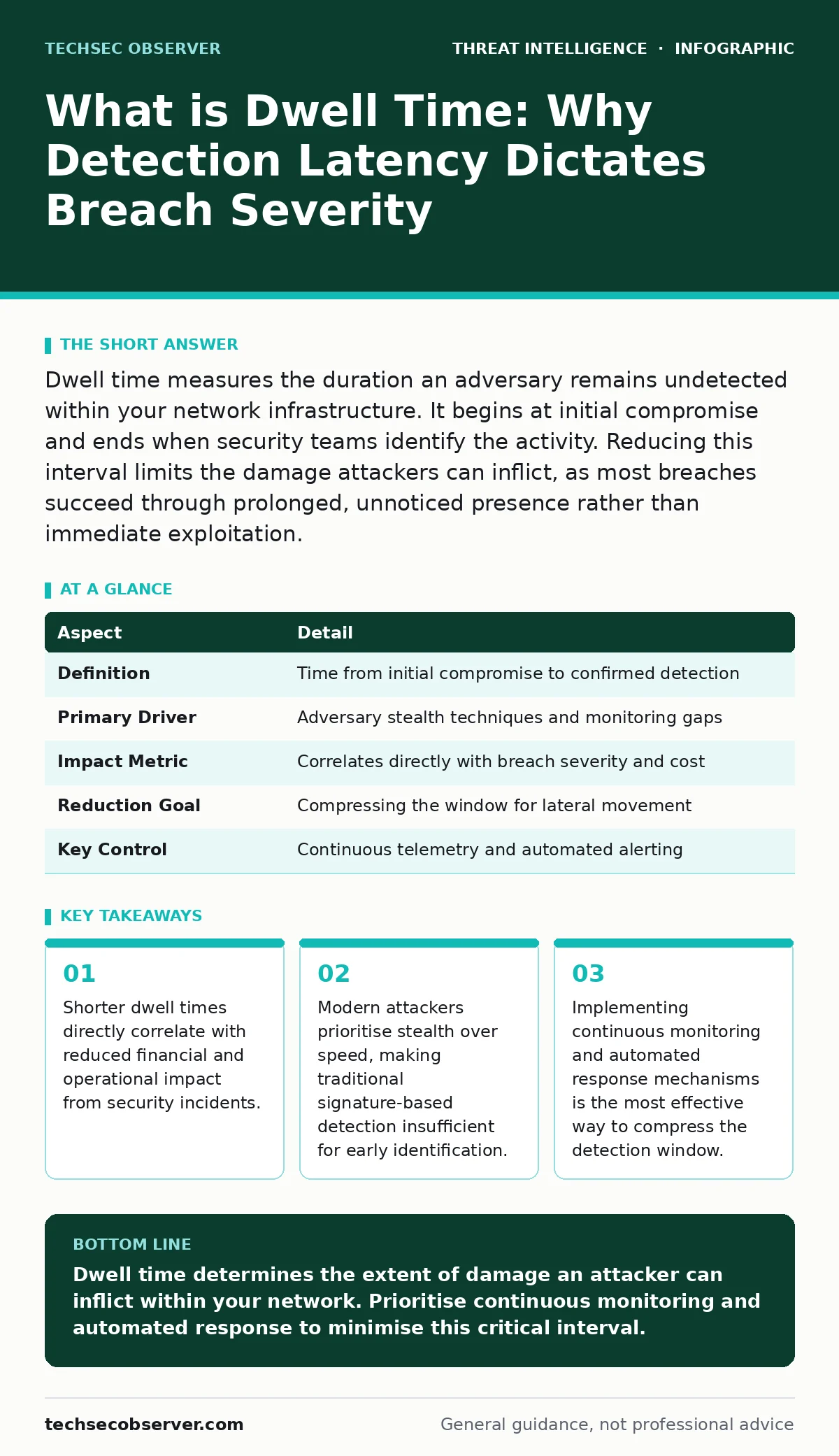
Dwell time measures the duration an adversary remains undetected within your network infrastructure. It begins at initial compromise and ends when security teams identify the activity. Reducing this interval limits the damage attackers can inflict, as most breaches succeed through prolonged, unnoticed presence rather than immediate exploitation.
What is dwell time in cybersecurity
Dwell time is the interval between an attacker gaining initial access to a system and the organisation detecting that intrusion. This metric measures how long an adversary operates within your environment without triggering alerts or manual investigation. Understanding this duration is critical because it determines the scope of potential damage. A longer period allows attackers to map the network, escalate privileges and steal data before anyone intervenes. The goal of defensive security is not merely to prevent entry, but to minimise this silent period.
| Aspect | Detail |
|---|---|
| Definition | Time from initial compromise to confirmed detection |
| Primary Driver | Adversary stealth techniques and monitoring gaps |
| Impact Metric | Correlates directly with breach severity and cost |
| Reduction Goal | Compressing the window for lateral movement |
| Key Control | Continuous telemetry and automated alerting |
How attackers extend their presence
Adversaries deliberately prolong their stay to avoid triggering alarms. They adopt low-and-slow tactics, performing small actions that blend with normal traffic patterns. This approach bypasses simple threshold alerts that look for sudden spikes in activity. Attackers often live off the land, using legitimate administrative tools already present on the system.
This technique avoids introducing foreign binaries that signature scanners would flag. They may also disable logging services on compromised hosts to create blind spots. By manipulating the environment, they ensure their commands leave minimal forensic traces. This strategic patience forces defenders to rely on anomaly detection rather than known bad indicators.
Why traditional defenses fail to shorten the window
Standard perimeter controls assume that stopping the initial entry is the primary objective. This mindset leaves internal networks vulnerable once that boundary is breached. Once inside, attackers move laterally, seeking higher-value targets like domain controllers or database servers. Traditional antivirus software often misses these movements because they use legitimate processes.
Network firewalls may not inspect encrypted internal traffic, allowing command-and-control communications to pass unnoticed. Without visibility into user actions and process behaviour, the organisation remains blind to the intrusion. The focus on prevention creates a false sense of security, ignoring the inevitable breach scenario. Defenders must accept that entry will occur and prioritise detection speed instead.
The hidden cost of delayed detection
Prolonged presence increases the complexity of incident response. Attackers use the extra time to establish persistence mechanisms, ensuring they can return even after cleanup. They may implant rootkits or create backdoor accounts that are difficult to identify. Each day of undetected activity expands the attack surface.
The adversary learns more about the environment, identifying security gaps and potential targets. This intelligence allows them to tailor subsequent attacks to bypass specific controls. The financial cost rises not just from data loss, but from the extended effort required to eradicate deeply embedded threats. Operational disruption also increases as systems must be taken offline for thorough investigation.
Reducing the interval through better visibility
Shortening the detection window requires shifting from reactive to proactive monitoring. You must collect telemetry from endpoints, networks and cloud services. Centralising this data allows for correlation of events that appear benign in isolation. For instance, a single failed login is normal, but multiple failures across different accounts suggest an attack.
Implementing user and entity behavior analytics helps identify deviations from established baselines. This technology flags unusual activities, such as a user accessing files at odd hours. Automated response systems can then isolate affected endpoints before the threat spreads. This continuous loop of detection and response compresses the available time for adversaries.
See also: Purple Team Cyber Security: Bridging Red and Blue for Faster Defences · Process Injection Prevention Checklist for Secure Code
Common misconceptions about detection speed
Many organisations believe that buying more security tools reduces the risk. This assumption is flawed because tool proliferation creates alert fatigue. Security teams drown in notifications, causing them to miss genuine threats amidst the noise. Another misconception is that zero trust architecture eliminates the need for internal monitoring. While zero trust restricts access, it does not detect compromised credentials. An attacker with valid credentials can still move laterally if the system does not monitor their actions. Relying solely on prevention ignores the reality of sophisticated attacks. Effective security requires a balance of prevention, detection and response capabilities.
Integrating detection into your defence strategy
A mature security programme treats detection as a continuous process. Regular testing of detection rules ensures they remain effective against new techniques. Purple teaming exercises simulate real-world attacks to validate monitoring capabilities. These tests reveal gaps in visibility and response procedures. You should also review logs regularly to refine your baselines. As business processes change, normal behaviour shifts, and detection rules must adapt. Collaborating between security and IT teams improves the quality of telemetry. Clear communication channels ensure that alerts lead to swift action. This integrated approach minimises the time attackers have to cause harm.
Key takeaways
- Shorter dwell times directly correlate with reduced financial and operational impact from security incidents.
- Modern attackers prioritise stealth over speed, making traditional signature-based detection insufficient for early identification.
- Implementing continuous monitoring and automated response mechanisms is the most effective way to compress the detection window.
Dwell time determines the extent of damage an attacker can inflict within your network. Prioritise continuous monitoring and automated response to minimise this critical interval.
Frequently asked questions
How do you calculate dwell time accurately?
Measure the timestamp of the initial compromise event against the timestamp of the first confirmed detection alert. Accurate logging and synchronised clocks across systems are required for precision.
Does zero trust reduce dwell time?
Zero trust limits lateral movement but does not automatically detect intrusions. It must be combined with robust monitoring to identify and respond to compromised credentials quickly.
What is the average dwell time for breaches?
There is no single average, as it varies by industry and attacker sophistication. However, reducing this time is universally beneficial for limiting breach impact and recovery costs.
Can automation replace human analysts in detection?
Automation handles routine alerts and initial containment, but human analysts are needed for complex investigations. A hybrid approach ensures speed without sacrificing accuracy in nuanced scenarios.
How this guide was produced: written by the TechSec Observer editorial team with AI assistance, checked against the public references listed below, and reviewed when the facts change. See our editorial policy or report an error.