Purple Team Cyber Security: Bridging Red and Blue for Faster Defences
Purple teaming collapses the delay between detection and response by forcing defenders to adapt tactics while attackers are still active.

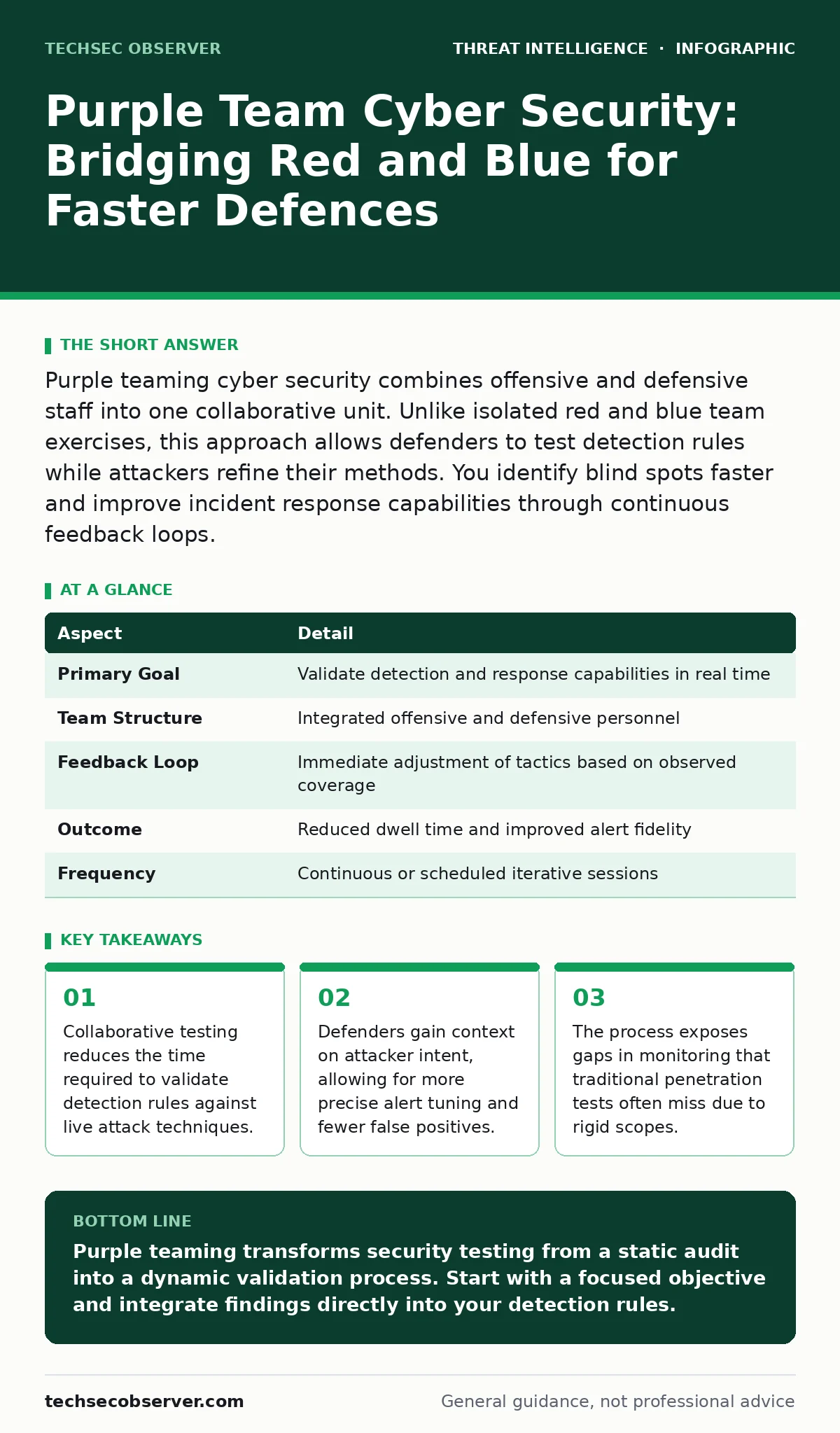
Purple teaming cyber security combines offensive and defensive staff into one collaborative unit. Unlike isolated red and blue team exercises, this approach allows defenders to test detection rules while attackers refine their methods. You identify blind spots faster and improve incident response capabilities through continuous feedback loops.
The Mechanics of Purple Team Cyber Security
Purple teaming cyber security is a collaborative approach where offensive security testers and defensive security analysts work together in real time. Traditional security assessments keep these groups separate, creating a disconnect between attack execution and defensive observation.
Imagine a construction crew testing a bridge. The red team applies stress loads to specific joints. The blue team monitors strain gauges to detect failure points. In a purple team model, both groups stand on the bridge together. When the red team shifts weight, the blue team immediately adjusts sensor sensitivity. This shared context transforms abstract test results into actionable intelligence.
| Aspect | Detail |
|---|---|
| Primary Goal | Validate detection and response capabilities in real time |
| Team Structure | Integrated offensive and defensive personnel |
| Feedback Loop | Immediate adjustment of tactics based on observed coverage |
| Outcome | Reduced dwell time and improved alert fidelity |
| Frequency | Continuous or scheduled iterative sessions |
This method shifts the focus from finding vulnerabilities to verifying that your security stack can see and stop the exploitation of those vulnerabilities. You stop asking if a system is breakable and start asking if your monitors would notice the break.
How the Collaboration Works in Practice
The process begins with a clear objective rather than a broad scope. You select specific attack techniques that matter to your organisation. The red team member executes these techniques while the blue team member observes the resulting telemetry.
The critical difference from a standard penetration test is the pause and discuss phase. When an attack goes undetected, the teams do not move to the next target. They stop. The blue team explains why the alert did not fire. The red team explains why the technique bypassed the control. Together, they adjust the detection rule or the defensive posture.
This iteration continues until the defensive team can reliably detect the specific technique. The red team then modifies the method to bypass the new rule. The blue team must then update their monitoring again. This cat-and-mouse dynamic happens in minutes rather than weeks.
You gain visibility into the exact data points required for detection. Often, defenders rely on high-level logs that lack the granularity needed to spot advanced tactics. The red team provides the low-level indicators that make those logs useful.
Common Misconceptions About the Approach
Many organisations confuse purple teaming with a combined red and blue team exercise. This is a fundamental error. A combined exercise still keeps the teams separate until the final report. Purple teaming requires shared access to tools and real-time communication channels.
Another mistake is treating it as a one-time event. Security controls evolve, and attackers adapt. A single session provides a snapshot of your current posture. It does not build lasting resilience. You must repeat the process with new techniques and updated environments.
Some teams attempt to automate the entire purple teaming process. While automation helps with data collection, the human element is vital. Detecting nuances in attacker behaviour requires contextual understanding that scripts cannot replicate. You need humans to interpret why a specific sequence of events is suspicious.
Do not use purple teaming to replace penetration testing. Penetration tests identify vulnerabilities. Purple teaming validates your ability to detect exploitation. You need both. A system can be secure from external entry but blind to internal lateral movement.
Impact on Security Operations Centres
The direct impact is a reduction in alert fatigue. When defenders understand the specific signatures of successful attacks, they can tune their Security Information and Event Management systems more precisely. This leads to fewer false positives and faster triage of genuine incidents.
Defenders also gain a deeper understanding of attacker dwell time. Dwell time is the period between initial compromise and detection. By testing detection rules against active attacks, you compress this window. You move from reactive monitoring to proactive validation.
The cultural shift is significant. Defensive staff stop viewing offensive testers as adversaries. They see them as partners in improving system resilience. This collaboration breaks down silos that often hinder incident response. Information flows freely between teams, accelerating the containment of threats.
You must ensure that blue team members have access to the same threat intelligence used by the red team. Without this shared knowledge base, defenders cannot understand the sophistication of the techniques being tested. They may dismiss advanced tactics as impossible or irrelevant.
Technical Depth for Developers and Engineers
For those building security tooling, purple teaming reveals the limitations of static analysis. Static analysis examines code without executing it. It often misses runtime behaviours that only appear during active exploitation.
Consider NTLM relay attacks. These attacks leverage legacy authentication protocols to move laterally within a network. Static rules may flag unusual authentication attempts. However, they often fail to detect the relay mechanism itself. Purple teaming allows engineers to observe the exact packet sequences involved.
You can use this data to build more accurate detection models. Instead of relying on broad heuristics, you can program specific logic to identify the unique characteristics of the relay. This reduces noise and increases the signal-to-noise ratio in your monitoring tools.
Process injection techniques also benefit from this approach. Attackers often inject code into legitimate processes to avoid detection. By observing the memory modifications in real time, engineers can identify the specific APIs abused. This allows for targeted monitoring of those APIs rather than blanket restrictions.
Integrating with Broader Security Strategies
Purple teaming does not exist in a vacuum. It must align with your broader security architecture. You should integrate findings directly into your incident response plans. If a technique bypasses your current controls, update your playbooks to address the gap.
Network traffic analysis plays a key role here. While endpoint detection is critical, network logs often reveal lateral movement that endpoints miss. Purple teaming sessions should include network visibility components to ensure you are monitoring all potential attack vectors.
Remote desktop abuse is another common vector for lateral movement. Attackers use legitimate remote access tools to maintain persistence. Purple teaming can test whether your monitoring can distinguish between authorised administrative access and malicious remote desktop usage.
You should also consider the impact on system performance. Intensive testing can strain resources. Ensure that your testing environment mirrors production in terms of load and complexity. Otherwise, your detection rules may not hold up under real-world conditions.
What to Do About It
Start by identifying high-value assets and the specific threats targeting them. Do not attempt to test every possible attack vector. Focus on techniques that are most likely to succeed against your environment.
Select a small, cross-functional team. Include one offensive specialist and one defensive analyst. Equip them with shared communication tools and real-time access to logs. Define clear success criteria for each session.
Begin with simple techniques. Validate your ability to detect basic file modifications or login failures. Once these are reliable, progress to more complex methods like LSASS credential theft. This gradual increase in complexity builds confidence and skill.
Document every finding. Create a repository of detection rules and attacker techniques. Share this knowledge across the organisation. Training is as important as technology in building a resilient defence.
Key takeaways
- Collaborative testing reduces the time required to validate detection rules against live attack techniques.
- Defenders gain context on attacker intent, allowing for more precise alert tuning and fewer false positives.
- The process exposes gaps in monitoring that traditional penetration tests often miss due to rigid scopes.
Purple teaming transforms security testing from a static audit into a dynamic validation process. Start with a focused objective and integrate findings directly into your detection rules.
Frequently asked questions
Is purple teaming the same as a red team exercise?
No. Red team exercises simulate full-scale attacks to test defence capabilities. Purple teaming focuses on specific techniques and immediate feedback to improve detection.
How often should we conduct purple teaming?
Regularly. Security controls and attacker tactics evolve. Quarterly sessions are a good starting point, but continuous improvement is ideal.
Do we need dedicated purple team staff?
Not necessarily. Existing red and blue team members can collaborate. The key is the process, not the job title.
Can purple teaming replace penetration testing?
No. Penetration testing identifies vulnerabilities. Purple teaming validates detection and response. Both are necessary for a complete security posture.
How this guide was produced: written by the TechSec Observer editorial team with AI assistance, checked against the public references listed below, and reviewed when the facts change. See our editorial policy or report an error.