Purple Teaming Checklist: Align Red and Blue for Faster Detection
Most organisations fail because they measure attack success rather than detection quality, leaving critical blind spots in their monitoring infrastructure.
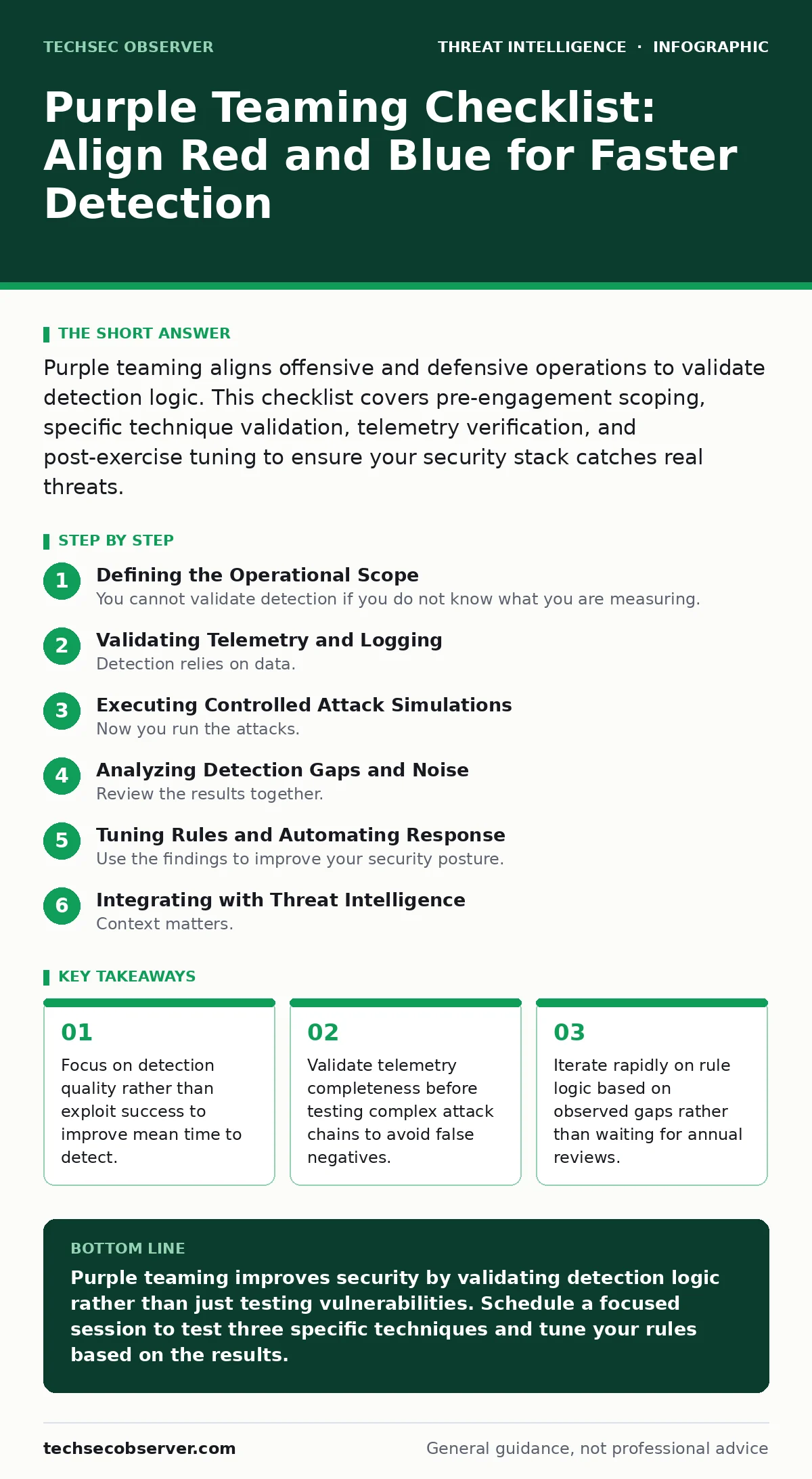
Purple teaming aligns offensive and defensive operations to validate detection logic. This checklist covers pre-engagement scoping, specific technique validation, telemetry verification, and post-exercise tuning to ensure your security stack catches real threats.
Defining the Operational Scope
You cannot validate detection if you do not know what you are measuring. Start by defining the specific adversary tactics you intend to test. This prevents the exercise from becoming a generic penetration test that offers little value to the defensive team.
- Map specific MITRE ATT&CK techniques to business risk: Align testing with the threats most likely to impact your organisation.
- Define success criteria as detection and response: Measure whether alerts fire and operators act, not whether systems are breached.
- Establish safe harbour boundaries for production systems: Prevent accidental disruption of critical services during live testing.
This scope ensures both teams understand the objective. It shifts the focus from breaking in to being seen. You avoid the common pitfall of testing low-value targets that do not reflect actual adversary behaviour.
Validating Telemetry and Logging
Detection relies on data. If the logging pipeline is incomplete, no amount of rule tuning will help. You must verify that the necessary events are generated, captured, and forwarded before you simulate any activity.
- Verify endpoint telemetry collection for process creation: Ensure parent-child process relationships are recorded for behavioural analysis.
- Confirm network flow data capture for east-west traffic: Internal lateral movement often goes unnoticed if only perimeter traffic is logged.
- Test log ingestion latency and completeness: Delayed or missing logs create blind spots that attackers will exploit.
Imagine an attacker uses a legitimate tool like PowerShell. If your endpoint detection and response solution does not log script block execution, you are blind to that activity. This step saves hours of troubleshooting false negatives later. It also relates closely to the principles found in our guide on user and entity behavior analytics, where data quality dictates analytical success.
Executing Controlled Attack Simulations
Now you run the attacks. These are not full breaches but precise simulations of specific techniques. You execute them in a controlled manner to observe how the defensive stack reacts.
- Simulate credential dumping using standard tools: Test if memory access monitoring detects attempts to read LSASS.
- Execute living-off-the-land binary abuse: Verify detection of standard system utilities used for malicious purposes.
- Test lateral movement via remote execution protocols: Check if anomalous remote command execution triggers alerts.
Refer to the LSASS credential theft guide for specific memory access patterns to monitor. Do not attempt complex exploits that may crash systems. Focus on the actions an attacker takes after initial access. This approach mirrors the precision required in AI red teaming, where specific prompt injections are tested against model defences.
Analyzing Detection Gaps and Noise
Review the results together. Identify where alerts failed to fire and where they produced excessive noise. This joint review is the core of purple teaming. It turns raw data into actionable improvements.
- Catalogue missed detections with root cause analysis: Determine if the failure was due to missing logs, poor rules, or blind spots.
- Review false positives generated during the exercise: Tune rules to reduce alert fatigue without dropping true positives.
- Document time-to-detect for each tested technique: Establish a baseline metric for future improvement comparisons.
You may find that your intrusion detection system catches network scans but misses file exfiltration. This gap informs your next tuning cycle. Avoid the mistake of blaming the tool; often the issue is configuration or data visibility. This process complements blue team operations by providing realistic test data for validation.
Tuning Rules and Automating Response
Use the findings to improve your security posture. Update detection rules, refine playbooks, and automate responses where possible. This closes the loop between testing and improvement.
- Update detection signatures based on observed artefacts: Incorporate specific indicators from the simulation into your rules.
- Refine automated response playbooks for confirmed threats: Ensure automatic containment does not disrupt legitimate business processes.
- Schedule follow-up validation of tuned rules: Verify that changes detect the technique without generating new false positives.
Consider how DNS tunneling might evade standard network filters. If your tests show gaps in DNS monitoring, add specific rules for anomalous query lengths or entropy. This iterative tuning is where real security improvement happens. It ensures your defences adapt to the techniques you have specifically tested.
See also: Active Directory Attack Warning Signs Early Detection Methods · What is Dwell Time: Why Detection Latency Dictates Breach Severity
Integrating with Threat Intelligence
Context matters. Raw alerts are less useful than alerts enriched with intelligence. Use your findings to improve how you contextualise incoming threats.
- Enrich alerts with relevant threat intelligence feeds: Connect internal telemetry with external indicators of compromise.
- Map simulation results to current threat actor behaviour: Prioritise tuning for techniques used by groups targeting your sector.
- Review threat intelligence reports for emerging techniques: Stay ahead of new TTPs that may not yet be in your detection suite.
See our guide on threat intelligence reports for methods to ingest and apply this data. You can also explore domain fronting techniques to ensure your web proxies do not allow covert command and control channels. This integration ensures your defences are relevant to the current threat environment.
Documenting and Sharing Lessons Learned
Knowledge must be captured. Document the outcomes, the gaps, and the improvements. Share these insights with both offensive and defensive teams to build institutional knowledge.
- Create a detailed report of findings and improvements: Include technical details for developers and summary metrics for leadership.
- Update internal playbooks with new detection guidance: Ensure operators know how to handle the specific techniques tested.
- Schedule regular purple teaming cycles: Make this a recurring activity rather than a one-off project.
Imagine a scenario where a new cloud service is deployed without proper logging. Your documentation should highlight this gap to prevent future blind spots. This practice supports remote desktop abuse mitigations by ensuring all remote access is logged and monitored. Consistent documentation turns individual exercises into organisational resilience.
Key takeaways
- Focus on detection quality rather than exploit success to improve mean time to detect.
- Validate telemetry completeness before testing complex attack chains to avoid false negatives.
- Iterate rapidly on rule logic based on observed gaps rather than waiting for annual reviews.
Purple teaming improves security by validating detection logic rather than just testing vulnerabilities. Schedule a focused session to test three specific techniques and tune your rules based on the results.
Frequently asked questions
How does purple teaming differ from red teaming?
Red teaming simulates a full adversary campaign to test overall security, while purple teaming focuses on specific techniques to improve detection and response capabilities.
How often should we conduct purple teaming exercises?
Aim for quarterly cycles to keep detection rules current and ensure new threats are being monitored effectively.
Do we need a dedicated purple team?
No, existing red and blue team members can collaborate. The key is shared goals and open communication during the exercise.
What if we lack the skills to simulate advanced attacks?
Start with basic techniques and use open-source tools. Focus on improving your detection for common threats before moving to complex scenarios.
How this guide was produced: written by the TechSec Observer editorial team with AI assistance, checked against the public references listed below, and reviewed when the facts change. See our editorial policy or report an error.