What is Domain Fronting: Mechanics, Detection and Mitigation
Domain fronting hides traffic by routing it through a popular service, creating a blind spot that standard perimeter controls cannot see without deep packet inspection.

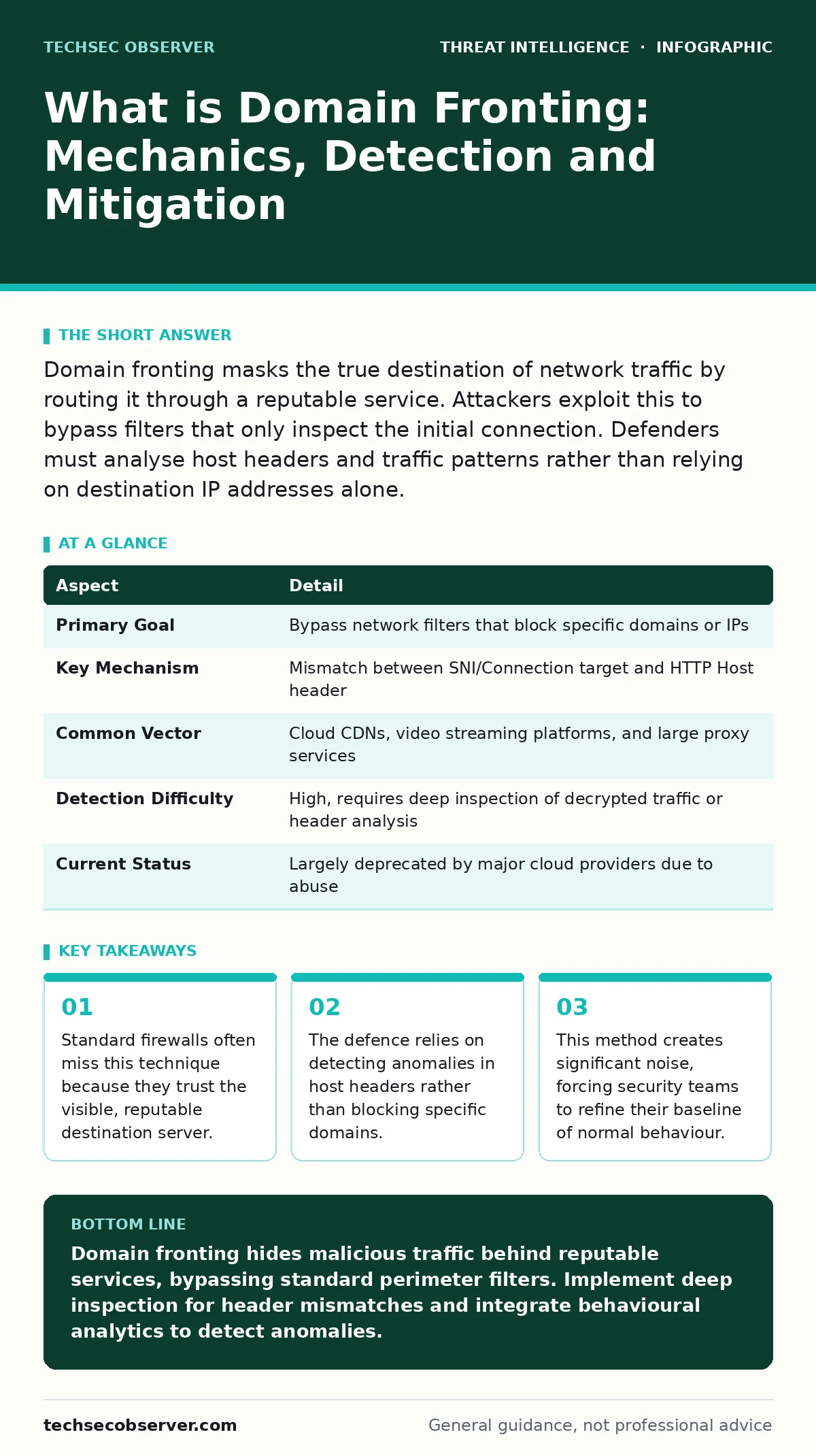
Domain fronting masks the true destination of network traffic by routing it through a reputable service. Attackers exploit this to bypass filters that only inspect the initial connection. Defenders must analyse host headers and traffic patterns rather than relying on destination IP addresses alone.
An Everyday Analogy for Hidden Traffic
Imagine sending a confidential letter inside a package addressed to a large, trusted retail chain. The postal service delivers the package to that chain’s distribution centre without suspicion. The retail worker then opens the package and hands the confidential letter to the intended recipient, who was listed only on a small, hidden label inside. The outer label hides the true nature of the delivery.
Domain fronting operates on this same principle of layered concealment. It exploits how modern web protocols handle routing and identification. The outer layer appears benign, while the inner request targets a different, often malicious, destination. This separation allows traffic to pass through security controls that only examine the outer layer.
What is domain fronting
Domain fronting is a technique that obscures the true destination of HTTP or HTTPS requests by using a legitimate, high-profile domain as a front. The client establishes a connection to a trusted service, such as a cloud provider or media platform. The actual target server sits behind this front. The security controls see only the trusted domain and permit the connection. The true intent remains hidden within the encrypted payload or specific HTTP headers.
This method relies on the architecture of Content Delivery Networks and proxy services. These services route traffic based on internal instructions rather than the initial connection point. The defender sees a connection to a safe domain. The attacker reaches a blocked or monitored domain. The disconnect between the visible connection and the actual content creates the vulnerability.
How the Mechanism Works in Practice
The process begins with the client initiating a connection to a reputable domain. This domain belongs to a large service provider that supports multiple subdomains and services. The client uses the Transport Layer Security protocol to encrypt the channel. The initial handshake reveals only the reputable domain to any observer.
Inside this encrypted channel, the client sends an HTTP request. This request contains a Host header specifying the actual target server. The reputable service receives the request and forwards it to the backend server indicated by the Host header. The response returns through the same reputable domain. The observer sees only encrypted traffic to and from the safe domain. The actual content exchange remains invisible to shallow inspection tools.
| Aspect | Detail |
|---|---|
| Primary Goal | Bypass network filters that block specific domains or IPs |
| Key Mechanism | Mismatch between SNI/Connection target and HTTP Host header |
| Common Vector | Cloud CDNs, video streaming platforms, and large proxy services |
| Detection Difficulty | High, requires deep inspection of decrypted traffic or header analysis |
| Current Status | Largely deprecated by major cloud providers due to abuse |
Who Is Affected and Why It Matters
Organisations that rely on perimeter-based security controls face the greatest risk. If your network filters only check the destination IP address or the Server Name Indication, you are vulnerable. These controls assume the visible destination is the actual destination. Domain fronting breaks this assumption.
Software developers must understand this because application traffic often uses APIs hosted on such services. If your application communicates with a backend via a CDN, an attacker could potentially hijack this pattern. The risk extends to any environment where encrypted traffic is permitted without deep inspection. The technique effectively renders the perimeter porous for specific types of exfiltration and command-and-control traffic.
This technique is particularly dangerous when combined with other attacks. For instance, an attacker might use process injection to place their payload in a legitimate system process. They then use domain fronting to communicate with their server. The process looks legitimate, and the network traffic looks legitimate. The combination makes detection significantly harder.
What People Usually Get Wrong
Many security professionals believe that blocking a domain stops all traffic to it. This belief is false in the context of domain fronting. You can block the malicious domain at your firewall, but the attacker will simply route through a different front. The connection to the front domain remains allowed.
Another common mistake is assuming that TLS decryption solves the problem. While decrypting traffic allows you to see the Host header, it is resource-intensive. Most organisations cannot decrypt all outbound traffic. They rely on sampling or filtering. Attackers exploit this gap by using encrypted channels that are never inspected.
Some assume that since major cloud providers have restricted this feature, the technique is dead. This is incorrect. While mainstream providers have tightened their configurations, smaller services or misconfigured servers may still support it. Furthermore, the concept of hiding intent behind a trusted channel remains a valid attack vector.
See also: How Data Exfiltration Works: The Silent Stages of Theft
Detection Strategies for Security Teams
Effective detection requires moving beyond simple destination checks. You must analyse the relationship between the Server Name Indication and the HTTP Host header. These two fields should match in normal traffic. A mismatch indicates potential domain fronting.
Implementing deep packet inspection allows you to examine these headers. However, you must balance this with privacy and performance concerns. You cannot inspect every packet. Instead, focus on anomalous patterns. Look for connections to reputable domains that exhibit unusual data volumes or timing patterns.
Integrating this analysis with user and entity behavior analytics enhances detection. UEBA systems can flag when a specific user or device starts communicating with a reputable service in an unusual way. The combination of network-level header analysis and behavioural context reduces false positives.
Regular purple teaming exercises should test this specific vector. Attackers in these exercises can attempt to use domain fronting to bypass your controls. This reveals gaps in your visibility. It also tests whether your detection rules trigger on header mismatches.
Mitigation and Future Resilience
Mitigation focuses on reducing the attack surface and improving visibility. Configure your proxies and firewalls to reject requests where the SNI and Host header do not match. This is a strong defence against many forms of fronting.
Encourage the use of standard protocols that do not support this mismatch. Some newer protocols enforce stricter alignment between connection parameters and application-layer data. Migrating to these standards reduces the opportunity for abuse.
Educate your development teams about the risks. They should avoid architectures that rely on opaque proxying for sensitive data. If you must use CDNs, ensure they are configured to prevent misuse. Validate that the service provider does not allow arbitrary host header routing.
Finally, maintain an updated threat intelligence feed. While the specific mechanics of domain fronting may evolve, the underlying principle of hiding behind trusted services remains. Stay alert for new variations. Combine this awareness with protections against Active Directory attacks and remote desktop abuse, as attackers often move laterally after establishing initial access.
Key takeaways
- Standard firewalls often miss this technique because they trust the visible, reputable destination server.
- The defence relies on detecting anomalies in host headers rather than blocking specific domains.
- This method creates significant noise, forcing security teams to refine their baseline of normal behaviour.
Domain fronting hides malicious traffic behind reputable services, bypassing standard perimeter filters. Implement deep inspection for header mismatches and integrate behavioural analytics to detect anomalies.
Frequently asked questions
Does using HTTPS prevent domain fronting detection?
No, HTTPS encrypts the traffic, which can hide the host header from shallow inspection. You must decrypt the traffic or use other metadata to detect the mismatch.
Can I block domain fronting with a simple firewall rule?
No, simple firewalls check destination IPs or domains. They cannot see the internal host header that directs traffic to the true target.
Are all cloud services vulnerable to this technique?
Most major providers have disabled features that allow arbitrary host header routing. However, misconfigured services or smaller providers may still be vulnerable.
How does this relate to LSASS credential theft?
It does not directly cause credential theft, but it can be used to exfiltrate credentials once stolen. The technique hides the data transfer from network monitors.
How this guide was produced: written by the TechSec Observer editorial team with AI assistance, checked against the public references listed below, and reviewed when the facts change. See our editorial policy or report an error.