What is User Behavior Analytics: How Baselines Detect Anomalies
User behavior analytics shifts security focus from known threat signatures to statistical deviations in normal activity patterns.

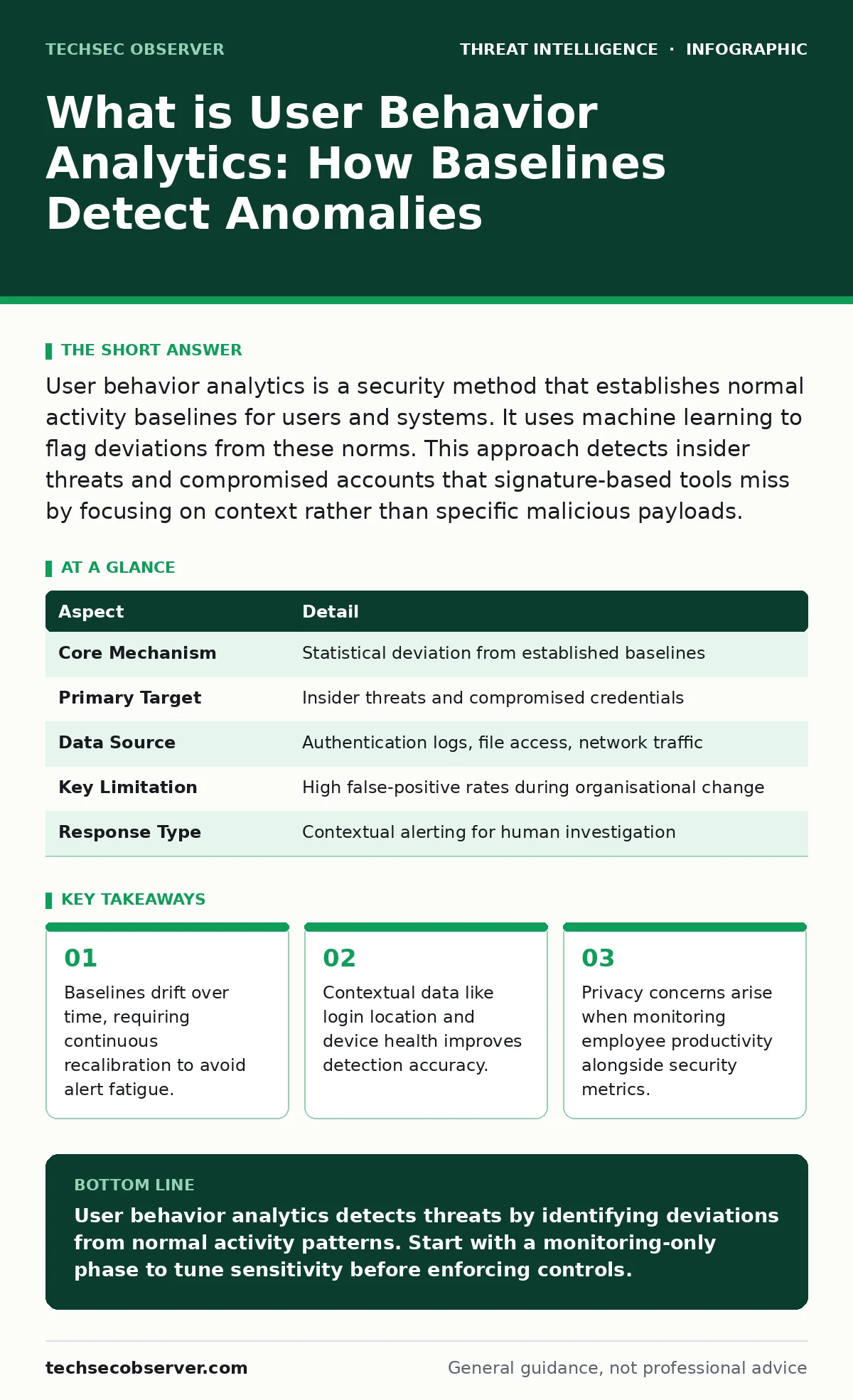
User behavior analytics is a security method that establishes normal activity baselines for users and systems. It uses machine learning to flag deviations from these norms. This approach detects insider threats and compromised accounts that signature-based tools miss by focusing on context rather than specific malicious payloads.
What is user behavior analytics
User behavior analytics is a security discipline that monitors digital activity to identify deviations from established norms. It answers the question of what is user behavior analytics by defining the practice as the statistical analysis of routine actions. The system learns what normal looks like for each entity. It then flags actions that fall outside that expected range. This method detects threats that hide within legitimate traffic.
Traditional security tools rely on known signatures. They block traffic matching a specific malware hash or exploit pattern. User behavior analytics operates differently. It does not need to know the attacker’s identity. It only needs to know that the current action differs significantly from the historical pattern. This distinction allows detection of novel attacks.
Imagine a library where every patron borrows books at predictable times. If a patron suddenly checks out fifty technical manuals at midnight, the librarian notices. The act of borrowing is legal. The timing and volume are abnormal. Security systems apply this logic to digital footprints. They measure the volume, timing and type of data access.
| Aspect | Detail |
|---|---|
| Core Mechanism | Statistical deviation from established baselines |
| Primary Target | Insider threats and compromised credentials |
| Data Source | Authentication logs, file access, network traffic |
| Key Limitation | High false-positive rates during organisational change |
| Response Type | Contextual alerting for human investigation |
How behavioral baselines are constructed
The system begins by ingesting telemetry from endpoints, networks and applications. It aggregates this data over a training period. During this phase, the algorithm identifies patterns. It notes typical login hours, frequent file types and common network destinations. This creates a baseline profile for each user or device.
Machine learning models refine these profiles continuously. They account for seasonal variations and project cycles. A developer accessing code repositories during work hours is normal. The same access at 3:00 AM from a new country is not. The system calculates a risk score based on the degree of deviation. Small deviations may be ignored. Large deviations trigger alerts.
This process requires high-quality data. Incomplete logs create blind spots. If the system cannot see certain activities, it cannot build an accurate baseline. The result is a model that flags normal behaviour as suspicious. This leads to alert fatigue, where analysts ignore warnings because too many are false positives.
The hidden costs of anomaly detection
Organisations often underestimate the operational burden of these systems. Tuning the sensitivity is a constant struggle. Set the threshold too low, and the system flags routine administrative tasks. Set it too high, and it misses subtle exfiltration attempts. Finding the balance requires dedicated security analysts.
Privacy is another significant cost. Monitoring user behaviour touches on employee surveillance. Legal teams must review data collection practices. Clear policies must define what is monitored and why. Employees need to understand that the goal is security, not productivity tracking. Without trust, morale suffers and cooperation declines.
Imagine an employee working remotely from a holiday location. The system flags the login as suspicious. The employee must prove their identity. This friction disrupts workflow. If this happens frequently, staff may bypass security controls to avoid inconvenience. This creates a new vulnerability. The system designed to protect the organisation becomes a barrier to safe operation.
Who is affected by behavioral monitoring
The primary target is the insider threat. This includes malicious employees who steal data. It also covers negligent users who fall for phishing attacks. When an attacker compromises a legitimate account, they inherit that user’s baseline. Their actions, however skilled, will eventually deviate from the owner’s habits.
External attackers also face this scrutiny. Once they gain access, they become part of the entity landscape. Their movement through the network leaves traces. If they move laterally to systems the original user never touched, the anomaly detection system notices. This limits the effectiveness of passive hiding strategies.
Administrators and service accounts require special handling. These entities perform automated tasks that may look erratic to a human observer. The system must distinguish between scripted automation and manual manipulation. Failure to do so generates noise. Analysts waste time investigating routine backup jobs or scheduled scans.
Common misconceptions about detection
Many assume these systems provide complete visibility. They do not. They only see what is logged. If an application does not send logs to the central repository, the system is blind to that activity. Gaps in telemetry create gaps in the baseline. Attackers exploit these blind spots by operating in unmonitored zones.
Another misconception is that the system identifies the attacker. It identifies the anomaly. The alert says "this user is acting strangely." It does not say "this user is an attacker." Human investigation is required to determine the cause. The deviation might be a legitimate change in work habits. It might be a compromised account. The system provides context, not verdicts.
Some believe that once deployed, the system requires no maintenance. This is false. Models degrade over time. They suffer from concept drift. As user behaviour evolves, the old baseline becomes inaccurate. Regular review and retraining are necessary. Without this, the system’s effectiveness declines rapidly.
See also: What is Domain Fronting: Mechanics, Detection and Mitigation · Active Directory Attack Warning Signs Early Detection Methods
Integrating with broader security strategies
User behavior analytics works best when combined with other controls. It complements identity management by validating credential usage. It supports endpoint detection by providing context for suspicious processes. When integrated with threat intelligence, it can correlate internal anomalies with external indicators of compromise.
Consider the concept of attacker dwell time. This is the period between initial breach and detection. Traditional tools often miss the early stages. Behavioral analytics can shorten this window. By detecting unusual activity early, organisations can respond faster. This reduces the impact of the breach.
It also relates to process injection. An attacker may inject malicious code into a legitimate process. The process itself is signed and trusted. However, the process’s network behaviour may change. It may start communicating with unknown external IPs. Behavioral analytics detects this change in network patterns. It flags the process for further inspection.
Practical steps for implementation
Start with a clear definition of what constitutes normal behaviour. Involve stakeholders from different departments. Understand their workflows. This ensures the baseline reflects reality. Exclude known automated tasks from initial monitoring. Focus on human users first.
Deploy the system in a monitoring-only mode. Do not enforce blocks immediately. Allow the system to learn. Review the alerts generated during this period. Tune the sensitivity based on false positives. This iterative process takes time. Rushing it leads to poor performance.
Train analysts on how to interpret the alerts. They must know how to investigate the source of the anomaly. Provide them with tools to correlate behavioural data with other logs. This enables efficient investigation.
Key takeaways
- Baselines drift over time, requiring continuous recalibration to avoid alert fatigue.
- Contextual data like login location and device health improves detection accuracy.
- Privacy concerns arise when monitoring employee productivity alongside security metrics.
User behavior analytics detects threats by identifying deviations from normal activity patterns. Start with a monitoring-only phase to tune sensitivity before enforcing controls.
Frequently asked questions
How does user behavior analytics differ from SIEM?
SIEM aggregates logs for correlation and reporting. User behavior analytics applies statistical models to those logs to identify anomalies. SIEM shows what happened; behavioral analytics shows what is unusual.
Can these systems detect external attacks?
They detect the effects of external attacks once the attacker is inside the network. They monitor internal behaviour, so they only see the attacker’s actions after initial compromise.
Do these systems replace firewalls?
No. Firewalls block traffic based on rules. Behavioral analytics monitors activity based on patterns. They serve different purposes and should be used together for defence in depth.
How long does it take to establish a baseline?
It typically takes several weeks of continuous monitoring. The system needs enough data to identify patterns and variations. Complex environments may require longer training periods.
How this guide was produced: written by the TechSec Observer editorial team with AI assistance, checked against the public references listed below, and reviewed when the facts change. See our editorial policy or report an error.