Process Injection Prevention Checklist for Secure Code
Memory layout randomisation alone fails against injection because the attacker controls the target process execution context and writes directly into allocated space.

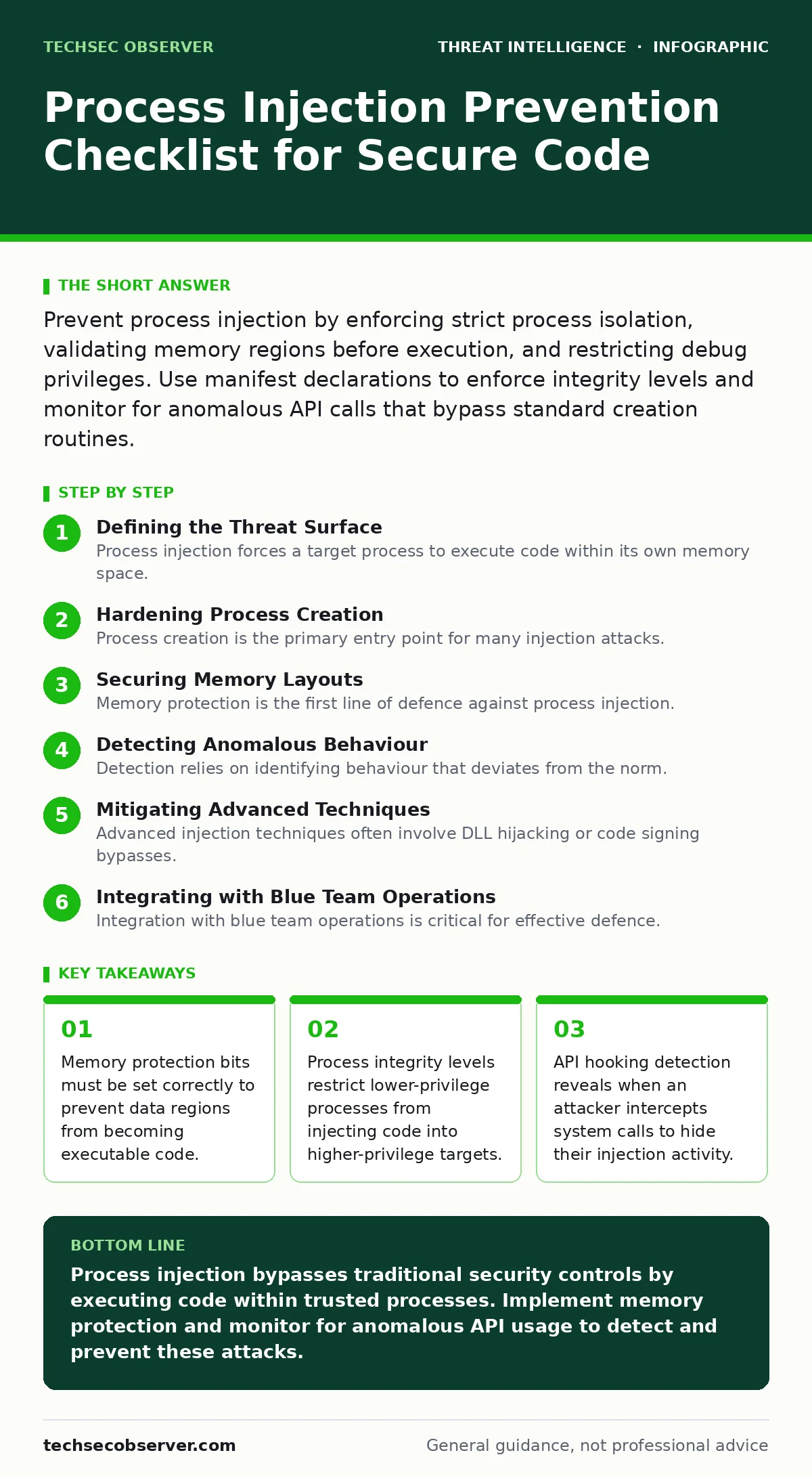
Prevent process injection by enforcing strict process isolation, validating memory regions before execution, and restricting debug privileges. Use manifest declarations to enforce integrity levels and monitor for anomalous API calls that bypass standard creation routines.
Defining the Threat Surface
Process injection forces a target process to execute code within its own memory space. This technique bypasses application whitelisting because the executing binary remains legitimate. Attackers use this method to hide malicious activity under the guise of trusted system processes. You must understand that standard antivirus signatures often fail here because the injected code resides in memory, not on disk. The goal is to make the memory environment hostile to unauthorised code execution.
Hardening Process Creation
- Enforce User Account Control: Prevents standard users from modifying system-wide process states.
- Restrict CreateProcess API access: Limits the ability to spawn new processes with elevated privileges.
- Validate command-line arguments: Stops injection via crafted arguments that trigger unintended execution paths.
- Disable unnecessary services: Reduces the number of potential host processes for injection.
- Apply least privilege to service accounts: Limits the damage if a service process is compromised.
Process creation is the primary entry point for many injection attacks. If an attacker cannot create a new process, they must inject into an existing one. Restricting the CreateProcess API and similar functions reduces the attack surface. You should also validate command-line arguments to prevent argument injection, which can lead to unintended process execution. Disabling unnecessary services removes potential host processes that attackers might target for injection.
Securing Memory Layouts
- Enable Data Execution Prevention: Marks memory regions as non-executable to stop code from running in data areas.
- Use Address Space Layout Randomisation: Randomises memory addresses to make prediction of injection points difficult.
- Implement Control Flow Guard: Validates indirect calls to ensure they point to legitimate function entry points.
- Disable ASLR bypass techniques: Prevents attackers from using information leaks to defeat randomisation.
- Monitor memory allocation patterns: Detects unusual memory requests that may indicate injection preparation.
Memory protection is the first line of defence against process injection. Data Execution Prevention ensures that memory regions marked for data storage cannot execute code. Address Space Layout Randomisation makes it difficult for attackers to predict where to inject their code. Control Flow Guard validates indirect function calls, preventing attackers from hijacking the execution flow. You must also monitor memory allocation patterns to detect unusual requests that may indicate preparation for an injection attack.
Detecting Anomalous Behaviour
- Monitor for suspicious API calls: Flags unusual use of
WriteProcessMemoryorVirtualAllocEx. - Analyse process tree anomalies: Detects orphaned processes or unexpected parent-child relationships.
- Track file system changes: Identifies new files created in temporary directories that may contain injected code.
- Use user and entity behavior analytics: Baseline normal process behaviour to spot deviations indicative of injection.
- Check for debug privilege abuse: Detects when processes attempt to attach debuggers to other processes.
Detection relies on identifying behaviour that deviates from the norm. Suspicious API calls, such as WriteProcessMemory, are strong indicators of injection attempts. Analysing the process tree helps identify orphaned processes or unexpected parent-child relationships that may result from injection. Tracking file system changes can reveal new files created in temporary directories, which may contain injected code. User and entity behavior analytics provide a baseline for normal process behaviour, allowing you to spot deviations.
Mitigating Advanced Techniques
- Restrict DLL search order: Prevents DLL hijacking, a common precursor to injection.
- Validate signed modules: Ensures only trusted code is loaded into the process address space.
- Implement code signing: Verifies the integrity of executables and libraries before execution.
- Monitor for hooking: Detects when attackers intercept system calls to hide their activity.
- Use remote desktop abuse prevention: Limits lateral movement that often accompanies injection attacks.
Advanced injection techniques often involve DLL hijacking or code signing bypasses. Restricting the DLL search order prevents attackers from loading malicious libraries. Validating signed modules ensures that only trusted code is loaded into the process address space. Implementing code signing verifies the integrity of executables and libraries before execution. Monitoring for hooking detects when attackers intercept system calls to hide their activity. Preventing remote desktop abuse limits lateral movement that often accompanies injection attacks.
See also: Active Directory Attack Warning Signs Early Detection Methods · What is Dwell Time: Why Detection Latency Dictates Breach Severity
Integrating with Blue Team Operations
- Share IOCs with blue team operations: Enables rapid detection and response to new injection techniques.
- Conduct purple teaming exercises: Tests the effectiveness of your detection and prevention controls.
- Review attacker persistence techniques: Understands how injection is used to maintain access after initial compromise.
- Analyse LSASS credential theft: Identifies injection into the LSASS process to steal credentials.
- Monitor for domain fronting: Detects C2 traffic that may be used to deliver injection payloads.
Integration with blue team operations is critical for effective defence. Sharing indicators of compromise enables rapid detection and response to new injection techniques. Conducting purple teaming exercises tests the effectiveness of your detection and prevention controls. Reviewing attacker persistence techniques helps you understand how injection is used to maintain access after initial compromise. Analysing LSASS credential theft identifies injection into the LSASS process to steal credentials. Monitoring for domain fronting detects command and control traffic that may deliver injection payloads.
Key takeaways
- Memory protection bits must be set correctly to prevent data regions from becoming executable code.
- Process integrity levels restrict lower-privilege processes from injecting code into higher-privilege targets.
- API hooking detection reveals when an attacker intercepts system calls to hide their injection activity.
Process injection bypasses traditional security controls by executing code within trusted processes. Implement memory protection and monitor for anomalous API usage to detect and prevent these attacks.
Frequently asked questions
How does process injection differ from DLL injection?
Process injection is a broader term that includes injecting code into a process, while DLL injection specifically involves loading a malicious dynamic link library into a target process.
Can antivirus software detect process injection?
Traditional antivirus software may struggle to detect process injection because the malicious code resides in memory. Behavioural analysis and endpoint detection and response tools are more effective.
What is the role of Data Execution Prevention in preventing injection?
Data Execution Prevention marks memory regions as non-executable, preventing code from running in data areas. This makes it difficult for attackers to execute injected code.
How can I prevent DLL hijacking?
Restrict the DLL search order and validate signed modules to ensure only trusted code is loaded. Implement code signing to verify the integrity of executables and libraries.
How this guide was produced: written by the TechSec Observer editorial team with AI assistance, checked against the public references listed below, and reviewed when the facts change. See our editorial policy or report an error.