Neural networks for small businesses: practical security risks
Small organisations adopt automated decision systems without realising that local data processing creates hidden operational dependencies.

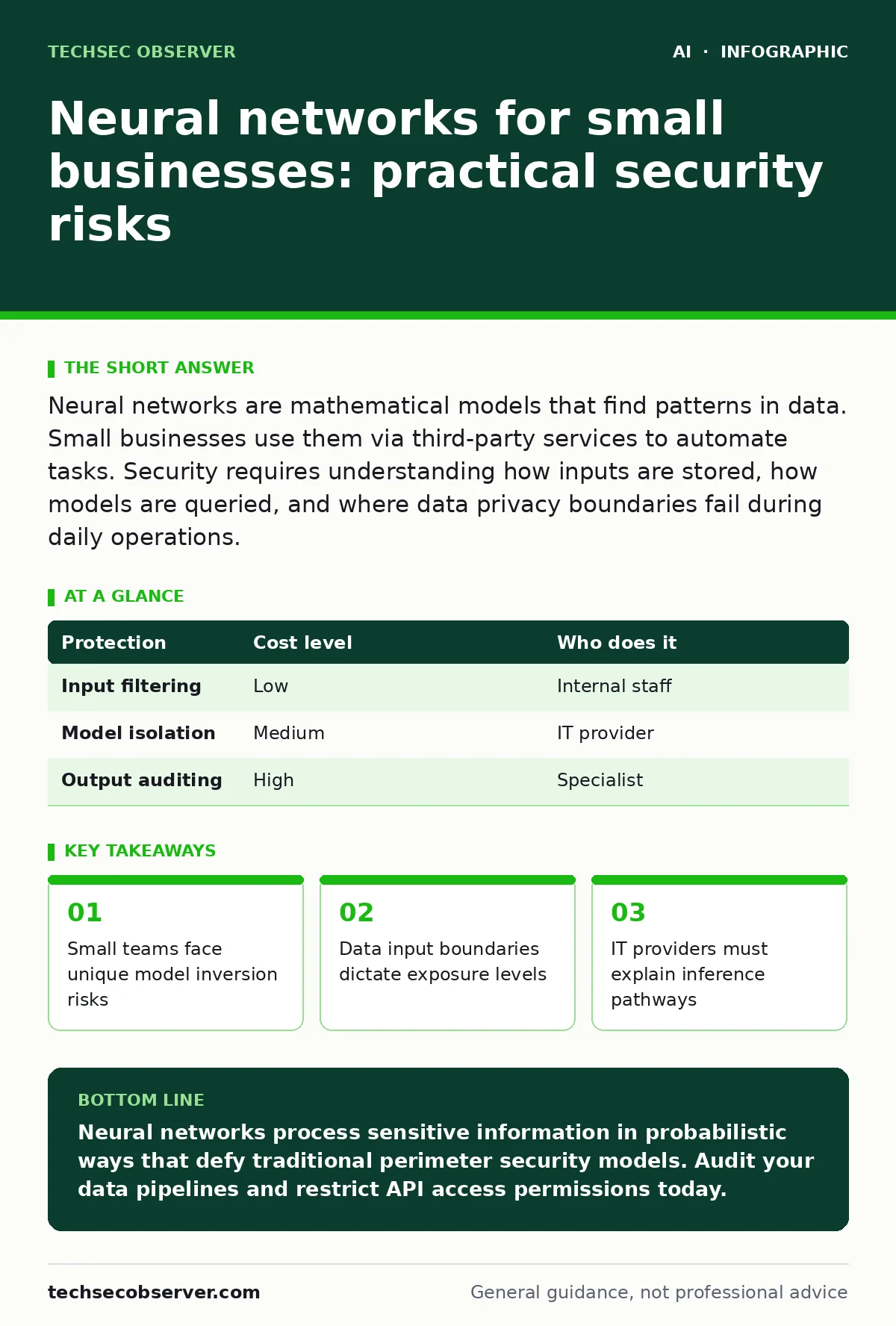
Neural networks are mathematical models that find patterns in data. Small businesses use them via third-party services to automate tasks. Security requires understanding how inputs are stored, how models are queried, and where data privacy boundaries fail during daily operations.
Why neural networks matter at small scale
Small organisations often deploy machine learning tools without dedicated security personnel, treating complex algorithms like standard software libraries. Automated systems process customer queries, financial records, and proprietary designs through external application programming interfaces. Adopting these tools introduces architectural risks that traditional firewalls fail to address. Understanding how neural networks process information helps technical managers secure their operational edges.
Decentralised tool adoption creates severe visibility gaps across modern enterprises. Employees frequently paste internal source code into public interfaces to generate documentation, creating significant shadow AI challenges that bypass traditional perimeter defenses. Managing this unstructured usage requires clear policies regarding which datasets may touch external inference engines.
The architecture of automated decision tools
Neural networks consist of layered nodes that transform numerical inputs into weighted probabilities. Each layer extracts increasingly abstract features from raw data, whether processing text, images, or numerical transactions. Small businesses rarely train these models from scratch; instead, they fine-tune existing architectures or query hosted endpoints managed by third-party infrastructure providers.
Pre-trained weights dictate how a model responds to specific prompts, but those same weights can sometimes be reverse-engineered by malicious actors. Attackers reconstruct training instances from model outputs through systematic querying techniques. Securing your business operations requires recognising that the software does not merely process data; it sometimes memorises subtle patterns present in the original training data leakage scenarios.
Hidden operational dependencies and data flow
Data pipelines connect local client devices to remote inference servers, creating multiple interception points along the journey. Client applications send raw text or images across public networks where intermediate proxies might log sensitive parameters. Securing these pathways demands end-to-end transport encryption combined with strict validation of all incoming and outgoing payloads.
Local caching mechanisms inside web browsers often retain intermediate model states and user inputs long after a session closes. Forensic recovery tools extract these cached prompts from standard workstation storage drives, exposing confidential business logic to anyone with physical or remote access to the machine. Developers must configure applications to clear local memory buffers immediately after inference tasks finish.
Practical deployment strategies for lean teams
Lean teams must implement strict access controls around any endpoint that connects internal databases to automated decision systems. Restricting API keys to specific network ranges stops external actors from hijacking your organisation's quota or poisoning your classification pipelines. Monitoring outgoing payload sizes helps detect unauthorised data exfiltration disguised as routine background telemetry.
Input sanitisation prevents malicious actors from manipulating model behavior through clever prompt engineering. Treating natural language instructions as executable code allows attackers to bypass safety filters embedded within the neural network architecture. Sanitising pipelines strip out control characters and hidden instructions before the data reaches the primary processing nodes.
| Protection | Cost level | Who does it |
|---|---|---|
| Input filtering | Low | Internal staff |
| Model isolation | Medium | IT provider |
| Output auditing | High | Specialist |
Evaluating risk through structured protection
Layered defenses mitigate common failure modes associated with probabilistic software outputs. Technical supervisors should audit third-party vendors for compliance with established data protection frameworks before signing service agreements. Effective AI governance frameworks establish clear boundaries regarding model ownership, liability for erroneous decisions, and mandatory incident reporting timelines.
Automated logging captures anomalous model behaviour, such as sudden spikes in token consumption or unusual classification drift. Reviewing these logs weekly highlights potential intrusion attempts before operational disruption occurs. Establishing baseline metrics for normal query patterns makes identifying malicious probing attempts significantly faster.
See also: People-Search Sites: Risks and Protection for Small Businesses · Secure macOS for Small Teams: Practical Settings and Delegation
Questions for your technology partner
Outsourcing infrastructure does not transfer the ultimate operational liability for data breaches away from your business. Technical managers must interrogate vendors regarding their specific data retention schedules and model training practices. Asking precise questions ensures your technology partners maintain adequate safeguards for your proprietary information.
- Where are our input prompts stored after the inference cycle completes?
- How do your systems handle multi-tenant isolation within shared model environments?
- What mechanisms prevent our proprietary data from entering future public model training runs?
- Can you provide audit logs detailing every external API call originating from our local network?
- Which fallback procedures operate when the primary model hosting infrastructure experiences an outage?
Key takeaways
- Small teams face unique model inversion risks
- Data input boundaries dictate exposure levels
- IT providers must explain inference pathways
Neural networks process sensitive information in probabilistic ways that defy traditional perimeter security models. Audit your data pipelines and restrict API access permissions today.
Frequently asked questions
Can a neural network completely replace human judgment in small business workflows?
Automated systems lack contextual awareness and frequently generate plausible falsehoods, meaning human oversight remains mandatory for critical decisions.
How do malicious actors extract sensitive information from a hosted neural network?
Attackers use systematic queries to map model responses, gradually reconstructing the underlying patterns and memorised training data.
Are local models safer than cloud-hosted neural network services?
Running models locally keeps data inside your physical perimeter, but small businesses rarely possess the hardware required to maintain them securely.
What causes classification drift in operational neural networks?
Changing real-world data patterns diverge from the original training distribution, causing the model to produce increasingly inaccurate predictions over time.
How this guide was produced: written by the TechSec Observer editorial team with AI assistance, checked against the public references listed below, and reviewed when the facts change. See our editorial policy or report an error.