Shadow AI Risks: How Unsanctioned Models Compromise Your Data
Unapproved AI tools create invisible data exfiltration channels that bypass your security controls and expose intellectual property to public model training.

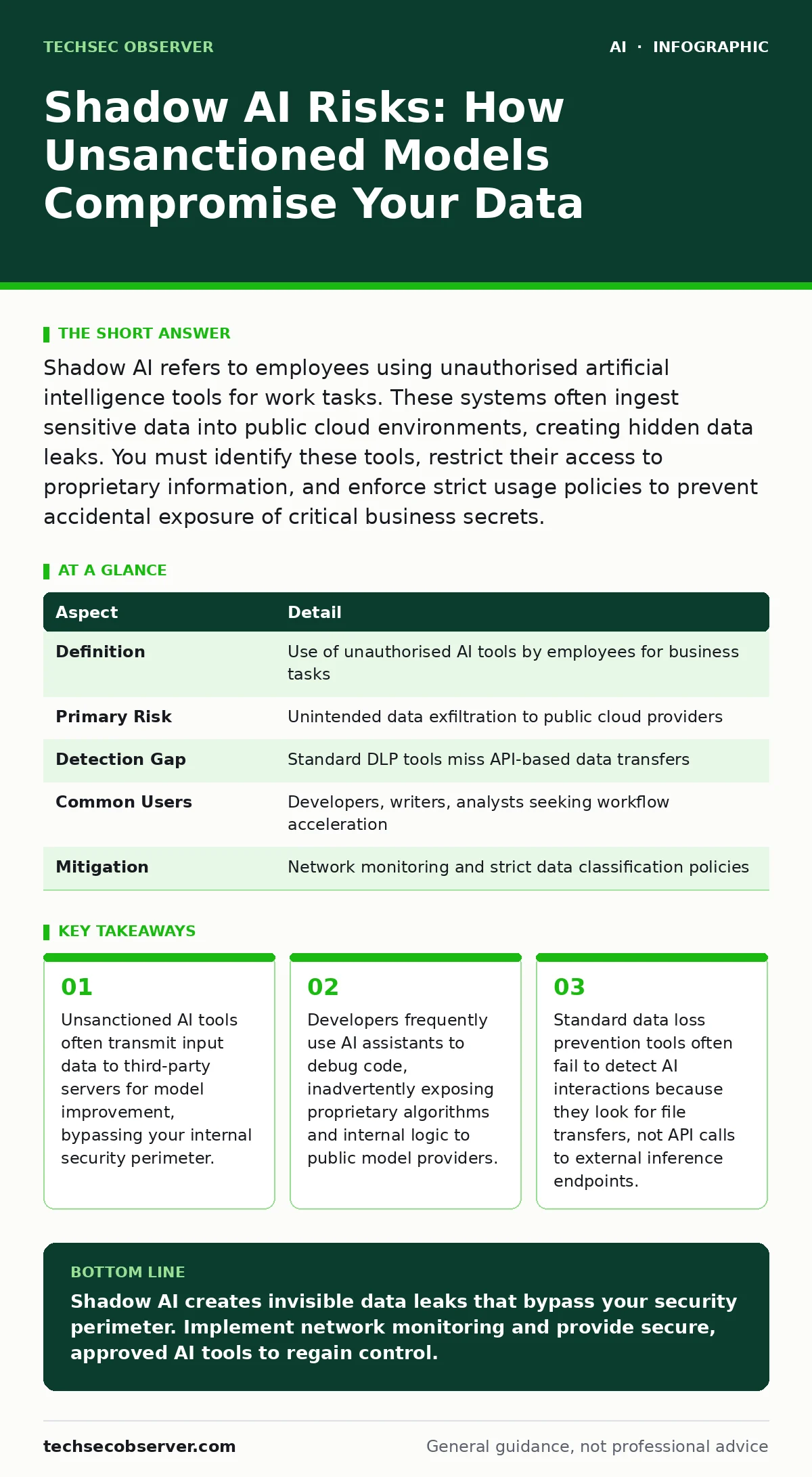
Shadow AI refers to employees using unauthorised artificial intelligence tools for work tasks. These systems often ingest sensitive data into public cloud environments, creating hidden data leaks. You must identify these tools, restrict their access to proprietary information, and enforce strict usage policies to prevent accidental exposure of critical business secrets.
What is shadow AI
Shadow AI describes the use of artificial intelligence applications within an organisation without the knowledge or approval of the IT and security teams. Imagine a library where patrons secretly photocopy restricted archives and mail them to unknown recipients. The organisation loses control over the information, yet the act appears as normal daily activity.
This phenomenon occurs when staff members subscribe to personal AI services to accelerate their workflow. They might use chatbots for drafting emails, coding assistants for writing scripts, or image generators for marketing materials. The tools function effectively, but the organisation cannot audit the data flowing into them. You lose visibility over where your intellectual property resides once it leaves your secure environment.
At a glance
| Aspect | Detail |
|---|---|
| Definition | Use of unauthorised AI tools by employees for business tasks |
| Primary Risk | Unintended data exfiltration to public cloud providers |
| Detection Gap | Standard DLP tools miss API-based data transfers |
| Common Users | Developers, writers, analysts seeking workflow acceleration |
| Mitigation | Network monitoring and strict data classification policies |
How shadow AI works in practice
The mechanism relies on the fundamental architecture of large language models. Most consumer-facing AI services require users to send prompts to remote servers. These servers process the input and return a generated response. The provider often retains the input data to improve their models. When an employee pastes a confidential contract into a public chatbot, that text becomes part of the provider’s training dataset.
The data transfer happens over standard HTTPS traffic. Your firewall sees encrypted web traffic to a known domain. It does not inspect the payload for sensitive keywords unless you deploy deep packet inspection, which is resource-intensive. The AI provider receives the data, processes it, and may use it to refine their algorithms. Your sensitive information is now embedded in a model that could theoretically regenerate parts of it for other users.
Who is affected by shadow AI
You might assume only junior staff fall into this trap. The reality is different. Senior engineers and data scientists are the primary drivers of shadow AI. They need powerful tools to solve complex problems quickly. A developer facing a tight deadline will not wait for IT to approve a secure AI instance. They will use the tool that works immediately.
Marketing teams also contribute significantly. They generate creative assets using public image generators. These prompts often contain brand guidelines, campaign strategies, and unreleased product details. Legal departments might use AI to summarise case law, inadvertently uploading privileged client communications. The risk scales with the seniority of the user because they handle more sensitive data.
shadow ai risks to your organisation
The immediate danger is data leakage. You lose control over your intellectual property. Competitors or malicious actors could potentially access this information if the AI provider suffers a breach or if their models allow inference attacks. The long-term risk is compliance failure. Regulations often require strict controls over personal and financial data. Using unapproved tools violates these controls, exposing the organisation to legal penalties.
Another risk is model poisoning. If your data influences a public model, you might inadvertently introduce biases or errors that affect other users. This creates reputational damage. Furthermore, shadow AI tools often lack enterprise-grade security features. They do not support single sign-on, audit logging, or data residency controls. You cannot verify who accessed the data or when. This opacity makes incident response nearly impossible.
What people usually get wrong
Many organisations believe that blocking access to AI websites solves the problem. This approach fails because determined users find workarounds. They use personal devices, mobile data, or virtual private networks to bypass network restrictions. Blocking does not address the underlying motivation: the need for productivity tools.
Another misconception is that only unstructured text is at risk. Code, spreadsheets, and configuration files are equally vulnerable. Developers often paste entire files into AI assistants to explain their function. This exposes the full structure of your application. You must treat all data types as sensitive. Treating AI usage as a minor policy violation ignores the severe technical consequences. It is a data security issue, not just a tooling preference.
How to manage and mitigate the risks
You need a strategy that combines visibility with approved alternatives. First, identify where shadow AI is happening. Monitor network logs for requests to known AI provider domains. Look for unusual outbound traffic patterns. Implement data loss prevention rules that flag sensitive keywords in clipboard data. If an employee copies a large block of code, trigger an alert.
Second, provide sanctioned AI tools. If staff cannot use public tools, they will find ways to do so. Deploy enterprise-grade AI solutions that keep data within your environment. These tools should offer audit trails and data isolation. They must integrate with your existing identity management systems. This ensures you know who is using the AI and what they are asking.
Third, enforce strict data classification. Mark sensitive documents with clear labels. Configure your approved AI tools to reject prompts containing classified data. This technical guardrail prevents accidental uploads. Regularly review access logs to detect anomalies. Combine these technical measures with clear policies. Explain the risks and the available tools. Make the secure path the easy path.
Integrating with broader AI security
Shadow AI management does not exist in isolation. It connects to wider security practices. You should align your controls with AI governance frameworks to ensure consistency. Regular AI red teaming can help you test how well your policies hold up against determined users. Consider AI model monitoring for your approved tools to detect misuse.
If you use AI for defence, AI-assisted threat detection can help spot shadow AI activity faster. Be aware of prompt injection attacks that might exploit unsanctioned models. Protect your infrastructure from malware that targets AI infrastructure. Ensure your exposed AI model servers are properly secured. Understand the risks of jailbreaking AI chatbots that might bypass your restrictions. These elements form a cohesive defence strategy.
Key takeaways
- Unsanctioned AI tools often transmit input data to third-party servers for model improvement, bypassing your internal security perimeter.
- Developers frequently use AI assistants to debug code, inadvertently exposing proprietary algorithms and internal logic to public model providers.
- Standard data loss prevention tools often fail to detect AI interactions because they look for file transfers, not API calls to external inference endpoints.
Shadow AI creates invisible data leaks that bypass your security perimeter. Implement network monitoring and provide secure, approved AI tools to regain control.
Frequently asked questions
Can I detect shadow AI without installing agent software on every device?
Yes, by monitoring network traffic for connections to known AI provider domains and analysing outbound data patterns for anomalies.
Does using a private browser mode prevent data leakage to AI providers?
No, private mode only clears local history. The AI provider still receives and potentially stores the data sent to their servers.
Is it legal to use shadow AI for personal tasks on work devices?
It depends on your organisation’s acceptable use policy. Most companies prohibit unauthorised software, regardless of the task’s nature.
How do I handle legacy code that was written with public AI tools?
Treat it as potentially tainted. Review the code for hardcoded secrets or proprietary logic exposure. Refactor critical sections if necessary.
How this guide was produced: written by the TechSec Observer editorial team with AI assistance, checked against the public references listed below, and reviewed when the facts change. See our editorial policy or report an error.