Social Media Privacy Risks: How Data Leaks Happen and How to Stop Them
Your social media activity builds a profile that persists long after you delete accounts, often revealing more than you intend through metadata and network analysis.

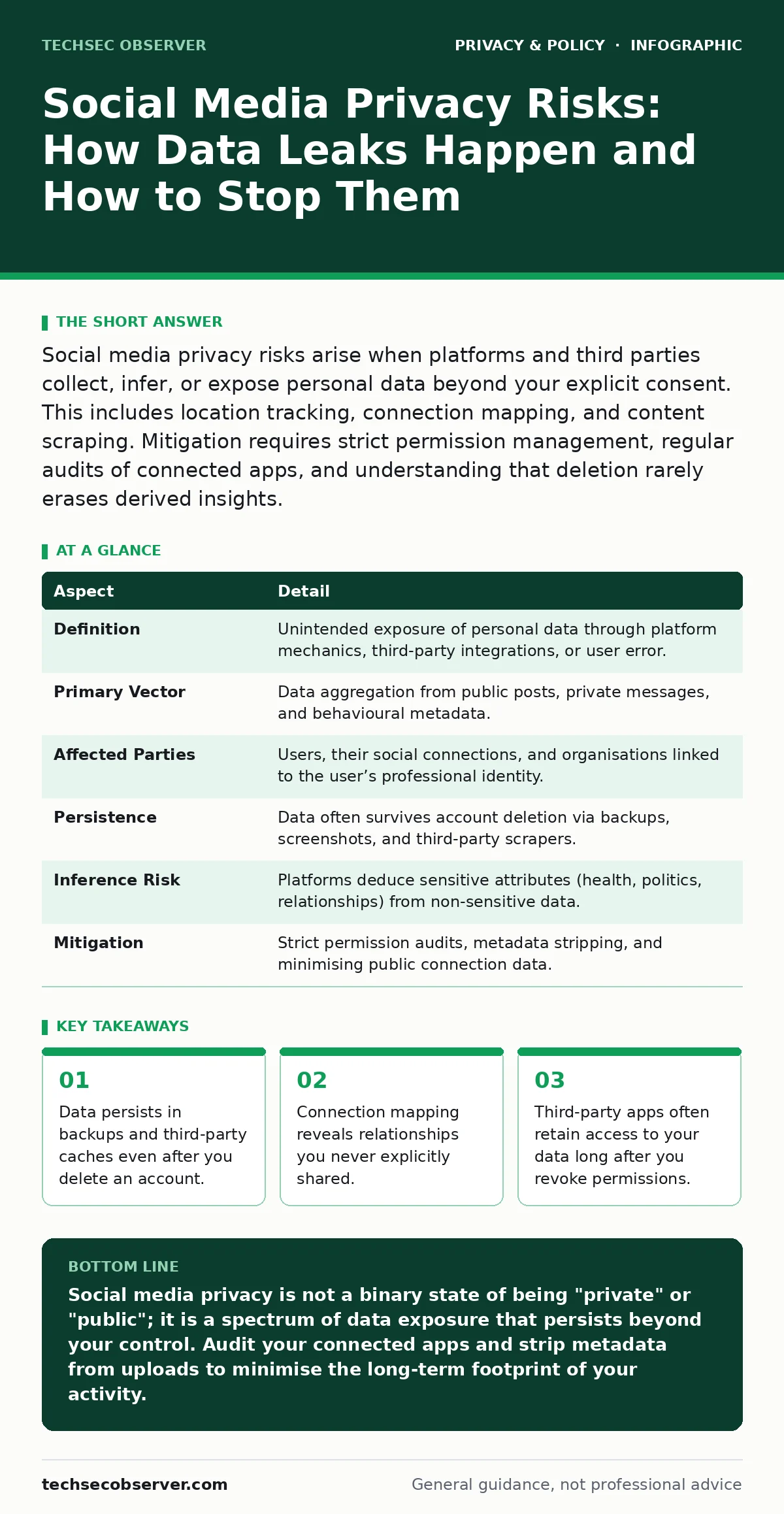
Social media privacy risks arise when platforms and third parties collect, infer, or expose personal data beyond your explicit consent. This includes location tracking, connection mapping, and content scraping. Mitigation requires strict permission management, regular audits of connected apps, and understanding that deletion rarely erases derived insights.
The Glass House Analogy
Imagine living in a house made entirely of glass. You can draw the curtains, but the neighbours still see your movements through the windows. Social media platforms operate similarly. You control the content you post, but the platform controls the structure of the house, the windows, and who can look inside. The privacy risk is not just about what you say; it is about the context in which you say it.
This context includes when you post, where you are, who you talk to, and how long you linger on a page. These signals create a profile that is far more detailed than your public bio. The platform aggregates these signals to predict your behaviour, sell targeted advertising, or, in some cases, expose your data to external breaches.
| Aspect | Detail |
|---|---|
| Definition | Unintended exposure of personal data through platform mechanics, third-party integrations, or user error. |
| Primary Vector | Data aggregation from public posts, private messages, and behavioural metadata. |
| Affected Parties | Users, their social connections, and organisations linked to the user’s professional identity. |
| Persistence | Data often survives account deletion via backups, screenshots, and third-party scrapers. |
| Inference Risk | Platforms deduce sensitive attributes (health, politics, relationships) from non-sensitive data. |
| Mitigation | Strict permission audits, metadata stripping, and minimising public connection data. |
How Exposure Occurs
The mechanism of exposure is rarely a single breach. It is usually a slow leak of contextual data. When you log in, the platform records your device fingerprint. This includes your browser type, operating system, and screen resolution. Combined with your login time and location, this creates a unique identifier. Even if you use a pseudonym, this technical footprint can link your anonymous activity to your real identity.
Metadata is the silent carrier of privacy risks. Every photo you upload contains Exif data. This data records the precise GPS coordinates of where the photo was taken, the time, and the camera model. If you do not strip this metadata before uploading, you reveal your home address or workplace location. Many users believe that setting an account to "private" protects this data. It does not. The platform still collects and stores the metadata for its own purposes.
The Role of Connections
Your privacy is not solely dependent on your own settings. It is also dependent on the settings of people you interact with. If a friend tags you in a post, that post may become visible to their followers, even if your account is private. This is known as a social graph leak. The platform’s algorithm prioritises engagement, often pushing tagged content to wider audiences than the original poster intended.
Furthermore, the platform maps your relationships. It analyses who you message, who you like, and who you visit frequently. This creates a graph of your social network. Researchers and malicious actors can use this graph to infer sensitive information. For instance, if you frequently interact with pages related to a specific medical condition, the platform may infer that you have that condition, even if you never posted about it. This inferred data is often sold to advertisers or used to refine predictive models.
Third-Party Integrations
Most users connect social media accounts to other services. You might use your social login to access a news site, a game, or a shopping platform. This convenience creates a massive attack surface. When you grant permission, you are often allowing the third party to access your profile, friend list, and sometimes your posts.
The danger lies in the persistence of these permissions. Many users revoke access in their social media settings, but the third-party service may have already copied the data. There is no standard mechanism to force a third party to delete data once it has been collected. Furthermore, if the third-party service suffers a breach, your social media data is compromised. The breach may not be on the social platform itself, but the data originated there.
Common Misconceptions
Many users believe that deleting a post removes it from the internet. This is incorrect. While the post disappears from the platform’s main feed, it may remain in search engine caches, archive sites, or screenshots. Digital content is copied faster than it can be deleted. The only true deletion is preventing the initial upload.
Another common error is the belief that "private" accounts are secure against all threats. Private accounts protect against casual outsiders, but not against platform insiders, automated scrapers, or friends who leak data. Additionally, metadata often travels with private posts. The platform’s servers still see the full data payload, including location and device info, regardless of your audience settings.
People often overlook the risk of people-search sites. These aggregators pull data from public records and social media profiles. Even if you delete your social media account, your name, address, and phone number may remain on these sites. This creates a persistent link between your online and offline identities. To understand how to manage this, you might look into reducing your digital footprint.
See also: Private file sharing services: secure transfer workflows · Block Wi-Fi Finder Apps From Mapping Your Network
Reducing the Risk
Mitigation requires a shift from reactive cleaning to proactive minimisation. Start by auditing your connected apps. Remove access for any service you do not actively use. Check the permissions each app has. Does a weather app need access to your friend list? If so, revoke it. This limits the blast radius of a potential breach.
Manage your metadata carefully. Before uploading photos, use a tool to strip Exif data. Many modern operating systems and privacy-focused browsers offer built-in features to do this automatically. If you are using a standard browser, consider extensions that block metadata injection. However, be aware that some platforms strip metadata server-side, while others do not. Do not rely on the platform to protect you.
Review your privacy settings regularly. Platforms change these settings by default. A setting that was "private" last year may become "public" after an update. Check who can see your friends list, who can tag you, and who can find you by email or phone number. Disable search engine indexing for your profile if the option exists.
The Hidden Cost of Convenience
The trade-off for social media is always data. The platform provides a free service in exchange for behavioural data. This is the core business model. Understanding this helps you make informed choices. You cannot stop the platform from collecting data, but you can limit the amount and sensitivity of that data.
Consider the long-term impact of your digital presence. Employers, partners, and adversaries can piece together a narrative from your fragmented posts. This narrative may not reflect your current views or actions. It is a static snapshot of past behaviour. To build a more secure digital life, consider adopting privacy by design principles in your own projects and daily habits.
Furthermore, be mindful of legitimate interest under the GDPR. Platforms often claim they have a legitimate interest in processing your data for advertising. This legal basis allows them to process data without explicit consent in many jurisdictions. Understanding this legal framework helps you realise that opting out is often difficult and that data collection is the default state.
Key takeaways
- Data persists in backups and third-party caches even after you delete an account.
- Connection mapping reveals relationships you never explicitly shared.
- Third-party apps often retain access to your data long after you revoke permissions.
Social media privacy is not a binary state of being "private" or "public"; it is a spectrum of data exposure that persists beyond your control. Audit your connected apps and strip metadata from uploads to minimise the long-term footprint of your activity.
Frequently asked questions
Does deleting my social media account remove all my data?
No. While the platform may delete your primary profile data, backups, cached versions, and data shared with third parties often remain. Contact the platform for their specific data retention policy.
Can I stop the platform from tracking my location?
You can disable location services for the app in your device settings. This prevents the app from accessing your GPS, but you may still reveal location through IP address or metadata in uploaded photos.
Are private messages truly private?
They are private from the public, but not necessarily from the platform. Many platforms scan messages for spam, abuse, or advertising targeting. End-to-end encryption, if available, protects messages from the platform itself.
How do I know if a third-party app is safe?
You generally cannot. Assume any third-party app may store your data insecurely. The safest approach is to avoid connecting social accounts to third-party services whenever possible.
How this guide was produced: written by the TechSec Observer editorial team with AI assistance, checked against the public references listed below, and reviewed when the facts change. See our editorial policy or report an error.