Legitimate Interest Under GDPR: Meaning, Definition and Practical Application
Legitimate interest allows lawful data processing without consent, but only when your needs do not override the individual's fundamental privacy rights.

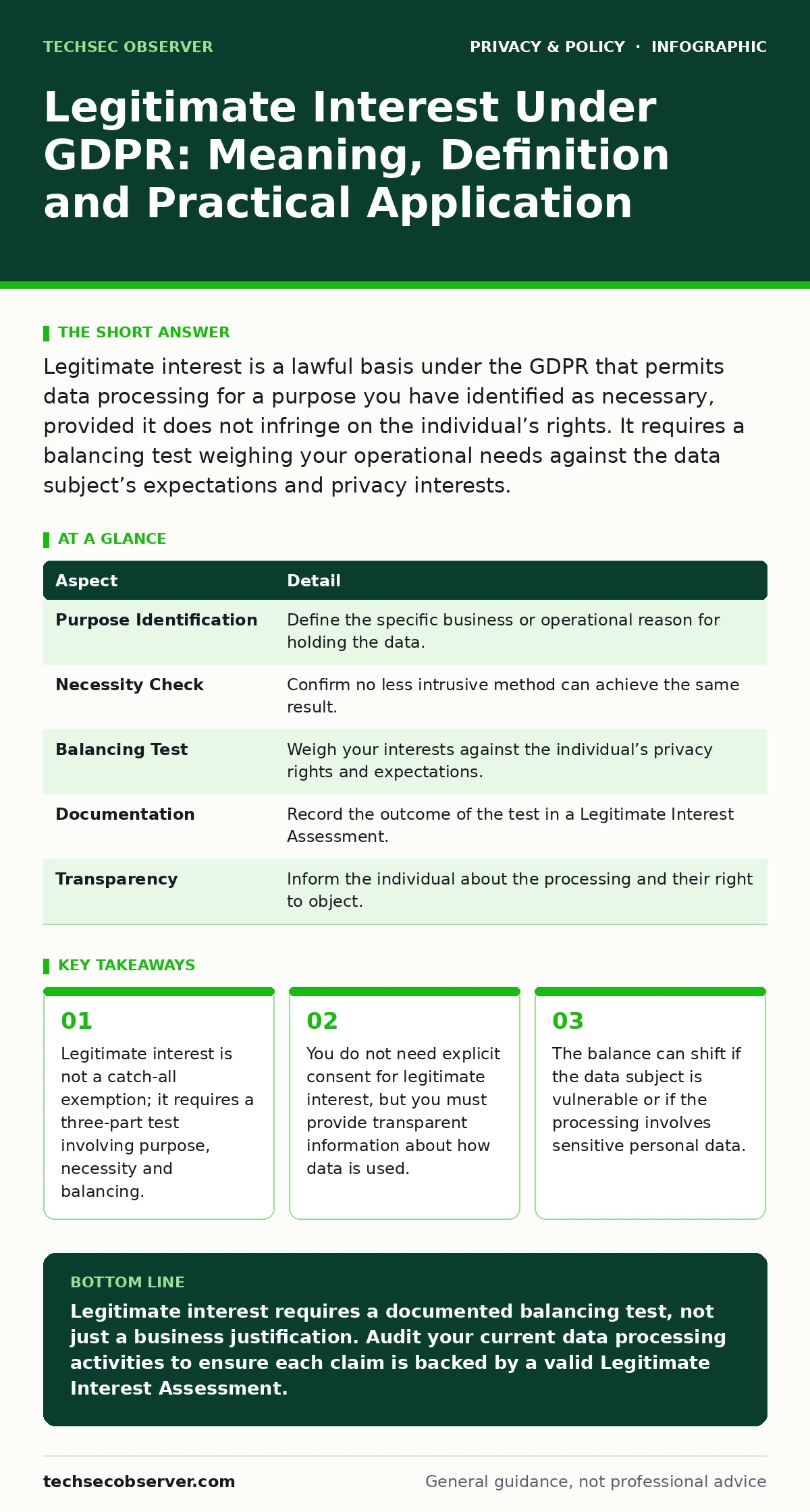
Legitimate interest is a lawful basis under the GDPR that permits data processing for a purpose you have identified as necessary, provided it does not infringe on the individual’s rights. It requires a balancing test weighing your operational needs against the data subject’s expectations and privacy interests.
The Bank Vault Analogy
Imagine you run a secure facility. You need to know who enters to prevent theft, but you do not need to inspect their pockets. Consent is like asking permission to look in every bag before entry. Legitimate interest is the security camera at the door. You justify it because protecting assets is a clear, defined purpose. You do not ask permission for every visitor, but you must ensure the cameras do not spy on private areas. This distinction separates operational necessity from intrusive surveillance.
The Three-Part Test Framework
The regulation does not define "legitimate interest" with a simple dictionary entry. Instead, it provides a mechanism for organisations to justify their own reasons for processing data. This mechanism relies on a structured evaluation known as the three-part test. You must identify a legitimate purpose, demonstrate that the processing is necessary to achieve it, and then balance that need against the individual’s rights. This framework forces you to articulate why you hold data rather than simply collecting it by default.
| Aspect | Detail |
|---|---|
| Purpose Identification | Define the specific business or operational reason for holding the data. |
| Necessity Check | Confirm no less intrusive method can achieve the same result. |
| Balancing Test | Weigh your interests against the individual’s privacy rights and expectations. |
| Documentation | Record the outcome of the test in a Legitimate Interest Assessment. |
| Transparency | Inform the individual about the processing and their right to object. |
How It Functions in Daily Operations
In practice, this basis supports routine activities that would halt if consent were required. Consider direct marketing to existing customers for similar products. You likely have a legitimate interest in informing them, provided they have not opted out. Network security is another common application. Monitoring traffic to detect malware serves a clear interest in system integrity.
However, this does not grant unlimited access to user content. You monitor the flow for anomalies, not the substance of private communications. Understanding these boundaries prevents mission creep, where data collected for one purpose is reused for another without re-evaluation. For more on technical boundaries, see our guide on privacy by design.
The Balancing Test in Depth
The most complex part of this basis is the balancing test. This is not a mathematical calculation but a reasoned argument. You must consider the nature of the data, the impact on the individual and the safeguards in place. If you process data that reveals health conditions, the bar for necessity is higher. If the individual is a child, their expectation of privacy is stronger. You must ask whether the person would reasonably expect you to process this information. Surprise is a strong indicator that the balance has tipped against you. If the processing feels like a hidden tracking mechanism, it likely fails the test.
Common Misconceptions and Pitfalls
Many organisations treat legitimate interest as a weaker form of consent. This is incorrect. It is a different legal foundation with different requirements. The most frequent error is assuming that because processing is "normal" for the industry, it is automatically lawful. Industry practice does not equal legal justification. Another pitfall is ignoring the right to object.
Under this basis, individuals can object to processing at any time. You must stop unless you can demonstrate compelling legitimate grounds that override their interests. This is a high threshold. Failing to have a clear objection process invalidates the entire justification. For related risks, consult our section on cookie consent management.
See also: How Data Exfiltration Works: The Silent Stages of Theft · People-Search Sites: Risks and Protection for Small Businesses
The Hidden Cost of Documentation
You must document your reasoning. This is called a Legitimate Interest Assessment (LIA). It records the purpose, the necessity check and the balancing outcome. This document is not optional. Regulators will ask for it during audits. If you cannot produce a coherent LIA, you cannot claim the basis. This creates an administrative burden. You must review these assessments periodically. If your data practices change, the old assessment may no longer apply. This ongoing maintenance is the hidden cost of choosing this basis over consent. It requires legal and technical teams to collaborate on risk evaluation.
When It Fails Completely
Legitimate interest is not available for all data types. You cannot use it to process special category data, such as health or biometric information, unless specific exceptions apply. These exceptions are narrow and rarely overlap with general business interests. It also fails when the processing is incompatible with the original purpose. If you collected data for billing and now want to use it for credit scoring, you must re-evaluate. The original interest in billing does not extend to financial profiling. Attempting to stretch the basis beyond its limits exposes you to significant compliance risk. For insights on data minimisation, see reducing your digital footprint.
Practical Steps for Implementation
Start by mapping your data flows. Identify where you rely on legitimate interest. For each instance, draft an LIA. Involve technical staff to assess necessity. Can you achieve the goal with aggregated data instead of personal data? If yes, do that. Then, review your privacy notices. They must clearly state the legal basis and the right to object. Finally, establish a process for handling objections. This ensures you can respond quickly and legally. Regular audits help maintain compliance as your services evolve. For technical privacy measures, refer to privacy-focused browsers.
Key takeaways
- Legitimate interest is not a catch-all exemption; it requires a three-part test involving purpose, necessity and balancing.
- You do not need explicit consent for legitimate interest, but you must provide transparent information about how data is used.
- The balance can shift if the data subject is vulnerable or if the processing involves sensitive personal data.
Legitimate interest requires a documented balancing test, not just a business justification. Audit your current data processing activities to ensure each claim is backed by a valid Legitimate Interest Assessment.
Frequently asked questions
Can I use legitimate interest for marketing emails to new prospects?
Generally no. Cold marketing to individuals usually requires consent. Legitimate interest is rarely sufficient for direct marketing to people who do not already have a relationship with you.
What happens if a user objects to processing under legitimate interest?
You must stop processing that specific data unless you can demonstrate compelling legitimate grounds that override their interests. This is difficult to prove, so stopping is the safe default.
Is legitimate interest a global standard?
No. It is specific to the GDPR and similar frameworks like the UK GDPR. Other jurisdictions may have different lawful bases or requirements for consent.
How often should I review my Legitimate Interest Assessments?
Review them whenever your processing activities change significantly or at least annually. Changes in technology, law or business strategy can alter the balance of interests.
How this guide was produced: written by the TechSec Observer editorial team with AI assistance, checked against the public references listed below, and reviewed when the facts change. See our editorial policy or report an error.