Training Data Leakage Mistakes and How to Fix Them
Neural networks memorise rare, unrepeated strings more reliably than frequent patterns, turning routine deduplication into a direct privacy risk.

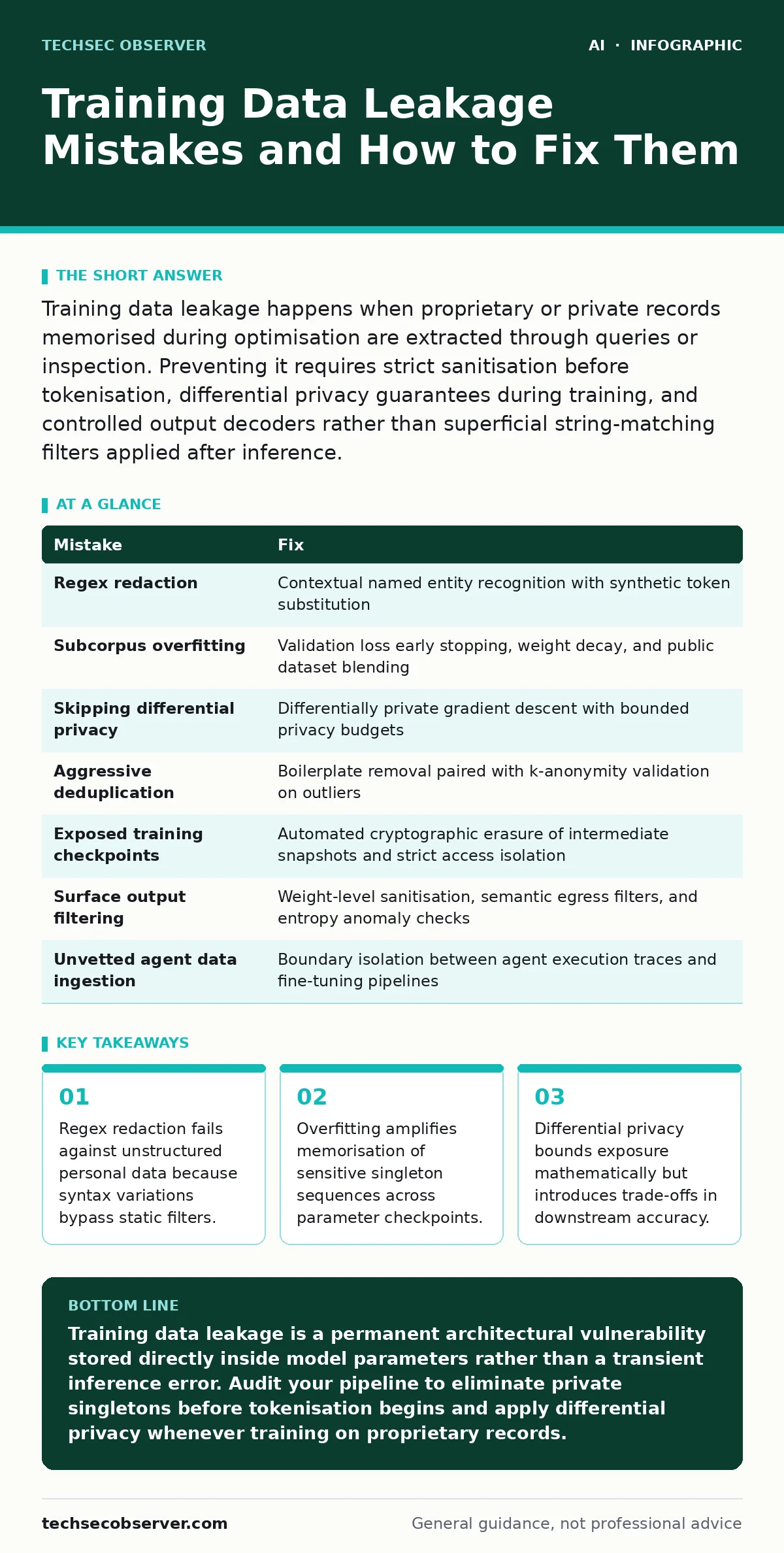
Training data leakage happens when proprietary or private records memorised during optimisation are extracted through queries or inspection. Preventing it requires strict sanitisation before tokenisation, differential privacy guarantees during training, and controlled output decoders rather than superficial string-matching filters applied after inference.
Mistake 1: Relying on regular expressions for data redaction
Why it hurts: Regular expressions target predictable formats such as national identity numbers, payment card digits, and standard email structures. Free-form text routinely bypasses these patterns through whitespace variations, uncommon delimiters, spelling errors, or narrative explanations that still convey identifying facts. When unscrubbed records pass into tokenisation, the model assigns distinct weights to those private sequences. Adversaries can later extract them verbatim using simple prompt completion or prefix probing attacks.
The fix: Combine deterministic regex scans with contextual named entity recognition models tuned specifically for personally identifiable information. Run data through multiple canonicalisation passes before pattern matching so that obscured identifiers are decoded into standard forms. Mask or replace detected entities with synthetic placeholders rather than simple deletions, which preserves sentence syntax while permanently severing the connection between sensitive values and the surrounding corpus.
Mistake 2: Overfitting on small, uncurated fine-tuning subsets
Why it hurts: Fine-tuning runs smaller datasets across several epochs, which accelerates convergence but dramatically increases parameter memorisation. While general pre-training distributes representations broadly across billions of parameters, downstream adaptation forces neural networks to store low-frequency sequences directly in residual stream weights. Rare names, internal URLs, or bespoke API keys appearing in a tiny dataset get memorised rather than generalised, making them trivial to extract with low-perplexity scoring probes.
The fix: Bound fine-tuning runs with early stopping based on validation loss plateaus rather than arbitrary epoch counts. Apply weight decay and dropout to penalise brittle parameter configurations that store exact token sequences. Where domain adaptation requires small corpora, mix the task data with neutral public instruction sets to dilute memorisation vectors without compromising task comprehension.
Mistake 3: Skipping differential privacy during gradient updates
Why it hurts: Standard stochastic gradient descent updates model weights proportionally to individual batch loss values, leaving the exact footprint of single records inside the final parameters. An attacker can run a membership inference attack—a technique that calculates whether a specific record formed part of the training set by measuring prediction confidence—to confirm private user records. Treating fine-tuning as private simply because the base weights are public is an expensive architectural error.
The fix: Train with differentially private stochastic gradient descent. This mechanism clips per-sample gradients to a fixed maximum norm and injects calibrated Gaussian noise during parameter updates, mathematically bounding how much any single record can alter model weights. The technique enforces a measurable privacy budget, though you must accept a moderate drop in task accuracy and higher computational overhead during training.
Mistake 4: Deduplicating training data across the entire corpus
Why it hurts: Deduplication is standard practice for dataset preparation, but deduplicating records down to single instances actually heightens risk. Counter-intuitively, rare sequences with unique surrounding tokens are memorised faster and more sharply than data repeated uniformly across diverse contexts. When a sensitive record appears exactly once, the optimiser tends to capture its entire token sequence as an isolated feature rather than generalising its semantic structure across distributed weights.
The fix: Focus deduplication efforts on removing synthetic artifacts, boilerplate headers, and template scaffolds rather than raw singleton texts. When unique records must enter the pipeline, verify they are blended into generalised structural clusters or synthesised through k-anonymity checks. Validating your pipeline against systematic extraction scenarios helps you spot vulnerable singletons; our separate guide on AI red teaming addresses how to construct these adversarial extraction evaluations safely.
Mistake 5: Neglecting memorisation across intermediate checkpoints
Why it hurts: Teams often enforce privacy policies on final release weights while storing intermediate training checkpoints in accessible development buckets. Memorisation does not scale linearly; models frequently memorise sensitive outlier records early during training before generalising or partially unlearning them in later epochs. If an attacker gains read access to an early checkpoint, they can extract raw sequences that are entirely unrecoverable from the final deployment build.
The fix: Treat all transient weights, optimizer states, and training snapshots under identical data classification rules as the source records themselves. Implement automated cryptographic erasure for transient checkpoints once their evaluation pass concludes, keeping only the final vetted artifact. Restrict checkpoint storage access through hardware-backed isolation, and audit systems following the practices laid out for exposed AI model servers to eliminate public visibility.
Mistake 6: Trusting output safety filters to hide internalized records
Why it hurts: Post-inference output filtering inspects generated text buffers and cancels responses containing blocked keywords or detected sensitive entities. This approach treats the symptom while leaving the root vulnerability unaddressed inside the parameter network. Attackers bypass string-matching egress filters using base64 encoding prompts, token insertion tricks, or translation layers that translate the memorised string before generation finishes, defeating the post-generation filter entirely.
The fix: Mitigate data risk inside the weights rather than relying entirely on inference-time suppression. When output guardrails are necessary, place them behind deep contextual semantic filters rather than naive substring blacklists. Combine this with structural entropy monitoring on output streams: generations that reproduce low-frequency memorised tokens exhibit unusually low perplexity, giving you an early mathematical trigger to terminate the generation before transmission.
Mistake 7: Failing to track token ingestion across automated agents
Why it hurts: Autonomous multi-step pipelines consume database records, tickets, and user interactions, then pass those transcripts directly into ongoing fine-tuning or continuous learning loops. Sensitive operational metadata—including connection strings, database schemas, and private employee messages—enters the model corpus without human review. Once encoded into model weights, that internal infrastructure data becomes accessible to any user querying the model, creating severe downstream risks.
The fix: Establish strict boundary isolation between run-time agent memory stores and model retraining pipelines. Strip internal communication metadata, telemetry headers, and structural connection strings before formatting any operational log into instruction-tuning pairs. The mechanisms governing these recursive automated ingestion risks are covered extensively in our analysis of AI agents.
| Mistake | Fix |
|---|---|
| Regex redaction | Contextual named entity recognition with synthetic token substitution |
| Subcorpus overfitting | Validation loss early stopping, weight decay, and public dataset blending |
| Skipping differential privacy | Differentially private gradient descent with bounded privacy budgets |
| Aggressive deduplication | Boilerplate removal paired with k-anonymity validation on outliers |
| Exposed training checkpoints | Automated cryptographic erasure of intermediate snapshots and strict access isolation |
| Surface output filtering | Weight-level sanitisation, semantic egress filters, and entropy anomaly checks |
| Unvetted agent data ingestion | Boundary isolation between agent execution traces and fine-tuning pipelines |
Key takeaways
- Regex redaction fails against unstructured personal data because syntax variations bypass static filters.
- Overfitting amplifies memorisation of sensitive singleton sequences across parameter checkpoints.
- Differential privacy bounds exposure mathematically but introduces trade-offs in downstream accuracy.
Training data leakage is a permanent architectural vulnerability stored directly inside model parameters rather than a transient inference error. Audit your pipeline to eliminate private singletons before tokenisation begins and apply differential privacy whenever training on proprietary records.
Frequently asked questions
What is training data leakage?
Training data leakage occurs when a machine learning model memorises private or confidential source records during training and subsequently reproduces them in generated outputs or exposes them to mathematical extraction techniques.
How does differential privacy prevent data extraction?
Differential privacy clips per-sample gradients and adds controlled statistical noise during optimisation. This mathematically prevents any individual record from exerting an outsized influence on the final model parameters.
Can membership inference attacks extract entire records?
Membership inference attacks do not extract text directly; instead, they measure output probabilities to determine whether a specific, known record was present in the training set. However, attackers can combine these attacks with generation probes to reconstruct records piece by piece.
Why do post-inference filters fail to stop data extraction?
Post-inference filters fail because they rely on predictable surface patterns like exact string matches. Attackers can prompt models to output memorised information using ciphers, alternative languages, or split tokens that bypass egress filters entirely.
How this guide was produced: written by the TechSec Observer editorial team with AI assistance, checked against the public references listed below, and reviewed when the facts change. See our editorial policy or report an error.