Exposed AI Model Servers: Response and Recovery Steps
Immediate containment of exposed inference endpoints prevents model theft and data leakage while forensic evidence remains intact for later analysis.

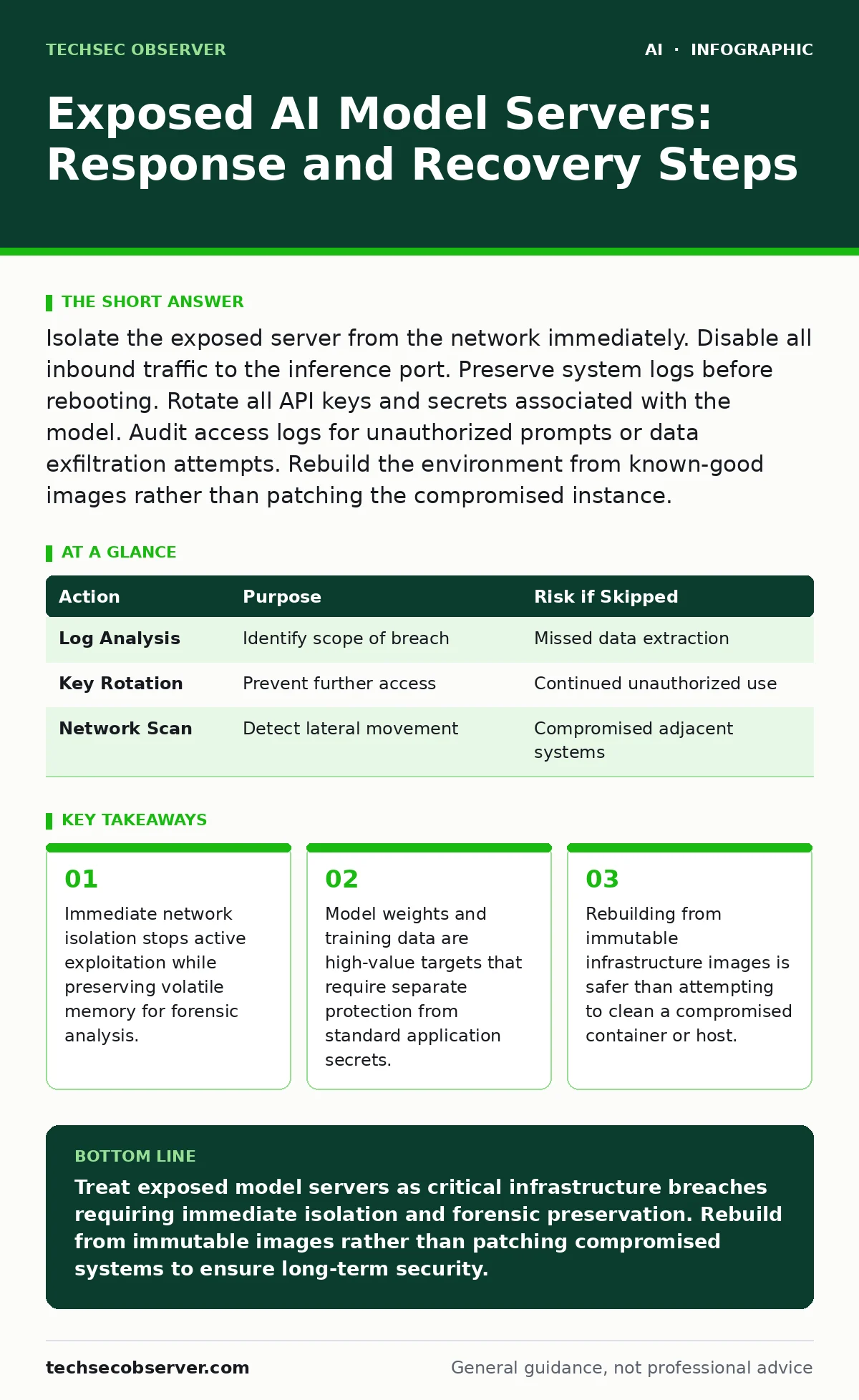
Isolate the exposed server from the network immediately. Disable all inbound traffic to the inference port. Preserve system logs before rebooting. Rotate all API keys and secrets associated with the model. Audit access logs for unauthorized prompts or data exfiltration attempts. Rebuild the environment from known-good images rather than patching the compromised instance.
First hour
The immediate priority is stopping the bleed. An exposed inference endpoint allows anyone on the internet to query your model. This enables prompt injection attacks, data extraction, and potential model theft. You must sever the connection between the public internet and the model server.
- Identify the specific IP addresses and ports serving the model.
- Apply firewall rules to block all inbound traffic to those ports.
- Disable the service process if firewall changes are not immediate.
- Capture a snapshot of the virtual machine or container state.
- Export application logs and system logs to a secure, offline location.
- Revoke all API keys and authentication tokens for the service.
Imagine you discover a public scanner has been querying your model for sensitive customer data. If you shut down the server to "stop the hackers," you lose the memory state showing exactly what was accessed. Keeping it running but air-gapped allows you to see the full extent of the breach.
First day
Once the server is isolated, you shift to containment and initial assessment. You need to understand what the attacker accessed. Exposed model servers are not just application servers. They hold proprietary weights, training data, and potentially user inputs that constitute sensitive personal information.
Review the access logs carefully. Look for unusual query patterns. Standard users ask questions. Attackers send structured prompts designed to extract system instructions or hidden data. This technique is often discussed in guides on jailbreaking AI chatbots. They attempt to bypass safety filters to reveal the underlying prompt structure or training data.
Check for lateral movement. Did the attacker use the model server as a pivot point to access other internal systems? Model servers often have elevated privileges to access databases or storage buckets. Verify that no new user accounts were created. Check for unexpected outbound connections that might indicate data exfiltration.
| Action | Purpose | Risk if Skipped |
|---|---|---|
| Log Analysis | Identify scope of breach | Missed data extraction |
| Key Rotation | Prevent further access | Continued unauthorized use |
| Network Scan | Detect lateral movement | Compromised adjacent systems |
If you find evidence of data poisoning attacks, where an attacker subtly altered training data to create hidden backdoors, the problem is deeper than a network breach. You may need to retrain the model from scratch. This is a complex scenario that requires careful validation of data integrity.
First week
Recovery involves rebuilding the environment. Do not attempt to clean the compromised server. The cost of missing a hidden backdoor is higher than the cost of rebuilding. Use immutable infrastructure principles. Start from a known-good base image.
Rotate all credentials again. Assume that any secret that existed on the compromised server is now public. This includes database passwords, API keys for third-party services, and internal service accounts. Update your deployment pipeline to enforce stricter access controls.
Implement stricter network segmentation. Model servers should not have direct internet access. They should sit behind a reverse proxy that validates requests. Use rate limiting to prevent abuse. Monitor for unusual query volumes. A sudden spike in requests often indicates an automated attack or scraping attempt.
Consider the role of AI agents in your architecture. If your model interacts with other systems via agents, ensure those connections are authenticated and authorized. An exposed model can become an entry point for an attacker to control downstream systems. This connects to broader concerns about AI governance and secure integration patterns.
Who to tell
Communication must be precise and timely. Internal stakeholders need to know the impact. Legal and compliance teams must assess data privacy implications. If user data was exposed, you may have legal obligations to notify affected individuals.
External partners may need to be informed if their data was involved. Vendors providing the underlying infrastructure should be notified of the incident. They may have additional logs or insights. Do not share technical details publicly until the investigation is complete. Misinformation can worsen the situation.
If you use AI-assisted threat detection tools, ensure they are not compromised. Verify their integrity before relying on them for further analysis. Attackers may try to poison these tools to hide their activity. Trust but verify your security stack.
How to stop a repeat
Prevention requires architectural changes. Exposed model servers are often the result of misconfiguration. Use infrastructure-as-code to manage deployments. This ensures that security settings are consistent and auditable. Manual changes are prone to error and easy to miss during audits.
Implement strict input validation. Model servers should reject malformed requests before they reach the inference engine. This reduces the attack surface for prompt injection and other exploits. Regular AI red teaming exercises can help identify these vulnerabilities before attackers do.
Monitor for shadow AI deployments. Employees may set up their own model servers without security oversight. These unmanaged instances are frequent sources of exposure. Establish clear policies and technical controls to detect and manage unauthorized AI services.
Checking for malware
AI infrastructure is a new target for malware. Attackers may install miners or backdoors on model servers. These threats are different from traditional malware. They may be designed to hijack compute resources for training other models.
Scan the system for known malicious signatures. However, signature-based detection is insufficient. Use behavioural analysis to detect unusual processes. Look for high CPU or GPU usage that does not match normal inference patterns. Refer to resources on malware that targets AI infrastructure for specific indicators of compromise.
Final verification
Before bringing the server back online, verify its integrity. Compare file hashes against known-good values. Check system configurations for unauthorized changes. Ensure that all security patches are applied.
Perform a final security review. Test the new controls against known attack vectors. Ensure that monitoring alerts are functioning correctly. Document the incident and the steps taken. This documentation is valuable for future incidents and compliance audits.
Long-term resilience
Security is not a one-time event. It is a continuous process. Regularly review your architecture for new risks. Stay updated on emerging threats in the AI space. Train your team on secure development practices.
Encourage a culture of security. Make it easy for developers to ask questions and report concerns. Security should be an enabler, not a blocker. By integrating security into the development lifecycle, you reduce the risk of exposure and improve overall system resilience.
Key takeaways
- Immediate network isolation stops active exploitation while preserving volatile memory for forensic analysis.
- Model weights and training data are high-value targets that require separate protection from standard application secrets.
- Rebuilding from immutable infrastructure images is safer than attempting to clean a compromised container or host.
Treat exposed model servers as critical infrastructure breaches requiring immediate isolation and forensic preservation. Rebuild from immutable images rather than patching compromised systems to ensure long-term security.
Frequently asked questions
Should I delete the exposed model server immediately?
No. Preserve the server state for forensic analysis. Powering off clears volatile memory which may contain evidence of the attack. Isolate it from the network first.
How do I know if my model weights were stolen?
Check access logs for large data transfers or unusual query patterns. Compare file hashes of the model weights against known-good versions. If stolen, assume the model is compromised.
Can I reuse the API keys after an exposure?
No. Assume all keys are compromised. Rotate all credentials immediately. Generate new keys and update all configurations. Old keys must be revoked and never reused.
What is the biggest risk of an exposed model server?
Data leakage and model theft. Attackers can extract sensitive training data or proprietary model weights. They can also use the server for compute-intensive attacks like mining.
How this guide was produced: written by the TechSec Observer editorial team with AI assistance, checked against the public references listed below, and reviewed when the facts change. See our editorial policy or report an error.