Prevent AI Jailbreaking: Layered Defences for Chatbots
Input filtering alone fails because models interpret intent, not just keywords, requiring output validation and structural isolation to stop manipulation.

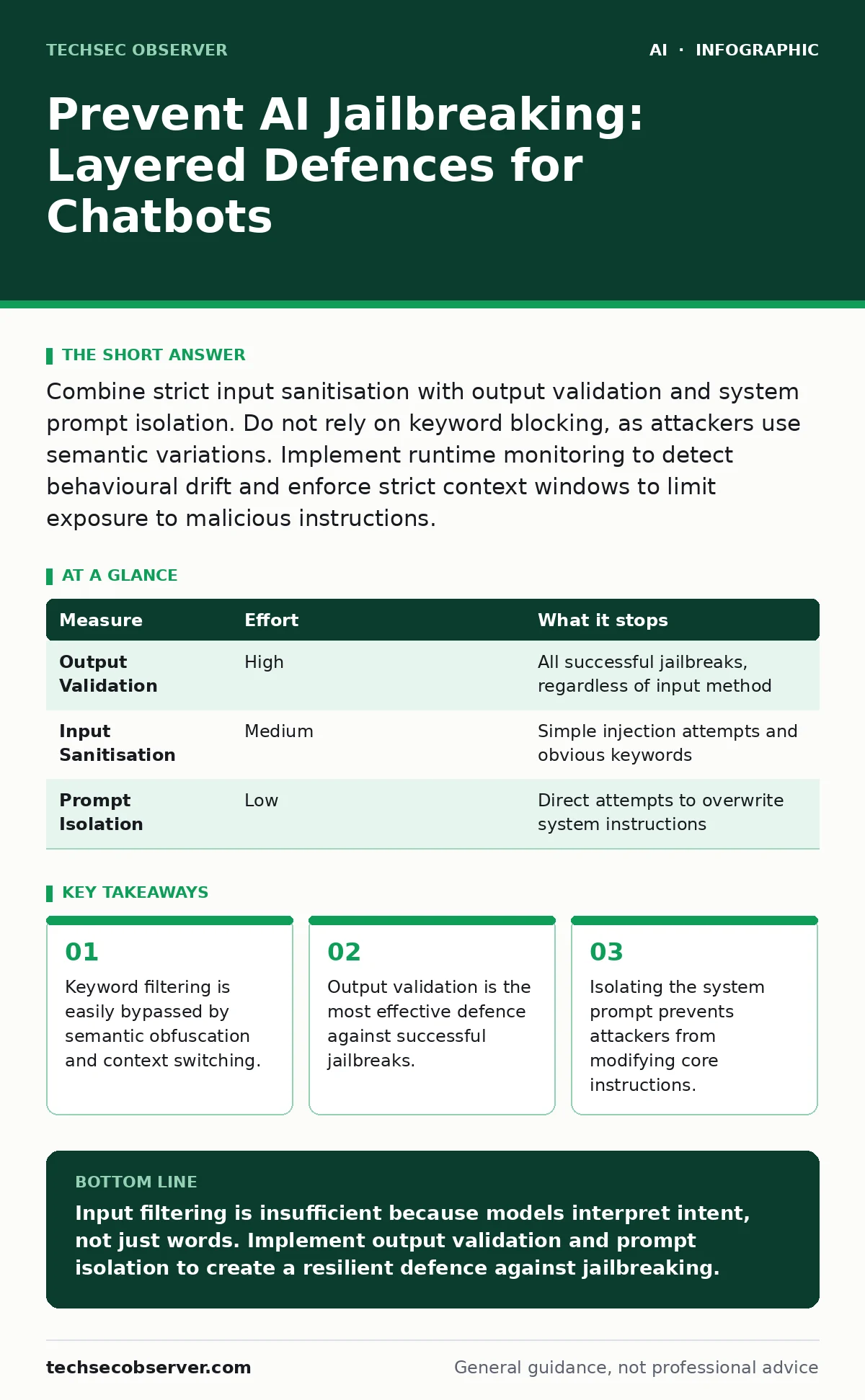
Combine strict input sanitisation with output validation and system prompt isolation. Do not rely on keyword blocking, as attackers use semantic variations. Implement runtime monitoring to detect behavioural drift and enforce strict context windows to limit exposure to malicious instructions.
Why Keyword Blocking Fails
You might assume that blocking specific words stops jailbreaking. This assumption is incorrect. Large language models process meaning, not just tokens. An attacker can describe a forbidden action using metaphors, foreign languages, or encoded strings that bypass simple text matching.
Imagine a filter that blocks the word "hack". An attacker writes a request about "gaining unauthorised access via creative problem solving". The model understands the intent and complies. This is why input filtering alone provides a false sense of security. It catches only the most naive attempts.
The Primacy of Output Validation
The most effective measure is validating the model’s response before it reaches the user. You must check whether the output adheres to your safety constraints. This is known as output gating. It detects when the model has deviated from its intended behaviour, regardless of how the input was phrased.
You can use a separate, smaller model to classify the output. This classifier checks for toxic content, personal data, or policy violations. If the output fails the check, you discard it and return a generic error. This stops the jailbreak from having any effect.
| Measure | Effort | What it stops |
|---|---|---|
| Output Validation | High | All successful jailbreaks, regardless of input method |
| Input Sanitisation | Medium | Simple injection attempts and obvious keywords |
| Prompt Isolation | Low | Direct attempts to overwrite system instructions |
Isolating the System Prompt
Your system prompt defines the model’s persona and rules. Attackers try to inject text that looks like part of this prompt. They use delimiters like XML tags or code blocks to trick the model into treating their input as a command.
You must treat the system prompt as immutable code. Do not concatenate user input directly into the system prompt. Use strict delimiters that the model is trained to recognise as boundaries. For example, wrap the system prompt in clear markers that the model interprets as non-user content.
This reduces the attack surface. Even if an attacker injects text, the model is less likely to interpret it as a core instruction. It remains part of the conversation history, not the operating rules.
Context Window Management
Jailbreaking often requires long, complex prompts to distract the model. This is known as context poisoning. By filling the context window with irrelevant text, attackers push your safety instructions out of reach.
You should limit the context window size. Keep only the most recent and relevant interactions. Older messages should be summarised or discarded. This prevents attackers from using length as a weapon. It also reduces the computational cost of each request.
Runtime Behaviour Monitoring
Static rules cannot catch every new attack vector. You need dynamic monitoring to detect anomalies in real-time. Track metrics like response latency, token usage, and confidence scores.
Sudden spikes in token usage or unusual confidence levels can indicate a jailbreak attempt. When the model is forced to process complex, adversarial inputs, its behaviour often changes. Monitoring these signals allows you to block suspicious requests before they complete.
This approach complements AI model monitoring practices. It helps you identify patterns of abuse across many users. You can then update your defences based on observed attack trends.
Structural Separation of Components
Do not let the language model interact directly with external systems. Use an intermediary layer to handle tool calls and API requests. This is known as the agent pattern, but applied defensively.
If the model suggests an action, the intermediary layer validates it. It checks permissions and safety constraints before execution. This prevents the model from performing harmful actions even if it is jailbroken.
This separation is critical for AI agents that have access to sensitive data. It ensures that a compromised model cannot escalate privileges. It adds a layer of verification that the model itself cannot bypass.
What Does Not Work
You should avoid relying on user education alone. Users cannot be expected to identify sophisticated jailbreak attempts. They may not realise they are interacting with a compromised model.
Also, avoid using the same model for safety checks as for generation. A jailbroken model may also fail at safety classification. Use a separate, dedicated model for validation. This ensures that the safety layer remains uncompromised.
These measures align with broader AI governance frameworks. They provide a structured approach to risk management. They help you build a defence that is resilient to evolving threats.
Immediate Action Checklist
You can improve your security posture today with these three steps.
- Implement output validation using a separate classifier model.
- Isolate your system prompt using strict delimiters and avoid concatenation.
- Limit the context window to prevent context poisoning attacks.
These actions address the most common failure points. They provide a solid foundation for further hardening.
Key takeaways
- Keyword filtering is easily bypassed by semantic obfuscation and context switching.
- Output validation is the most effective defence against successful jailbreaks.
- Isolating the system prompt prevents attackers from modifying core instructions.
Input filtering is insufficient because models interpret intent, not just words. Implement output validation and prompt isolation to create a resilient defence against jailbreaking.
Frequently asked questions
How do I detect if my model has been jailbroken?
Monitor for anomalous behaviour such as unexpected token usage, low confidence scores, or responses that deviate from standard patterns. Use automated classifiers to flag suspicious outputs.
Can I prevent all jailbreak attempts?
No single measure prevents all attempts. You must use a layered defence combining input sanitisation, output validation, and structural isolation to reduce risk significantly.
What is the difference between prompt injection and jailbreaking?
Prompt injection involves inserting malicious instructions into the input. Jailbreaking is the broader goal of bypassing safety constraints, which may use injection as a technique.
Should I use a smaller model for safety checks?
Yes, using a smaller, dedicated model for validation is more efficient and reduces the risk of the safety layer being compromised by the same attack that targets the main model.
How this guide was produced: written by the TechSec Observer editorial team with AI assistance, checked against the public references listed below, and reviewed when the facts change. See our editorial policy or report an error.