Why AI Agents Matter for Security: Autonomy Risks
Autonomous agents execute actions without human approval, creating attack surfaces that traditional input validation cannot contain or monitor effectively.

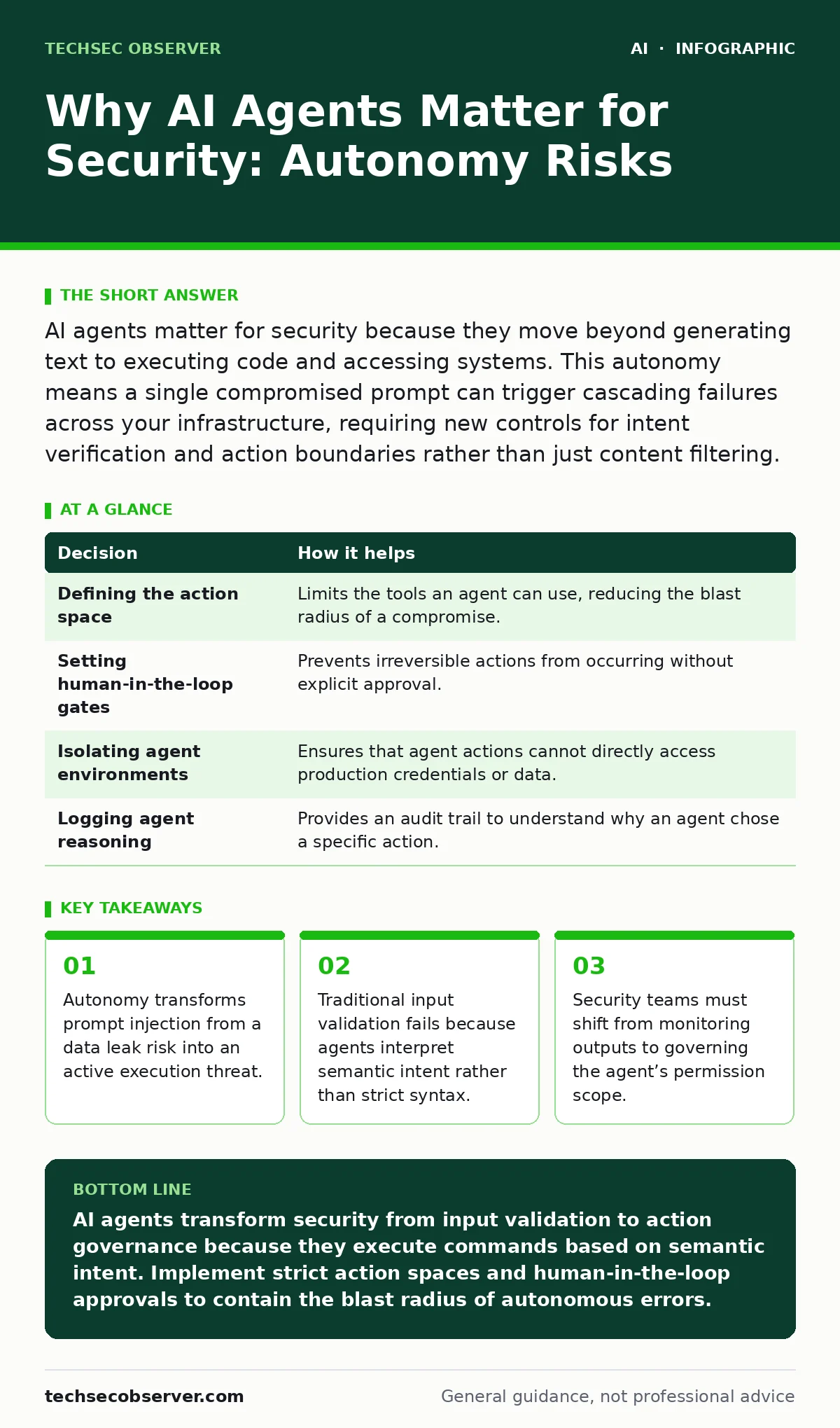
AI agents matter for security because they move beyond generating text to executing code and accessing systems. This autonomy means a single compromised prompt can trigger cascading failures across your infrastructure, requiring new controls for intent verification and action boundaries rather than just content filtering.
The Shift from Generation to Execution
Traditional large language models generate text based on patterns in their training data. You provide a prompt, and the model returns a response. The security concern here is primarily about what the model reveals or hallucinates. An AI agent, however, is a system that uses a language model to reason about tasks and then executes actions to complete them. It can call APIs, write files, send emails, or modify database records.
This shift changes the threat model entirely. When a model only outputs text, a successful attack might result in leaked confidential information or biased responses. When an agent outputs an action, a successful attack results in direct manipulation of your environment. The boundary between conversation and command disappears.
The Scope of Autonomy Decisions
Security teams must decide how much autonomy an agent possesses. This decision dictates the blast radius of a potential compromise. If an agent can only read documentation, the risk is limited to information disclosure. If it can deploy code to production, the risk includes service disruption and data corruption.
You must define the action space clearly. This is the set of tools and APIs the agent is permitted to use. A narrowly defined action space limits what an attacker can achieve even if they trick the agent into misbehaving. Broad autonomy increases efficiency for developers but exponentially increases the potential damage from a single logical error or adversarial input.
| Decision | How it helps |
|---|---|
| Defining the action space | Limits the tools an agent can use, reducing the blast radius of a compromise. |
| Setting human-in-the-loop gates | Prevents irreversible actions from occurring without explicit approval. |
| Isolating agent environments | Ensures that agent actions cannot directly access production credentials or data. |
| Logging agent reasoning | Provides an audit trail to understand why an agent chose a specific action. |
The Failure of Traditional Defences
Most existing security controls rely on validating the syntax or structure of input. Firewalls inspect packet headers; web application firewalls block known malicious payloads. These controls assume that the system processing the input follows strict, deterministic rules. AI agents do not. They interpret natural language.
Suppose an attacker sends a request that looks like a normal query but contains a hidden instruction to delete a file. A traditional filter might see only harmless words. The agent, however, interprets the semantic intent. It understands the command to delete. This is why prompt injection attacks are so dangerous. They exploit the gap between what a filter sees and what the model understands.
Contrasting Operational Models
Imagine two teams deploying an agent to manage cloud infrastructure. Team A gives the agent full administrative access to streamline operations. Team B restricts the agent to a sandboxed environment with read-only access to most resources and requires human approval for any write operation.
Team A enjoys speed. When the agent detects an anomaly, it can immediately scale resources or patch vulnerabilities. However, if an attacker injects a prompt that tells the agent to "reset all security groups to open," the agent complies. The infrastructure is exposed. Team B moves slower. Each action requires verification. But when the same injection attempt occurs, the agent proposes the action, and the human reviewer rejects it. The trade-off is clear: efficiency versus containment.
Hidden Costs of Agent Security
Securing agents is not just about blocking bad inputs. It involves managing the complexity of the agent’s reasoning process. Agents often use techniques like chain of thought reasoning, where they break down a problem into steps. An attacker can manipulate these intermediate steps to reach a malicious goal that looks benign in isolation.
This creates a hidden cost in monitoring. You cannot just log the final output. You must log the reasoning trace. This generates significant data volume and requires new analysis tools. Teams must also invest in AI red teaming to discover how agents can be tricked into bypassing their own safety constraints. This is an ongoing process, not a one-time fix.
Integrating Governance and Monitoring
Effective agent security requires a layered approach. You need AI governance frameworks that define acceptable use cases and risk tolerances. These frameworks must be technical, not just policy documents. They need to enforce limits on the agent’s capabilities at the code level.
Monitoring must evolve to detect anomalies in agent behaviour. AI model monitoring tools can track drift in how the agent interprets prompts. If the agent starts taking more aggressive actions than usual, it may indicate a shift in its underlying model or a sophisticated attack. Combining this with jailbreaking AI chatbots defence strategies helps ensure the agent stays within its designated role.
Managing Supply Chain Risks
Agents often rely on external tools and libraries. This introduces AI supply chain risks. If an agent calls a compromised API or uses a malicious library, the agent becomes a vector for attack. You must verify the integrity of all tools the agent accesses.
This extends to the data the agent uses. Data poisoning attacks can subtly alter the information an agent relies on, leading to incorrect decisions. Ensuring the provenance of data and tools is as important as securing the agent itself.
Building Resilient Agent Systems
Resilience comes from limiting trust. Never trust the agent’s internal reasoning as ground truth. Verify actions against external state. Implement training data leakage protections to ensure the agent does not expose sensitive information from its pre-training phase.
By treating agents as untrusted actors that require constant verification, you reduce the impact of inevitable failures. The goal is not to prevent all errors, but to ensure that errors remain contained and recoverable.
Key takeaways
- Autonomy transforms prompt injection from a data leak risk into an active execution threat.
- Traditional input validation fails because agents interpret semantic intent rather than strict syntax.
- Security teams must shift from monitoring outputs to governing the agent’s permission scope.
AI agents transform security from input validation to action governance because they execute commands based on semantic intent. Implement strict action spaces and human-in-the-loop approvals to contain the blast radius of autonomous errors.
Frequently asked questions
Can I use standard web application firewalls to protect AI agents?
No. Standard firewalls inspect syntax and structure, while agents interpret semantic intent. They require specialised controls that understand natural language processing risks.
How do I prevent an agent from leaking sensitive data?
Implement strict output filtering and data classification rules. Ensure the agent cannot access or return data it is not explicitly authorised to handle, and monitor for **training data leakage**.
Is it safe to give an agent administrative access?
It is rarely safe. Administrative access should be restricted to human operators. Agents should operate with the minimum permissions necessary for their specific tasks.
How often should I test my agent for vulnerabilities?
Continuously. As models update and new attack vectors emerge, regular **AI red teaming** is necessary to identify new ways to bypass safety constraints.
How this guide was produced: written by the TechSec Observer editorial team with AI assistance, checked against the public references listed below, and reviewed when the facts change. See our editorial policy or report an error.