Privacy by Design: Definition, Principles and Practical Implementation
Embedding privacy at the architectural level prevents data leaks that retroactive security patches cannot fix, shifting risk from users to systems.

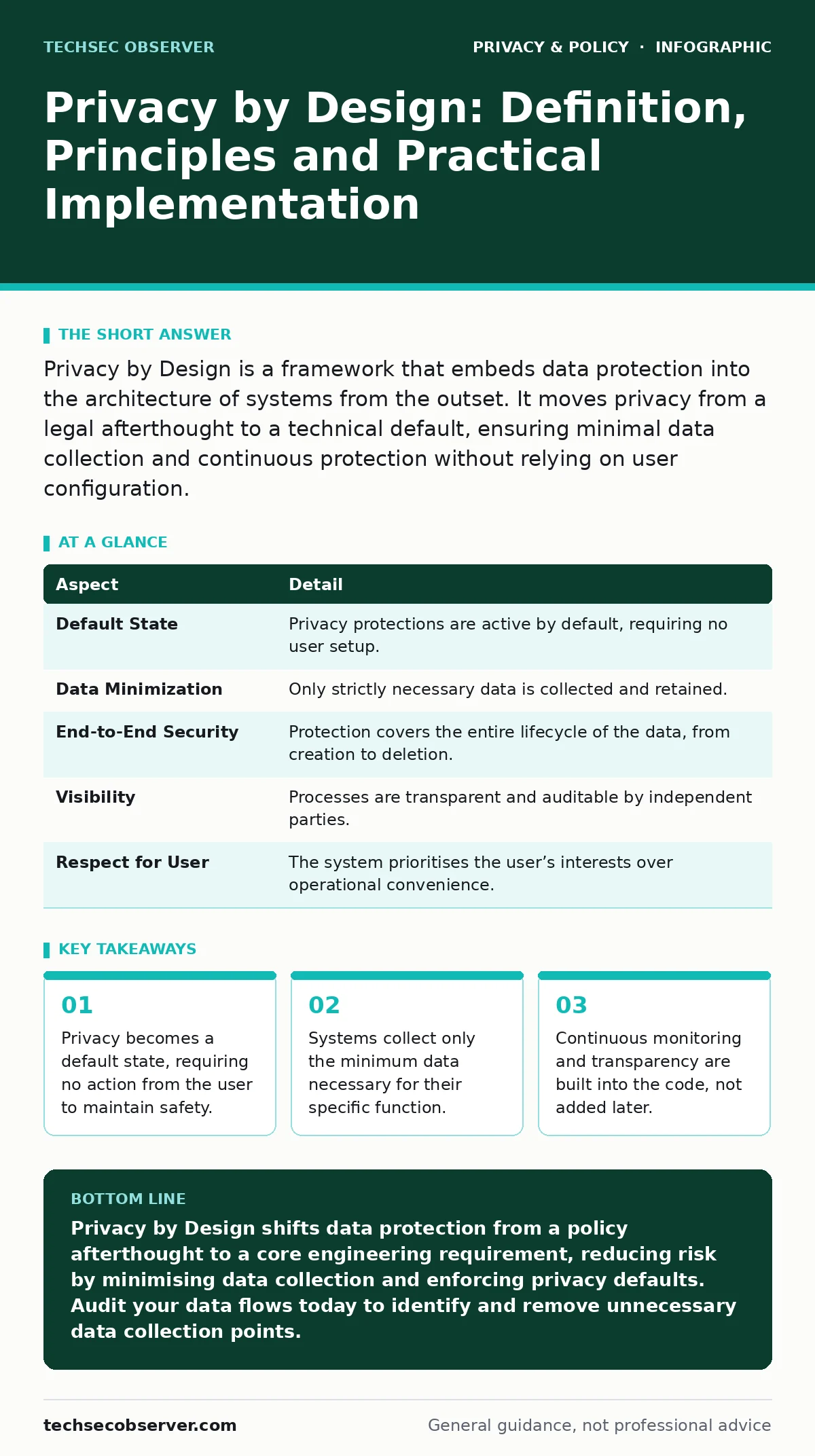
Privacy by Design is a framework that embeds data protection into the architecture of systems from the outset. It moves privacy from a legal afterthought to a technical default, ensuring minimal data collection and continuous protection without relying on user configuration.
From Afterthought to Architecture
Imagine building a house where the locks are installed after the walls are painted. You might add a deadbolt later, but the frame itself was never designed to hold it securely. Privacy by Design changes this order. It requires you to consider data protection before you write a single line of code or draw a system diagram.
This philosophy shifts privacy from a legal compliance task to an engineering requirement. Instead of asking how to protect data after it is collected, you ask why the data is needed in the first place. This proactive stance prevents vulnerabilities that are difficult or impossible to patch once a system is live.
| Aspect | Detail |
|---|---|
| Default State | Privacy protections are active by default, requiring no user setup. |
| Data Minimization | Only strictly necessary data is collected and retained. |
| End-to-End Security | Protection covers the entire lifecycle of the data, from creation to deletion. |
| Visibility | Processes are transparent and auditable by independent parties. |
| Respect for User | The system prioritises the user’s interests over operational convenience. |
The Problem of Retroactive Privacy
Many organisations treat privacy as a checklist item completed before launch. They add terms of service and cookie banners, assuming this satisfies legal and ethical obligations. This approach fails because technical architecture often leaks data regardless of policy.
Consider a logging system that records full IP addresses for debugging. Even if your policy says you anonymise data, the raw logs exist in storage. If that storage is breached, the anonymisation promise is broken. Privacy by Design addresses this by ensuring the logging mechanism never captures the full address in the first place.
The Seven Foundational Principles
The framework rests on seven specific principles. These are not abstract ideals but actionable engineering constraints. Each principle dictates a specific change in how systems are built and operated.
- Proactive not Reactive: Anticipate privacy breaches before they occur. Build safeguards into the design phase, not as responses to incidents.
- Privacy as the Default: Users should not have to take action to protect themselves. The system must provide the highest level of privacy automatically.
- Privacy Embedded into Design: Privacy is a core component of the functional architecture, not an add-on. It is integrated into the core logic of the application.
- Full Functionality: Privacy and security must not be treated as trade-offs against utility. The system should deliver complete functionality while maintaining strict privacy controls.
- End-to-End Security: Data is protected throughout its entire lifecycle. This includes encryption in transit and at rest, as well as secure deletion mechanisms.
- Visibility and Transparency: Operations are open to scrutiny. You must be able to demonstrate to users and regulators how data is handled.
- Respect for User Privacy: The system must be centred on the user’s interests. This includes providing clear choices and ensuring data is used only as agreed.
Technical Implementation Strategies
Implementing these principles requires specific technical choices. You must move beyond policy documents and alter how data flows through your system.
Data minimisation is the most powerful technical control. If you do not collect a piece of data, it cannot be leaked. This requires rigorous analysis of each field in your database. Ask whether each field is strictly necessary for the primary function. If the answer is no, remove it. This reduces the attack surface and simplifies compliance.
Encryption is another key mechanism. Use strong encryption for data at rest and in transit. However, encryption alone is not enough. You must also manage keys securely. If an attacker gains access to encryption keys, the data is exposed. Consider using hardware security modules or key management services that separate key access from data access.
Integration with Other Defences
Privacy by Design does not replace other security measures. It works alongside them to create a layered defence. It complements traditional security by focusing on data rights rather than just system integrity.
For instance, while a firewall blocks external attacks, Privacy by Design ensures that internal processes do not misuse data. It also intersects with legal frameworks. Understanding legitimate interest under the GDPR helps you determine when you can process data without explicit consent. This legal concept aligns with the technical goal of minimising data collection to only what is strictly necessary.
Additionally, consider how your system interacts with external services. Metadata exposure can reveal sensitive information even if the content is encrypted. By designing systems that strip or mask metadata, you prevent accidental leaks. This is particularly relevant when users employ privacy-focused browsers that block third-party trackers. Your system should respect these controls rather than trying to circumvent them.
See also: Private file sharing services: secure transfer workflows · Block Wi-Fi Finder Apps From Mapping Your Network
Common Misconceptions
Many teams misunderstand what Privacy by Design entails. These misconceptions lead to ineffective implementations and false senses of security.
One common error is equating privacy with security. Security protects data from unauthorised access. Privacy ensures data is used appropriately by authorised parties. A system can be secure but violate privacy if it collects excessive data or uses it in ways users did not expect.
Another mistake is assuming that user consent solves privacy problems. Consent is a legal mechanism, not a technical one. Relying on users to read and understand complex privacy settings is flawed. Most users will accept defaults. Therefore, the defaults must be privacy-preserving. This is why cookie consent management systems are often criticised; they shift the burden to the user rather than minimising tracking by default.
The Long-Term Benefit
Adopting this approach changes how your organisation views data. It moves data from an asset to be hoarded to a liability to be minimised. This shift reduces risk and builds trust.
Users are increasingly aware of social media privacy risks and how their data is used. They prefer services that respect their privacy. By embedding privacy into your design, you differentiate your product in a crowded market. This is not just about compliance; it is about sustainable business practice.
Furthermore, reducing data collection lowers storage costs and simplifies system architecture. Less data means fewer fields to validate, fewer queries to optimise, and less complexity to manage. This leads to more maintainable and efficient systems.
Practical Next Steps
Start by auditing your current data flows. Map out where data comes from, where it goes, and who accesses it. Identify any data that is collected but not strictly necessary. Remove these points of collection.
Next, review your default settings. Ensure that the most private option is the default. Test your system as a new user would. If a user must opt-in to privacy features, you have not implemented Privacy by Design.
Finally, consider how your system affects the broader ecosystem. Do not rely on users to manage their digital footprint through your platform. Instead, design systems that minimise the footprint automatically. This might involve limiting data retention periods or providing easy tools for users to export and delete their data.
Key takeaways
- Privacy becomes a default state, requiring no action from the user to maintain safety.
- Systems collect only the minimum data necessary for their specific function.
- Continuous monitoring and transparency are built into the code, not added later.
- This approach reduces liability and builds trust through technical enforcement rather than policy alone.
Privacy by Design shifts data protection from a policy afterthought to a core engineering requirement, reducing risk by minimising data collection and enforcing privacy defaults. Audit your data flows today to identify and remove unnecessary data collection points.
Frequently asked questions
Does Privacy by Design prevent all data breaches?
No, it reduces the impact and likelihood of breaches by minimising data exposure and enforcing strict access controls, but it cannot eliminate all security risks.
How does this differ from GDPR compliance?
GDPR is a legal framework setting requirements, while Privacy by Design is a technical methodology for meeting those requirements through system architecture.
Can small applications use Privacy by Design?
Yes, the principles apply to systems of any size. Small apps benefit significantly from data minimisation, which reduces complexity and storage costs.
What is the cost of implementing this approach?
Initial development costs may increase due to early analysis, but long-term costs decrease due to reduced storage, fewer security incidents, and simpler architecture.
How this guide was produced: written by the TechSec Observer editorial team with AI assistance, checked against the public references listed below, and reviewed when the facts change. See our editorial policy or report an error.