Differential privacy census: how noise protects your data
Statistical noise added to datasets prevents identification of individuals while preserving aggregate patterns for public policy and research.

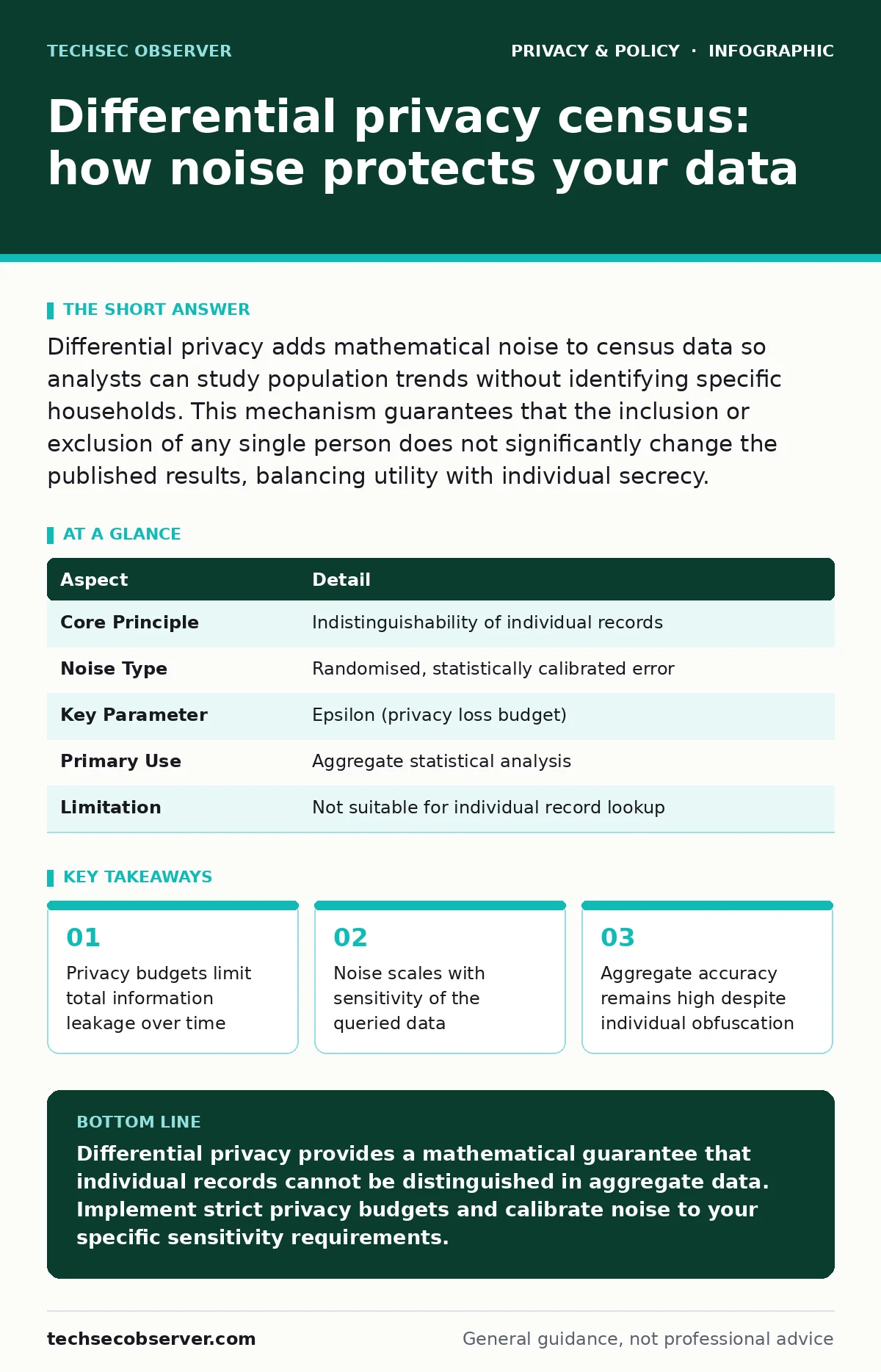
Differential privacy adds mathematical noise to census data so analysts can study population trends without identifying specific households. This mechanism guarantees that the inclusion or exclusion of any single person does not significantly change the published results, balancing utility with individual secrecy.
How the differential privacy census protects identity
Imagine a census bureau asking whether you own a specific rare item. If only one person in a district owns it, answering yes reveals your identity. Differential privacy solves this by adding random noise to the count. The result might show two owners when there is only one. An attacker cannot tell if the extra count is noise or a real person. This uncertainty protects you.
The mechanism relies on a strict mathematical definition. A dataset satisfies differential privacy if the probability of any output is nearly the same whether your record is present or absent. The "epsilon" parameter controls this trade-off. Lower epsilon values add more noise, offering stronger privacy but reducing data accuracy. Higher values preserve accuracy but increase re-identification risk. Census bureaus choose epsilon carefully to meet legal standards.
At a glance: core mechanics
| Aspect | Detail |
|---|---|
| Core Principle | Indistinguishability of individual records |
| Noise Type | Randomised, statistically calibrated error |
| Key Parameter | Epsilon (privacy loss budget) |
| Primary Use | Aggregate statistical analysis |
| Limitation | Not suitable for individual record lookup |
Why the census uses this method
Traditional anonymisation strips direct identifiers like names and addresses. This approach fails when combined with external datasets. An attacker can cross-reference age, zip code and income to re-identify a person. Differential privacy addresses this structural weakness. It does not hide data; it hides your contribution to the data.
The census affects everyone in the population. Funding for schools, hospitals and roads depends on accurate population counts. If people fear their data will be exposed, they may withhold information. This leads to undercounting and misallocated resources. Differential privacy provides a guarantee that participation does not increase your risk of exposure. It builds trust in the institution collecting the data.
What developers need to know about implementation
You must understand the privacy budget before querying data. Each query consumes part of the budget. The budget represents the total privacy loss allowed. Once exhausted, no further queries are permitted under the same guarantee. This prevents "tracking" an individual through repeated small queries.
Implementing this requires careful calibration of noise. The amount of noise depends on the sensitivity of the function. A sum query is more sensitive than an average query. You must add noise proportional to this sensitivity. Using too little noise breaks the privacy guarantee. Using too much renders the data useless.
Consider the composition theorem. If you run 10 queries, each with epsilon 0.1, the total privacy loss is not simply 1.0. Advanced composition bounds allow for tighter limits. You must track cumulative epsilon across all operations. This tracking often requires centralised coordination, which introduces new operational complexities.
What people usually get wrong
Many assume differential privacy makes data "anonymous". This is incorrect. The data remains linked to the original records in the secure environment. The protection is in the output, not the storage. An attacker with access to the raw database is not protected by this method.
Another common error is ignoring the context of auxiliary information. Differential privacy assumes the attacker has some background knowledge. If an attacker knows everything about a person except one detail, the noise must be large enough to hide that detail. Underestimating attacker knowledge leads to insufficient noise.
Some believe this method works for all data types. It excels at numerical aggregates. It struggles with complex machine learning models. Training a model on differentially private data requires significant noise injection during the gradient updates. This can degrade model performance significantly. You must accept this trade-off.
Balancing utility and privacy in practice
The goal is not perfect secrecy but bounded risk. You must define what "bounded" means for your use case. A healthcare provider might require higher accuracy for treatment decisions.
You should evaluate the sensitivity of your queries. Count queries are less sensitive than sum queries. Histograms require careful binning to limit sensitivity. Aggregating data before applying noise can improve utility. However, pre-aggregation reduces the flexibility of downstream analysis.
Consider the impact on minority groups. Noise affects small groups more than large ones. A small population might have its count obscured entirely. This can lead to underfunding for these communities. You must monitor these disparities and adjust parameters if necessary.
Related privacy mechanisms to consider
Differential privacy is one tool in a broader toolkit. It complements other measures but does not replace them. You should understand how it interacts with other privacy frameworks.
Metadata exposure often bypasses content-level protections. Even if the census data is noisy, the fact that a query was made might leak information. You must manage query logs carefully. See our guide on metadata exposure for details on this risk.
Privacy-focused browsers help users control local data collection. They do not protect data once it leaves the device. Differential privacy protects data in the cloud. These tools address different stages of the data lifecycle.
Legitimate interest under the GDPR provides a legal basis for processing. It does not provide a technical guarantee of privacy. You can have a legal basis but still fail to protect data technically. Differential privacy offers that technical layer.
People-search sites aggregate public data to create profiles. Differential privacy in government data releases reduces the fuel for these sites. It limits the granularity of data available for scraping.
Reducing your digital footprint is a personal strategy. It limits the data available for linkage attacks. Less external data means differential privacy is more effective.
Email aliases help manage identity exposure online. They do not protect statistical data. They are relevant to personal privacy, not aggregate privacy.
Parental controls protect children from online risks. They do not address data privacy in statistical releases. These are distinct concerns.
Social media privacy risks involve behavioural data. Differential privacy is less common here due to the dynamic nature of the data. It is more suited to static datasets like census records.
What to do next
Audit your data release processes. Identify where individual records could be inferred. Define your privacy budget and stick to it. Monitor the impact on data utility. Adjust parameters as needed. Stay informed about evolving standards and techniques.
Key takeaways
- Privacy budgets limit total information leakage over time
- Noise scales with sensitivity of the queried data
- Aggregate accuracy remains high despite individual obfuscation
Differential privacy provides a mathematical guarantee that individual records cannot be distinguished in aggregate data. Implement strict privacy budgets and calibrate noise to your specific sensitivity requirements.
Frequently asked questions
Does differential privacy protect against hackers?
No, it protects against statistical inference attacks. It does not secure databases against direct breaches or theft of raw data.
Can I reverse the noise to find original data?
No, the noise is statistically irreversible for individual records. Aggregate trends may be recovered, but individual contributions remain hidden.
Is differential privacy required by law?
Some regulations encourage or mandate privacy-enhancing technologies. Differential privacy is a leading standard for meeting these requirements.
How much noise is too much?
It depends on your accuracy requirements. Too much noise renders data useless. You must balance privacy guarantees with analytical utility.
How this guide was produced: written by the TechSec Observer editorial team with AI assistance, checked against the public references listed below, and reviewed when the facts change. See our editorial policy or report an error.