Who Is Responsible for Data Retention Policy: The Real Answer
Legal compliance officers define retention rules, yet engineering teams control the technical deletion mechanisms that actually enforce them.

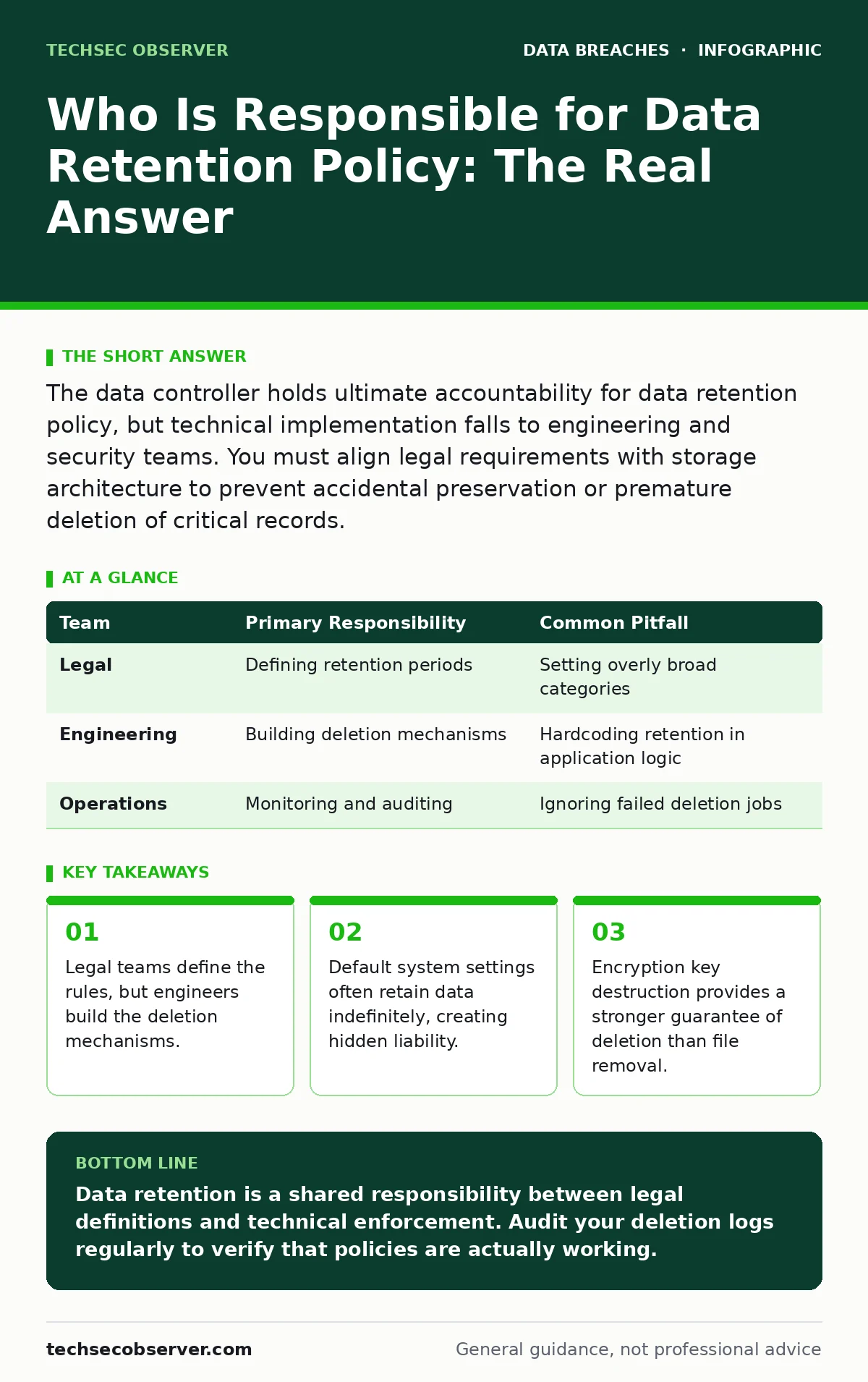
The data controller holds ultimate accountability for data retention policy, but technical implementation falls to engineering and security teams. You must align legal requirements with storage architecture to prevent accidental preservation or premature deletion of critical records.
Who is responsible for data retention policy?
The data controller bears the primary legal responsibility for establishing data retention policy. In most organisational structures, this accountability rests with the legal or compliance department. They determine how long specific data categories must be kept based on statutory requirements. Engineering and security teams share operational responsibility. They implement the technical controls that enforce these time limits. Without technical enforcement, written policies remain ineffective.
What happens when responsibility is unclear?
Ambiguity in ownership leads to data hoarding by default. When no single team owns the deletion process, developers tend to preserve data rather than risk accidental loss. This behaviour increases the attack surface. Stored data that serves no business purpose becomes a liability. Imagine a database where logs accumulate for years because no one authorised their purge. This accumulation complicates incident response and increases storage costs unnecessarily.
Which teams must collaborate on retention?
Three distinct groups must coordinate to enforce retention effectively. Legal teams define the retention periods for different data classes. Security architects design the storage solutions that support automated deletion. Database administrators execute the actual purging routines. Each group holds a piece of the puzzle. Legal cannot delete data they do not understand. Engineering cannot secure data without knowing its lifecycle. Misalignment between these groups creates gaps where data persists beyond its legal necessity.
| Team | Primary Responsibility | Common Pitfall |
|---|---|---|
| Legal | Defining retention periods | Setting overly broad categories |
| Engineering | Building deletion mechanisms | Hardcoding retention in application logic |
| Operations | Monitoring and auditing | Ignoring failed deletion jobs |
How do technical defaults undermine policy?
Cloud storage services and database systems often default to infinite retention. If you do not configure automatic deletion, data remains accessible until you manually remove it. This default behaviour contradicts the principle of data minimisation. Developers frequently overlook these settings during initial deployment. The result is a system that retains data long after its business value expires. You must explicitly configure retention rules for every storage bucket and database table.
What is the difference between deletion and destruction?
Deleting a file removes its pointer from the file system, but the underlying data may remain on the disk. Modern storage controllers can often recover these remnants. True destruction requires overwriting the storage media or destroying the physical hardware. For cloud environments, you cannot physically destroy the disk. Instead, you must rely on cryptographic erasure. Deleting the encryption keys renders the data unreadable, effectively destroying it. This method provides a higher assurance of deletion than standard file removal.
See also: Pseudonymization of Data: How to Reduce Risk Without Losing Utility · How public key infrastructure works behind digital trust
When does automated deletion fail?
Automated retention jobs can fail silently due to permission errors or network timeouts. If a deletion script lacks the necessary privileges, it may skip records without logging the failure. Over time, these skipped records accumulate. You must monitor deletion logs actively. Integrate alerts into your monitoring system to notify administrators when a retention job fails. Regular audits should compare the expected data volume against the actual stored volume. Discrepancies indicate that deletion processes are not functioning as intended.
How do backups complicate retention?
Backup systems often retain copies of data indefinitely, regardless of the primary system's retention policy. If you delete a record from your production database, it may still exist in a backup tape or snapshot. This creates a compliance risk. You must align backup retention windows with your data retention policy. Some backup solutions support granular deletion of specific records. Others require full backup rotation. Understand how your backup infrastructure handles deleted data to avoid accidental preservation.
What legal frameworks drive retention rules?
Different jurisdictions impose varying retention requirements. Financial records may require long-term preservation for audit purposes. Personal data often requires deletion after a short period to comply with privacy laws. Conflicting requirements can arise when data spans multiple regions. You must map each data category to its specific legal requirement. This mapping informs the technical configuration of your storage systems. Failing to distinguish between data types leads to either over-retention or premature deletion.
How do you prove compliance during an audit?
Auditors require evidence that retention policies are enforced technically, not just documented. You must provide logs showing successful deletion events. These logs should include timestamps, data identifiers, and the identity of the process that performed the deletion. Immutable logging systems prevent tampering with these records. Without verifiable logs, you cannot demonstrate compliance. Imagine an auditor asking for proof that specific records were deleted five years ago. Without logs, you cannot answer.
What is the role of data classification?
You cannot enforce retention without knowing what data you hold. Data classification assigns sensitivity and retention labels to information. Automated classification tools can scan storage for unlabelled data. This process reveals shadow IT and forgotten datasets. Unlabelled data often defaults to the highest retention period, increasing risk. Regular classification scans ensure that new data receives appropriate labels. This visibility allows you to apply the correct retention rules consistently.
How does retention impact incident response?
During a security incident, investigators need access to historical data. Overly aggressive retention policies may delete logs before investigators can analyse them. Conversely, excessive retention preserves too much irrelevant data, slowing down the investigation. You must balance retention with forensic needs. Define separate retention periods for operational data and forensic logs. Forensic logs often require longer retention to support digital forensics investigations. This separation ensures you retain evidence without bloating operational storage.
What is the cost of non-compliance?
Failing to enforce data retention policy can result in significant financial penalties and reputational damage. Regulators impose fines for retaining personal data beyond legal limits. You also face increased liability in the event of a data breach. The more data you hold, the greater the potential impact of a breach. Reducing data volume through strict retention limits lowers this risk. It also reduces storage costs and improves system performance. Compliance is not just a legal obligation; it is a security strategy.
Key takeaways
- Legal teams define the rules, but engineers build the deletion mechanisms.
- Default system settings often retain data indefinitely, creating hidden liability.
- Encryption key destruction provides a stronger guarantee of deletion than file removal.
Data retention is a shared responsibility between legal definitions and technical enforcement. Audit your deletion logs regularly to verify that policies are actually working.
Frequently asked questions
Can I use third-party tools for retention?
Yes, but you remain accountable for their configuration. Ensure the tool supports automated deletion and provides audit logs.
How often should I review retention policies?
Review them annually or whenever legal requirements or business processes change significantly.
What if I delete data by mistake?
Restore it from backups immediately, then investigate why the deletion occurred. Update access controls to prevent recurrence.
Does encryption replace retention policies?
No, encryption protects data at rest. Retention policies determine when that encrypted data should be destroyed or its keys deleted.
How this guide was produced: written by the TechSec Observer editorial team with AI assistance, checked against the public references listed below, and reviewed when the facts change. See our editorial policy or report an error.