Mistakes Leaving AI Infrastructure Open to Malware
Malware hides in training data and model weights, bypassing network defences by exploiting the trust placed in automated inference pipelines and unvalidated external inputs.

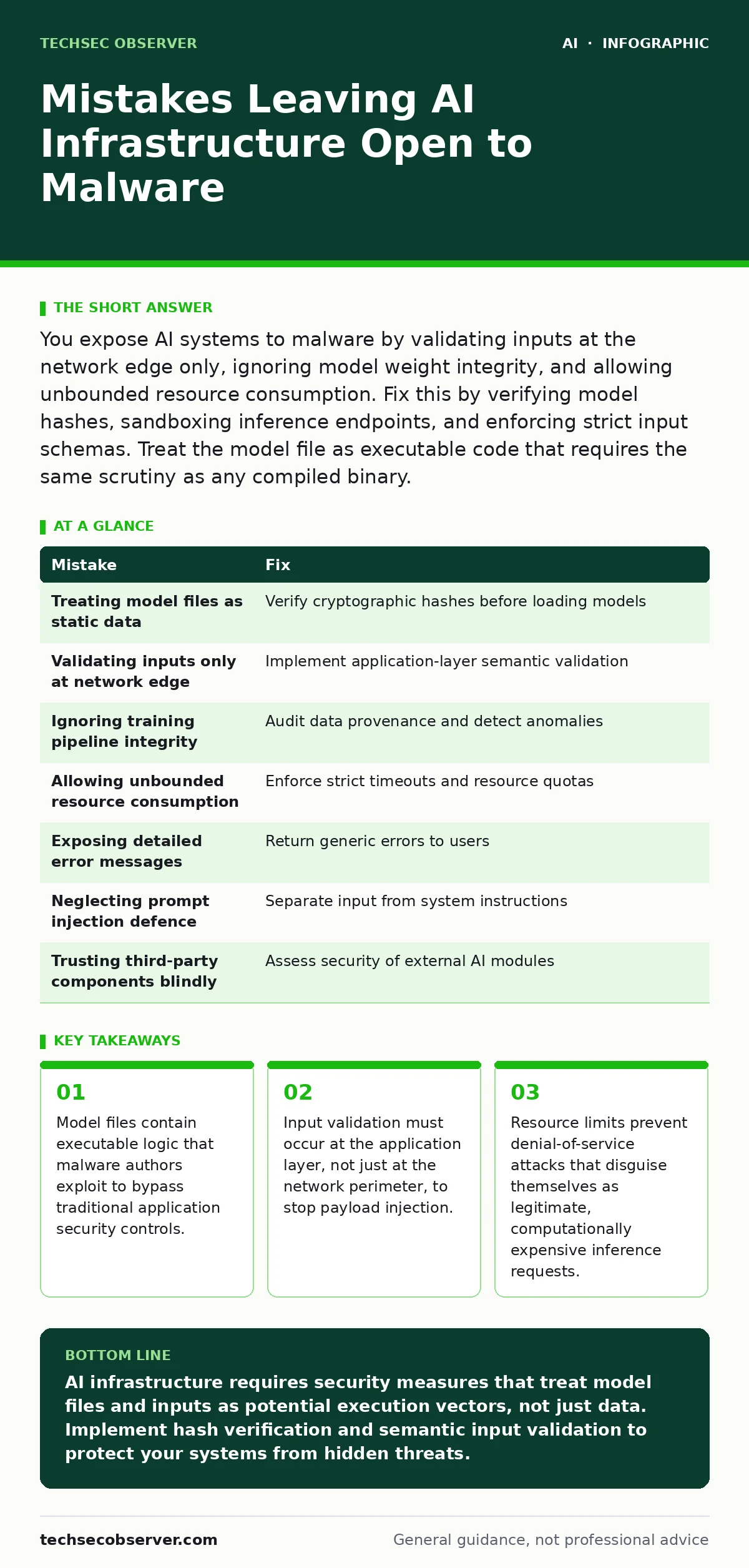
You expose AI systems to malware by validating inputs at the network edge only, ignoring model weight integrity, and allowing unbounded resource consumption. Fix this by verifying model hashes, sandboxing inference endpoints, and enforcing strict input schemas. Treat the model file as executable code that requires the same scrutiny as any compiled binary.
Mistake 1: Treating model files as static data
You often store trained machine learning models as static assets in object storage, assuming they are inert data. Malware authors know these files contain executable logic. When the inference engine loads the model, it executes the embedded code. If you load a tampered model without verification, you execute arbitrary commands on your server. This bypasses traditional application firewalls that only inspect HTTP headers.
Why it hurts:
The server executes malicious instructions embedded within the model weights. The attacker gains command execution on the inference host. You lose control of the container or virtual machine hosting the AI service. The malware can then pivot to other internal systems, stealing credentials or exfiltrating sensitive data processed by the model.
The fix:
Verify the cryptographic hash of every model file before loading it into memory. Compare the local hash against a known-good value stored in a secure, air-gapped repository. Implement automated checks in your deployment pipeline to reject any model whose signature does not match the expected value. This ensures the model has not been altered since the last successful validation step.
Mistake 2: Validating inputs only at the network edge
You configure your firewall to block known malicious IP addresses and filter traffic based on port numbers. You assume this is sufficient for AI services that accept natural language or structured data inputs. Attackers send requests from clean IP addresses using standard HTTPS protocols. The payload is hidden within the semantic structure of the input data, not in the network packet headers. Network-level tools cannot see the intent of the text.
Why it hurts:
Malicious instructions pass through your perimeter defences undetected. The AI model processes the input and executes the hidden command. This leads to data exfiltration or system compromise. The attack appears as normal user traffic in your logs, making detection difficult. You rely on the assumption that the input is benign, which is never a safe position.
The fix:
Implement application-layer input validation that parses the semantic content of requests. Use allowlists for expected input formats and lengths. Reject inputs that contain unusual character sequences or encoded payloads. Consider using a separate, lightweight model to classify inputs as benign or malicious before passing them to the main inference engine. This adds a layer of defence that understands the context of the data.
Mistake 3: Ignoring the integrity of the training pipeline
You focus security efforts on the inference stage, where users interact with the model. You neglect the training environment, which processes vast amounts of raw data. If an attacker injects malicious samples into the training dataset, the model learns to behave incorrectly. This is a form of data poisoning attacks. The model appears to function normally but contains hidden triggers that activate under specific conditions.
Why it hurts:
The model behaves unpredictably when it encounters specific trigger patterns. The attacker can force the model to output false information or execute unintended actions. This undermines the reliability of the entire system. You cannot detect this behaviour through standard monitoring because the model is technically functioning as trained. The root cause lies in the corrupted data used to build it.
The fix:
Audit the training data for anomalies and inconsistencies before training begins. Implement data provenance tracking to verify the source of every training sample. Use statistical methods to detect outliers that do not fit the expected distribution. Isolate the training environment from the internet and restrict access to authorised personnel only. This reduces the risk of data poisoning attacks compromising your model.
Mistake 4: Allowing unbounded resource consumption during inference
You allocate compute resources to your AI service without strict limits per request. You assume that legitimate users will not demand excessive processing power. Attackers craft inputs that require disproportionate computational effort to process. These inputs are designed to trigger worst-case scenarios in the model's architecture. The server spends excessive time and memory handling a single request, denying service to other users.
Why it hurts:
The inference server becomes unresponsive to legitimate traffic. The attacker achieves a denial-of-service effect without sending a high volume of requests. This type of attack is hard to detect because each individual request looks normal. Your monitoring tools may not flag the activity as malicious until the system crashes. You lose availability and potentially incur high cloud compute costs.
The fix:
Enforce strict timeouts and resource quotas for each inference request. Monitor the computational cost of processing specific inputs and terminate requests that exceed thresholds. Use containerisation to isolate each inference process and limit its memory and CPU usage. This prevents a single malicious request from consuming all available resources on the host machine.
Mistake 5: Exposing detailed error messages to users
You configure your AI service to return detailed error logs when processing fails. You believe this helps developers debug issues quickly. Attackers use these errors to map the internal structure of your application. They send malformed inputs to trigger specific errors, learning about the underlying libraries and configurations. This information helps them craft more effective attacks against your system.
Why it hurts:
The attacker gains insight into your technology stack and potential vulnerabilities. They can tailor their exploits to target specific components identified in the error messages. This reduces the effort required to compromise your system. You effectively provide a roadmap for attackers to bypass your defences. The convenience of detailed debugging aids is outweighed by the security risk.
The fix:
Return generic error messages to users that do not reveal internal details. Log detailed errors securely on the server side for developer review. Implement rate limiting on error-triggering endpoints to prevent automated scanning. This hides the internal workings of your application from potential attackers while still allowing your team to diagnose problems.
Mistake 6: Neglecting to monitor for prompt injection attacks
You assume that natural language inputs are safe because they are human-readable. You fail to implement specific defences against instructions hidden within the text. Prompt injection attacks trick the model into ignoring its original programming. The attacker embeds commands within the input that override the model's intended behaviour. This can lead to the model revealing sensitive information or performing unauthorized actions.
Why it hurts:
The model executes instructions it was not designed to follow. The attacker can manipulate the output to spread misinformation or steal data. This type of attack exploits the fundamental way large language models process context. Traditional input sanitisation methods often fail to detect these semantic manipulations. You need specific strategies to identify and block these instructions.
The fix:
Implement separation between user input and system instructions using clear delimiters. Use a secondary model to scan inputs for potential injection attempts before processing. Regularly test your model against known prompt injection vectors to ensure defences remain effective. This approach adds a layer of protection specifically designed to handle the unique risks of natural language processing.
Mistake 7: Trusting third-party AI components without verification
You integrate pre-built AI modules or APIs into your application without verifying their security. You assume that reputable vendors follow secure development practices. However, the AI supply chain risks are significant. A compromised third-party component can introduce vulnerabilities into your system. You inherit the security posture of every external tool you use.
Why it hurts:
A vulnerability in a third-party component becomes a vulnerability in your application. You may not be aware of the issue until it is exploited. The attack surface expands with every external dependency you add. You lose control over the security of parts of your system. This increases the likelihood of a successful breach.
The fix:
Conduct security assessments of all third-party AI components before integration. Monitor vendor security advisories for updates and patches. Limit the permissions granted to external APIs to the minimum required for functionality. This reduces the impact of a compromise in any single component and maintains greater control over your system's security posture.
| Mistake | Fix |
|---|---|
| Treating model files as static data | Verify cryptographic hashes before loading models |
| Validating inputs only at network edge | Implement application-layer semantic validation |
| Ignoring training pipeline integrity | Audit data provenance and detect anomalies |
| Allowing unbounded resource consumption | Enforce strict timeouts and resource quotas |
| Exposing detailed error messages | Return generic errors to users |
| Neglecting prompt injection defence | Separate input from system instructions |
| Trusting third-party components blindly | Assess security of external AI modules |
Key takeaways
- Model files contain executable logic that malware authors exploit to bypass traditional application security controls.
- Input validation must occur at the application layer, not just at the network perimeter, to stop payload injection.
- Resource limits prevent denial-of-service attacks that disguise themselves as legitimate, computationally expensive inference requests.
AI infrastructure requires security measures that treat model files and inputs as potential execution vectors, not just data. Implement hash verification and semantic input validation to protect your systems from hidden threats.
Frequently asked questions
How do I detect if my model has been poisoned?
Monitor for unusual performance drops or biased outputs on specific input patterns. Compare current model behaviour against a baseline established during initial testing to identify deviations.
Can traditional firewalls stop AI-specific malware?
No, traditional firewalls inspect network headers and ports, not the semantic content of data. You need application-layer controls to detect malicious instructions hidden within text or data structures.
What is the role of AI red teaming in this context?
AI red teaming involves simulating attacks against your AI systems to identify vulnerabilities. It helps you test defences against prompt injection and data poisoning before attackers do.
Should I block all external API calls to my AI service?
Not necessarily, but you should restrict permissions and monitor traffic closely. Implement strict authentication and authorisation checks for every API call to prevent unauthorised access.
How this guide was produced: written by the TechSec Observer editorial team with AI assistance, checked against the public references listed below, and reviewed when the facts change. See our editorial policy or report an error.