Active Directory Attack Warning Signs Early Detection Methods
Credential theft often leaves no login trace, so you must monitor process memory access patterns to detect silent compromise before lateral movement begins.

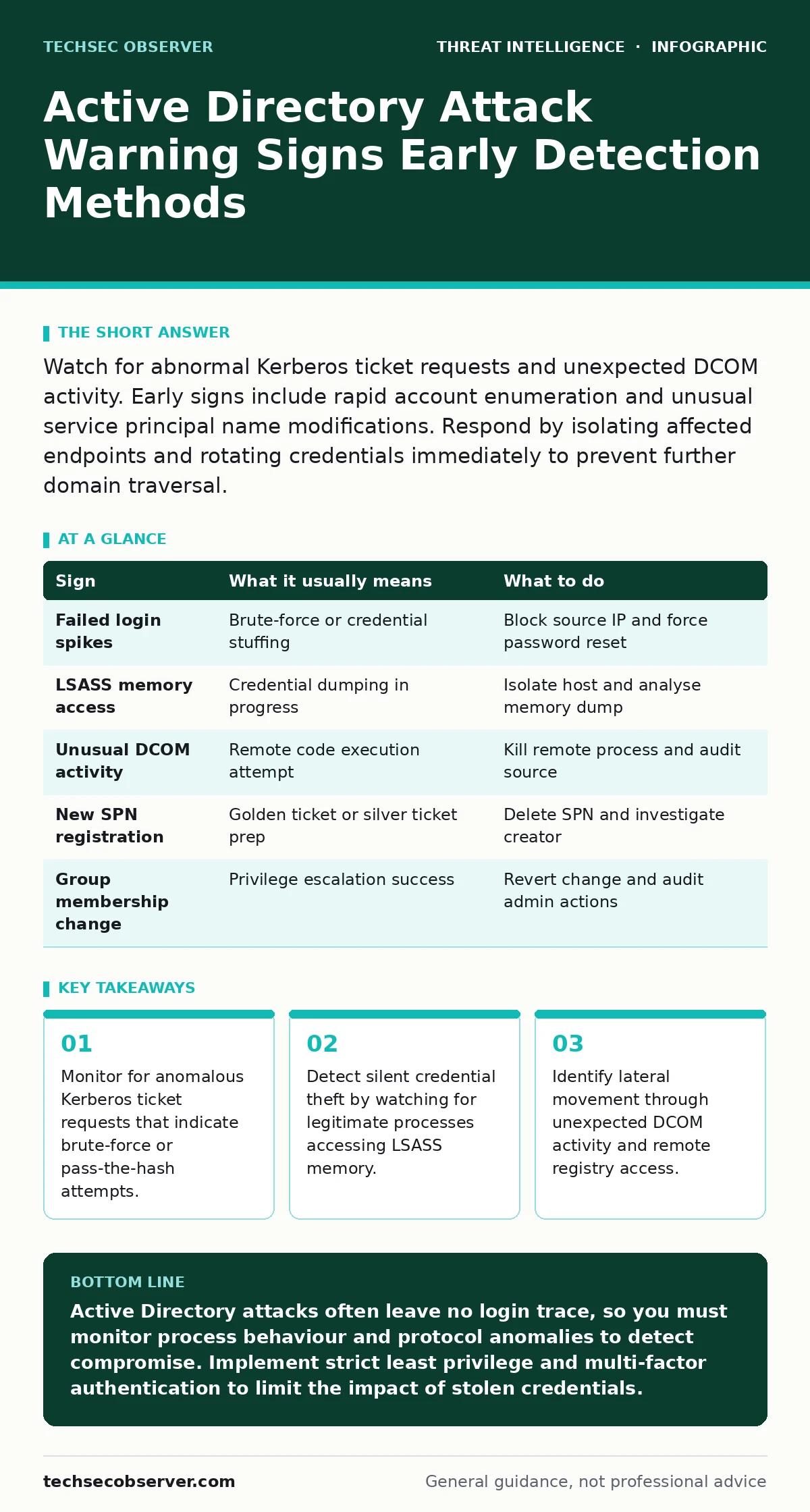
Watch for abnormal Kerberos ticket requests and unexpected DCOM activity. Early signs include rapid account enumeration and unusual service principal name modifications. Respond by isolating affected endpoints and rotating credentials immediately to prevent further domain traversal.
Recognising Immediate Active Directory Alerts
You will notice immediate alerts when authentication logs show sudden spikes in failed logins. These spikes often indicate brute-force attacks against privileged accounts. The system generates events for every failed attempt, creating a clear pattern. You should correlate these events with source IP addresses to identify external scanning. Internal scanners also generate these spikes when they test stolen credentials. The volume of failures is the first visible sign of compromise.
Detecting Silent Credential Theft
Silent attacks avoid generating login events entirely. Attackers use legitimate tools to dump credentials from memory. This technique bypasses standard authentication logging. You must monitor process behaviour rather than login attempts. Look for legitimate services accessing the Local Security Authority Subsystem Service. This access indicates credential dumping. Without monitoring process memory, you will miss this theft completely. The attacker already has the keys to the kingdom.
Identifying Lateral Movement Patterns
Lateral movement relies on abusing existing trust relationships. Attackers use Distributed Component Object Model to execute code remotely. This traffic often looks like normal administrative activity. You must baseline what normal DCOM activity looks like in your environment. Any deviation from this baseline warrants investigation. Remote registry access is another common vector. Attackers use this to modify boot configurations or install persistence mechanisms. Monitor for these remote execution attempts closely.
Spotting Privilege Escalation Attempts
Privilege escalation requires modifying group memberships or permissions. Attackers often add their accounts to high-privilege groups. This action generates specific directory service change events. You should alert on any modification to domain admin groups. Attackers also create new service principal names to intercept authentication traffic. This technique allows them to capture credentials without stealing them. Monitor for new SPN registrations and immediate service starts.
Understanding Kerberos Anomalies
Kerberos is the default authentication protocol in Active Directory. Attackers abuse it by requesting tickets for many accounts. This behaviour generates distinct event codes. You can detect this by looking for a high volume of ticket requests from a single source. This pattern indicates account enumeration or pass-the-ticket attacks. The attacker is testing which accounts are valid. They are not yet logging in, so you see no login events. The ticket requests are the only clue.
| Sign | What it usually means | What to do |
|---|---|---|
| Failed login spikes | Brute-force or credential stuffing | Block source IP and force password reset |
| LSASS memory access | Credential dumping in progress | Isolate host and analyse memory dump |
| Unusual DCOM activity | Remote code execution attempt | Kill remote process and audit source |
| New SPN registration | Golden ticket or silver ticket prep | Delete SPN and investigate creator |
| Group membership change | Privilege escalation success | Revert change and audit admin actions |
See also: Purple Team Cyber Security: Bridging Red and Blue for Faster Defences · Process Injection Prevention Checklist for Secure Code
Implementing Effective Monitoring Strategies
You need to centralise logs from all domain controllers. Distributed logging makes correlation difficult. Use a security information and event management system to aggregate data. Create rules that trigger on the specific events mentioned above. You must tune these rules to reduce noise. False positives will cause alert fatigue. Focus on high-fidelity signals like LSASS access and group changes. Regular review of these logs is necessary to maintain detection capability.
Responding to Detected Compromise
When you see a confirmed sign, act immediately. Isolate the affected endpoint from the network. This prevents further lateral movement. Reset the credentials of any compromised accounts. Check for persistence mechanisms on the host. Review other systems that the compromised account accessed. You must assume the attacker has moved laterally. Conduct a full forensic analysis to determine the scope. Document every step for future improvement.
Preventing Future Active Directory Attacks
Prevention requires limiting the attack surface. Disable unused accounts and services. Implement least privilege principles strictly. Regularly audit group memberships and permissions. Use multi-factor authentication for all privileged access. This stops credential theft from being useful. Monitor for known attack techniques continuously. Update your detection rules as new techniques emerge. Stay ahead of the attacker by understanding their methods.
Key takeaways
- Monitor for anomalous Kerberos ticket requests that indicate brute-force or pass-the-hash attempts.
- Detect silent credential theft by watching for legitimate processes accessing LSASS memory.
- Identify lateral movement through unexpected DCOM activity and remote registry access.
Active Directory attacks often leave no login trace, so you must monitor process behaviour and protocol anomalies to detect compromise. Implement strict least privilege and multi-factor authentication to limit the impact of stolen credentials.
Frequently asked questions
How do I distinguish between normal admin activity and an attack?
Baseline normal administrative actions and alert on deviations in timing, frequency, or source IP. Legitimate admins follow predictable patterns.
Can multi-factor authentication stop all Active Directory attacks?
MFA stops credential-based attacks but does not prevent pass-the-hash or memory-based theft. You still need to monitor for these techniques.
What is the most common initial access vector?
Phishing emails that steal credentials are common, but credential dumping from compromised endpoints is also frequent. Both require different detection methods.
How often should I review Active Directory logs?
Review logs daily for anomalies. Automated alerts should trigger immediate investigation. Regular manual review helps tune detection rules and reduce noise.
How this guide was produced: written by the TechSec Observer editorial team with AI assistance, checked against the public references listed below, and reviewed when the facts change. See our editorial policy or report an error.