AI in security operations: separating automation myths from reality
Machine learning models accelerate triage in security operations centers, yet they routinely obscure the underlying logic of network anomalies.

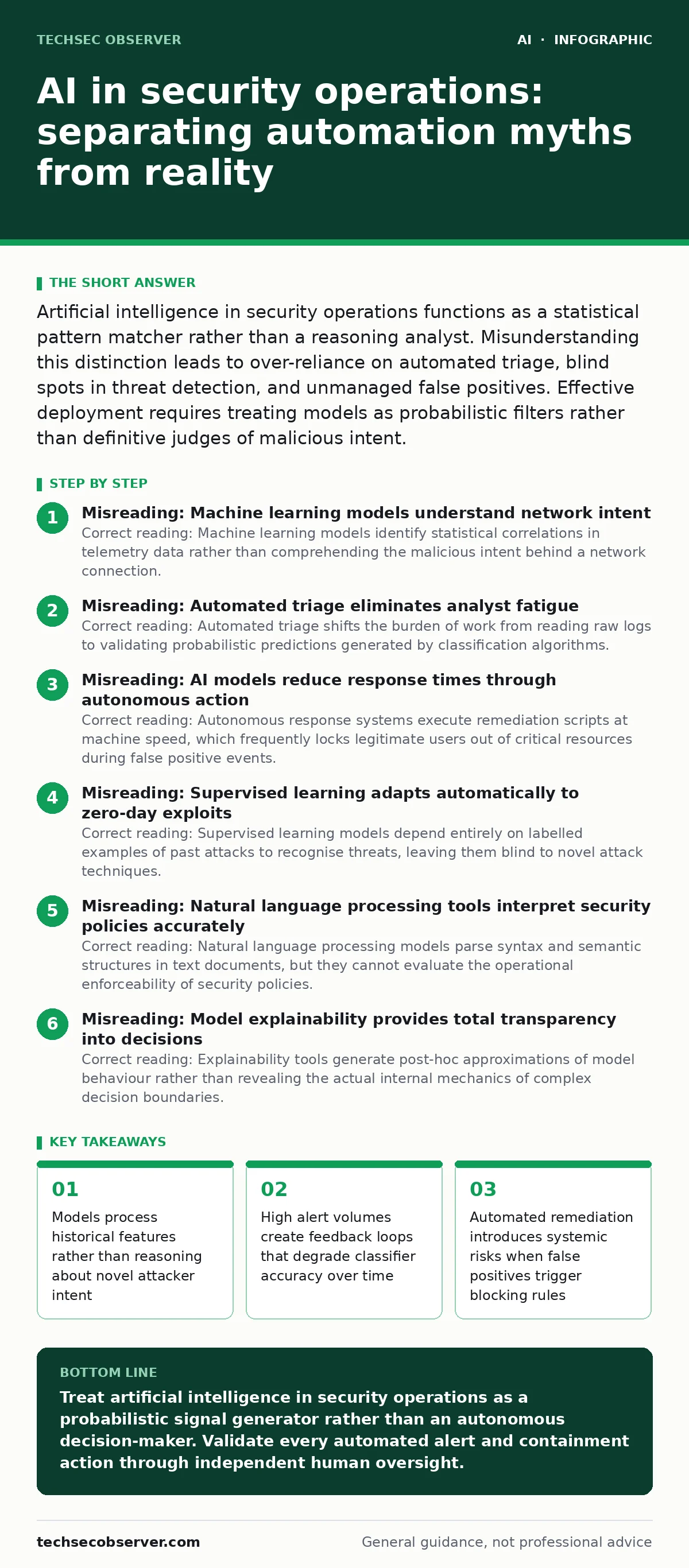
Artificial intelligence in security operations functions as a statistical pattern matcher rather than a reasoning analyst. Misunderstanding this distinction leads to over-reliance on automated triage, blind spots in threat detection, and unmanaged false positives. Effective deployment requires treating models as probabilistic filters rather than definitive judges of malicious intent.
Misreading: Machine learning models understand network intent
Correct reading: Machine learning models identify statistical correlations in telemetry data rather than comprehending the malicious intent behind a network connection. An anomaly detector flags deviations from baseline behaviour, but it cannot distinguish between a sophisticated intrusion and an unusual administrative task. Treating numerical similarity as semantic understanding creates severe blind spots.
Statistical classifiers rely on feature extraction, which reduces complex packet captures or log files into numerical vectors. Attackers routinely manipulate these features by injecting noise or mimicking normal user behaviour to slip past detection thresholds. Relying on mathematical distance metrics fails because mathematical proximity does not equate to security relevance.
Feature drift occurs when baseline network activities shift over time, rendering historical training data obsolete. Models trained on past traffic patterns will misclassify new legitimate software deployments as threats simply because those patterns were absent during the initial training phase. Maintenance requires continuous retraining, which introduces its own operational complexities and resource costs.
Misreading: Automated triage eliminates analyst fatigue
Correct reading: Automated triage shifts the burden of work from reading raw logs to validating probabilistic predictions generated by classification algorithms. Analysts spend considerable time investigating false positives, which occurs when benign actions match historical signatures of compromise. The sheer volume of alerts generated by automated systems often overwhelms security teams just as effectively as raw telemetry.
Alert fatigue persists because confidence scores attached to model outputs lack contextual grounding. A high confidence score merely indicates that an event closely resembles training data labelled as malicious, not that a human analyst has verified an active compromise. Analysts must still perform manual forensics to confirm the validity of every flagged anomaly.
Probabilistic triage systems can suffer from cascade failures when upstream data pipelines introduce corrupt inputs. Imagine a logging agent that drops timestamp fields, causing the downstream classifier to miscalculate session durations and flood the queue with high-severity alerts. Security operations must validate the integrity of input streams before trusting the outputs of neural networks.
Misreading: AI models reduce response times through autonomous action
Correct reading: Autonomous response systems execute remediation scripts at machine speed, which frequently locks legitimate users out of critical resources during false positive events. Automated containment measures lack the situational awareness required to measure business impact. Speed without context transforms a minor detection error into an operational outage.
Orchestration playbooks driven by probabilistic classifiers bypass human governance during critical incident response phases. When an automated containment rule isolates a primary database server due to a misidentified query pattern, recovery requires manual intervention that often exceeds the time saved by automation. Speed amplifies mistakes just as efficiently as it accelerates defence.
Systemic risks multiply when multiple automated agents interact across complex enterprise architectures without coordination. Imagine a scenario where one defensive model revokes compromised credentials while another model attempts to authenticate using those same credentials for health checks, triggering a cascading lockout loop. Safe deployment demands strict boundaries around autonomous actions.
Misreading: Supervised learning adapts automatically to zero-day exploits
Correct reading: Supervised learning models depend entirely on labelled examples of past attacks to recognise threats, leaving them blind to novel attack techniques. A zero-day exploit by definition lacks historical representation in training sets, meaning standard classifiers will treat malicious payloads as benign anomalies or ignore them entirely. Adaptation requires deliberate collection and labelling of new threat samples.
Generalisation limits prevent models from accurately extrapolating from known attack patterns to entirely new methodologies. While humans apply analogical reasoning to bridge gaps in threat intelligence, statistical algorithms interpolate within the boundaries of existing training distributions. Pushing a model outside its training domain yields unpredictable classifications.
Adversarial manipulation exploits the mathematical vulnerabilities inherent in pattern recognition systems. Attackers can craft inputs specifically designed to mislead classifiers by introducing subtle perturbations that alter the mathematical vector without changing the underlying functionality of the code. This reality mirrors challenges studied in research areas like AI red teaming, where models fail under targeted stress tests.
Misreading: Natural language processing tools interpret security policies accurately
Correct reading: Natural language processing models parse syntax and semantic structures in text documents, but they cannot evaluate the operational enforceability of security policies. Language models predict subsequent tokens based on probability, producing fluent summaries that occasionally invent non-existent configuration parameters or misinterpret compliance requirements. Syntax fluency masks underlying factual errors.
Policy documents contain nuanced legal and architectural dependencies that resist purely statistical interpretation. When an analyst asks an automated assistant to review an access control list against a regulatory standard, the model may overlook subtle contradictions between clauses. Automated text processing assists with document search, but it cannot replace human legal and technical validation.
Hallucinations in language models introduce plausible falsehoods into security assessments, creating vulnerabilities disguised as authoritative guidance. A model might invent a secure configuration syntax that appears correct yet exposes sensitive ports to the internet. Trusting generated text without verification violates foundational validation principles.
Misreading: Model explainability provides total transparency into decisions
Correct reading: Explainability tools generate post-hoc approximations of model behaviour rather than revealing the actual internal mechanics of complex decision boundaries. Feature importance scores highlight which inputs influenced a classification, but they fail to explain the complex non-linear interactions occurring across hidden layers. Approximations can mislead investigators into trusting flawed logic.
Feature attribution methods often conflict with one another, providing contradictory explanations for the same security alert. One interpretability algorithm might point to network packet size as the primary driver for a malicious classification, while a different method points to source port numbers. Relying on single-metric explanations creates a false sense of security regarding model transparency.
Regulators and internal auditors frequently demand clear provenance for automated security decisions, which current machine learning architectures struggle to provide reliably. Understanding these limitations connects directly to broader discussions surrounding AI transparency, where the gap between statistical correlation and causal proof remains wide.
Misreading: Security data is clean enough for reliable model training
Correct reading: Enterprise security telemetry is inherently noisy, incomplete, and biased, which corrupts the foundational data used to train predictive models. Missing log fields, asynchronous timestamps, and inconsistent naming conventions introduce systematic errors that degrade model accuracy. Training algorithms amplify existing data flaws rather than correcting them.
Data collection pipelines drop packets during peak network congestion, creating invisible gaps in the historical record supplied to training algorithms. Models trained on incomplete visibility learn to ignore missing data, assuming absence of evidence equals evidence of absence. This assumption breaks down when attackers deliberately blind logging sensors during early reconnaissance phases.
Data quality issues stem from organisational silos and fragmented asset inventories that plague modern enterprise environments. These foundational data integrity problems mirror challenges explored in data poisoning attacks, where poor hygiene creates vulnerabilities even without malicious interference. Clean data remains the rarest commodity in security engineering.
Key takeaways
- Models process historical features rather than reasoning about novel attacker intent
- High alert volumes create feedback loops that degrade classifier accuracy over time
- Automated remediation introduces systemic risks when false positives trigger blocking rules
Treat artificial intelligence in security operations as a probabilistic signal generator rather than an autonomous decision-maker. Validate every automated alert and containment action through independent human oversight.
Frequently asked questions
Can machine learning entirely replace human analysts in security operations?
Machine learning cannot replace human analysts because it lacks contextual reasoning, situational awareness, and the ability to interpret novel threat strategies. Models accelerate the sorting of high-volume telemetry, but human judgement remains necessary for investigation and remediation.
Why do false positives persist even after retraining security models?
False positives persist because enterprise network behaviour constantly shifts, creating natural variations that mimic historical threat signatures. Retraining updates historical baselines, but it cannot eliminate the fundamental overlap between benign administrative actions and malicious activity.
How do attackers exploit security models in operational environments?
Attackers exploit security models by introducing subtle data perturbations that shift feature vectors across decision boundaries without altering the malicious payload. This manipulation causes classifiers to misidentify active threats as benign background noise.
What is the primary risk of autonomous remediation in security systems?
The primary risk of autonomous remediation is the rapid execution of destructive actions during false positive events, which can lock legitimate users out of critical resources. Unchecked automation transforms detection errors into severe operational outages.
How this guide was produced: written by the TechSec Observer editorial team with AI assistance, checked against the public references listed below, and reviewed when the facts change. See our editorial policy or report an error.