AI transparency means you should verify model decisions
Transparency does not guarantee fairness, but it provides the only reliable method for auditing algorithmic bias and detecting hidden data leaks in production systems.

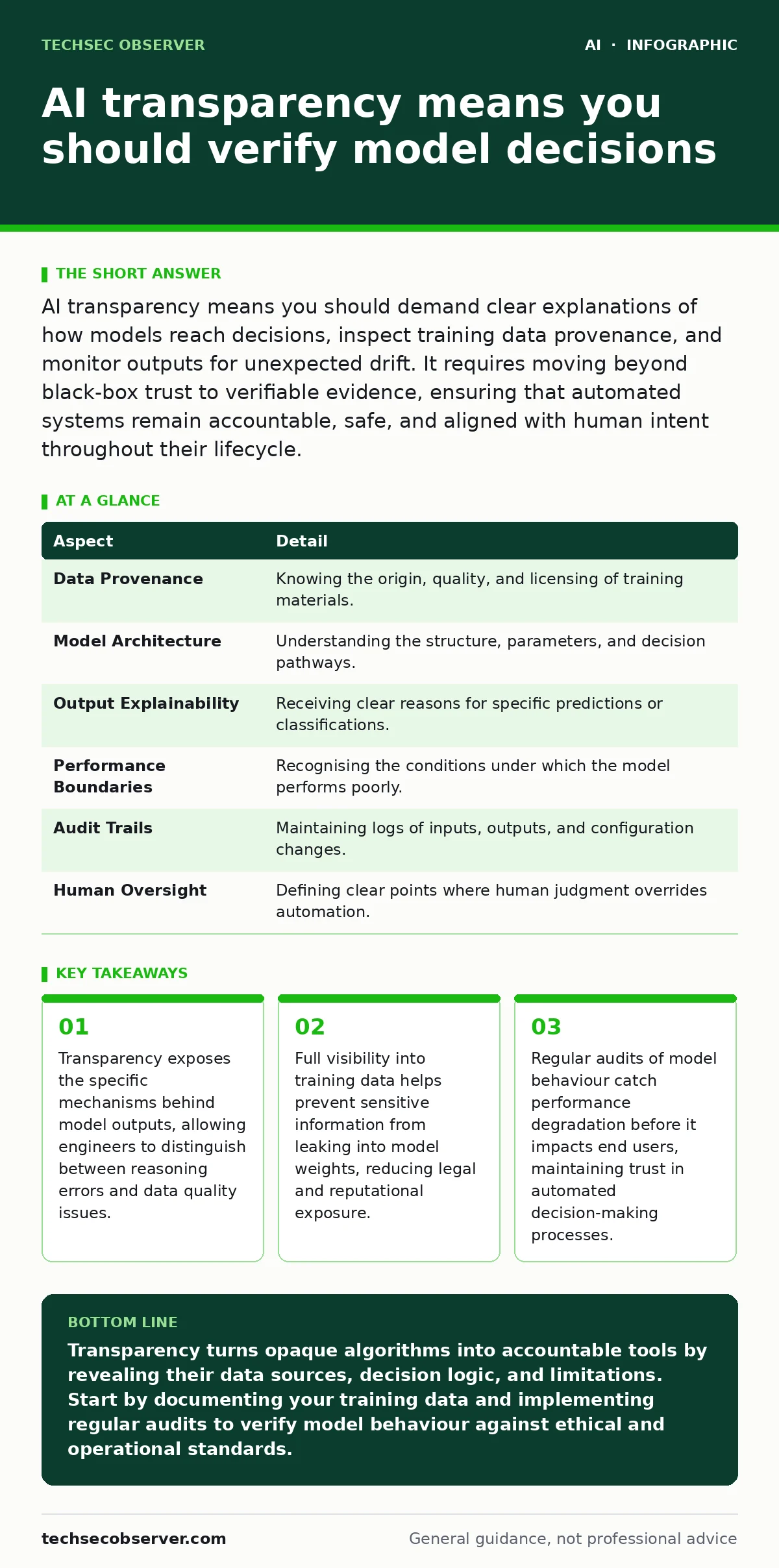
AI transparency means you should demand clear explanations of how models reach decisions, inspect training data provenance, and monitor outputs for unexpected drift. It requires moving beyond black-box trust to verifiable evidence, ensuring that automated systems remain accountable, safe, and aligned with human intent throughout their lifecycle.
The Glass Box Analogy
Imagine a chef who refuses to show you the recipe or the ingredients, yet insists the dish is safe to eat. You might taste the meal, but you cannot verify if it contains allergens or spoiled components. AI transparency operates on the same principle. It is the practice of making the inner workings of artificial intelligence systems visible and understandable to humans. This visibility applies to the data used for training, the architecture of the model, and the logic behind its final outputs.
Transparency does not mean publishing every line of code. It means providing enough context for a knowledgeable person to evaluate risk, verify fairness, and understand limitations. When you understand how a system works, you can predict where it might fail. This shifts your role from passive consumer to active auditor. You gain the ability to question results rather than accept them as inevitable truths generated by a mysterious machine.
At a Glance: Transparency Components
| Aspect | Detail |
|---|---|
| Data Provenance | Knowing the origin, quality, and licensing of training materials. |
| Model Architecture | Understanding the structure, parameters, and decision pathways. |
| Output Explainability | Receiving clear reasons for specific predictions or classifications. |
| Performance Boundaries | Recognising the conditions under which the model performs poorly. |
| Audit Trails | Maintaining logs of inputs, outputs, and configuration changes. |
| Human Oversight | Defining clear points where human judgment overrides automation. |
AI transparency means you should
AI transparency means you should treat every model output as a hypothesis rather than a fact. You must verify the source of the information, check for consistency across similar inputs, and understand the confidence level of the prediction. This mindset prevents over-reliance on automated systems that may hallucinate or exhibit bias. You should also document why you trust a specific result. This documentation serves as a defence against future errors and provides a basis for continuous improvement.
When you integrate AI into workflows, transparency dictates that you know what the model is optimising for. Is it maximising speed, accuracy, or engagement? Each goal introduces different trade-offs. A model optimised for speed may sacrifice nuance. A model optimised for engagement may amplify controversial content. Understanding these objectives allows you to align the tool with your ethical and operational standards. You cannot manage what you cannot see.
How Transparency Works in Practice
Transparency relies on three main layers. The first layer is data documentation. This involves recording the sources, dates, and potential biases of the training data. If you train a model on outdated news articles, it will reflect past prejudices. The second layer is model interpretability. Techniques such as attention maps or feature importance scores show which inputs influenced the output. This helps you identify if the model is using relevant features or spurious correlations.
The third layer is output explanation. The system should provide reasons for its decisions, not just the decisions themselves. For example, a loan approval model should state that income and credit history were the primary factors. This allows you to challenge the logic if it seems flawed. Transparency also requires monitoring for model drift, where the model's performance degrades as real-world data changes over time. Without this monitoring, you may continue using a model that no longer reflects reality.
Who Transparency Affects
Transparency affects developers, legal teams, and end users. Developers need it to debug errors and improve performance. When a model fails, knowing which part of the pipeline caused the failure saves time and resources. Legal teams need it to ensure compliance with regulations regarding data privacy and non-discrimination. They must prove that decisions were made fairly and without prohibited bias.
End users benefit from transparency through trust. If people understand how a system works and why it makes certain suggestions, they are more likely to use it effectively. However, transparency also creates responsibility. Once you know a model is biased, you cannot claim ignorance. This shifts the burden of proof onto the organisation using the technology. It forces a culture of accountability where every automated decision can be questioned and justified.
See also: AI in security operations: separating automation myths from reality
What People Usually Get Wrong
Many believe that transparency equals full disclosure of all code and data. This is incorrect. Full disclosure can expose intellectual property or sensitive user information. True transparency provides sufficient information for verification without compromising security or privacy. Another common mistake is assuming that a transparent model is automatically fair. A model can be fully explainable and still produce biased results if the training data is flawed. Transparency reveals the bias; it does not fix it.
People also confuse transparency with simplicity. Complex models can be transparent if their decision processes are documented and interpretable. Simple models can be opaque if their training data is unknown. The goal is not to simplify the AI, but to clarify its behaviour. You must distinguish between the complexity of the algorithm and the clarity of its documentation. Ignoring this distinction leads to either over-sharing or under-explaining, both of which create risk.
Practical Steps for Developers
To implement transparency, start by documenting your data pipeline. Record every source and transformation applied to the training data. This creates a clear history that can be audited later. Next, choose models that offer interpretability features. Avoid black-box solutions for high-stakes decisions. Use techniques like counterfactual explanations to test how small changes in input affect the output. This helps you understand the model's sensitivity and stability.
Regularly audit your models for bias and drift. Set up alerts for significant changes in performance or output distribution. Involve diverse stakeholders in the review process. Different perspectives can spot issues that technical teams might miss. Finally, maintain clear logs of all model interactions. These logs are vital for investigating errors and improving future iterations. Transparency is not a one-time task but a continuous practice.
Integrating with Broader Security Practices
Transparency works best when combined with other security measures. For instance, understanding data poisoning attacks becomes easier when you can trace anomalies back to specific training batches. If you know your data sources, you can spot when an attacker has inserted malicious samples. Similarly, AI supply chain risks are mitigated when you have visibility into third-party models and libraries you depend on. You can verify that these components have not been tampered with.
Transparency also supports AI model monitoring. When you know what normal behaviour looks like, deviations become obvious. This helps in detecting prompt injection attacks where users try to manipulate the model's output. By logging inputs and outputs, you can identify patterns of abuse. Furthermore, transparency aids in AI governance by providing the evidence needed for policy decisions. It ensures that ethical guidelines are not just words on paper but enforceable standards.
Consider the risks of training data leakage. If your model memorises sensitive information, transparency helps you identify which data points were problematic. You can then remove them and retrain. This proactive approach prevents jailbreaking AI chatbots attempts from exploiting hidden vulnerabilities. By making the system's boundaries clear, you reduce the attack surface. Transparency is a foundational element of a secure AI ecosystem.
Key takeaways
- Transparency exposes the specific mechanisms behind model outputs, allowing engineers to distinguish between reasoning errors and data quality issues.
- Full visibility into training data helps prevent sensitive information from leaking into model weights, reducing legal and reputational exposure.
- Regular audits of model behaviour catch performance degradation before it impacts end users, maintaining trust in automated decision-making processes.
Transparency turns opaque algorithms into accountable tools by revealing their data sources, decision logic, and limitations. Start by documenting your training data and implementing regular audits to verify model behaviour against ethical and operational standards.
Frequently asked questions
Does transparency slow down development?
Initial documentation takes time, but it reduces debugging effort and prevents costly errors later. It speeds up long-term maintenance and trust-building.
How much detail is enough?
Enough for an independent auditor to verify fairness, safety, and compliance. This usually means data provenance, model architecture, and decision rationale.
Can I be transparent without sharing code?
Yes. You can share documentation, data summaries, and interpretability reports without revealing proprietary source code or full datasets.
What if the model is too complex to explain?
Use surrogate models or feature importance tools to approximate the decision logic. Avoid using such models for high-stakes decisions if explanations remain unclear.
How this guide was produced: written by the TechSec Observer editorial team with AI assistance, checked against the public references listed below, and reviewed when the facts change. See our editorial policy or report an error.