User and Entity Behavior Analytics: Definition, Purpose and Mechanics
Move beyond static rules by learning how UEBA establishes behavioural baselines to detect subtle anomalies that traditional controls miss.

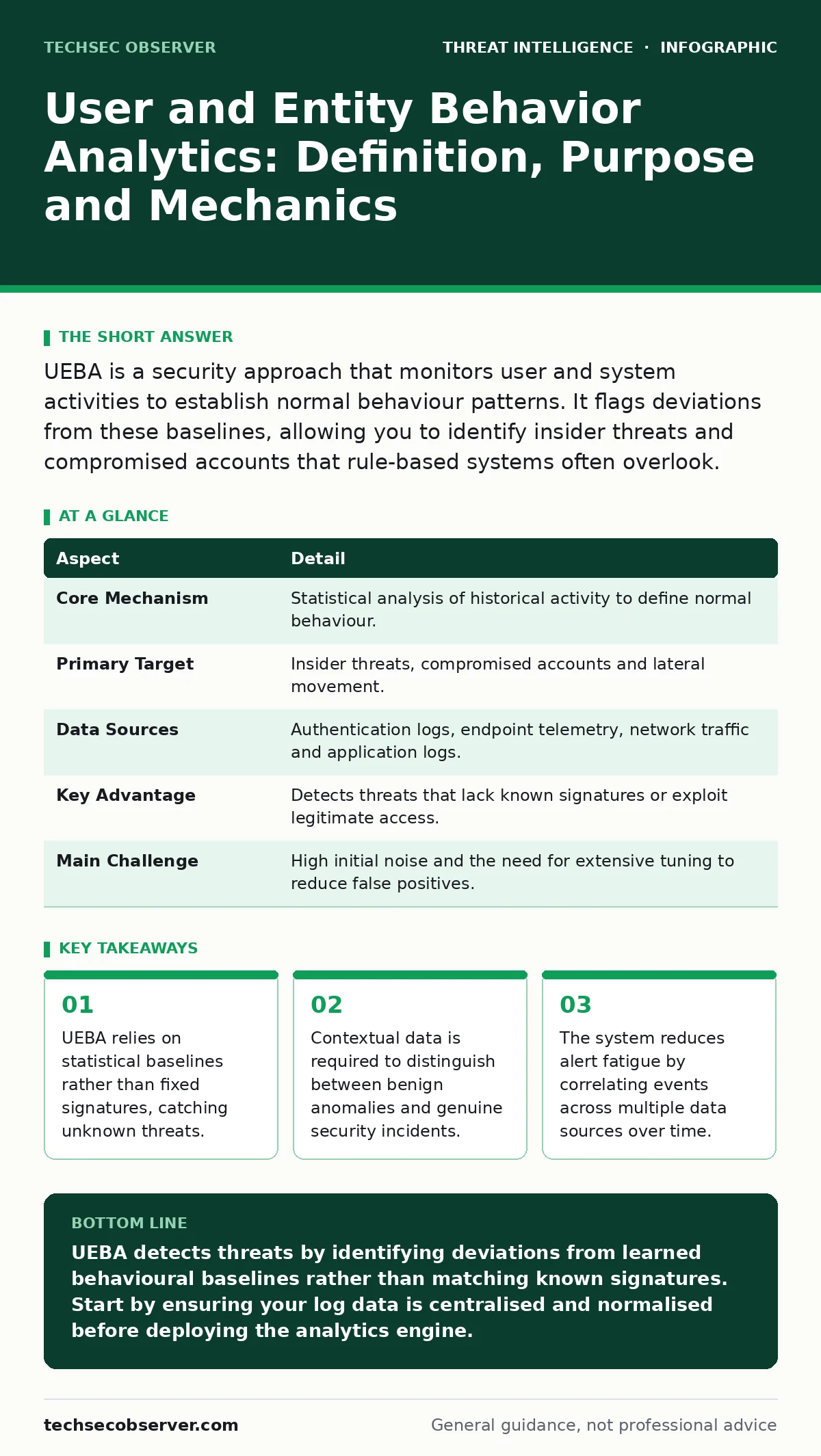
UEBA is a security approach that monitors user and system activities to establish normal behaviour patterns. It flags deviations from these baselines, allowing you to identify insider threats and compromised accounts that rule-based systems often overlook.
The Thermostat Analogy
Imagine a smart thermostat in your office. It does not simply record the temperature; it learns when the building is occupied, what the weather is outside, and how quickly the room heats up. If the thermostat detects the heating system running at full capacity at 3:00 am on a Sunday, it flags this as unusual. It does not need a rule saying "heating must be off on Sundays." It knows this because it has observed the pattern of normal usage for months.
User and entity behaviour analytics works on this same principle. Instead of monitoring temperature, it monitors digital activity. It learns the typical behaviour of every user and device in your network. When activity deviates significantly from this learned baseline, the system generates an alert. This shift from static rules to dynamic baselines is the core of the technology.
Why Static Rules Fail
Traditional security tools rely on predefined rules. You tell the system to block traffic from a specific country or to alert when a file is renamed to a known malware signature. This approach is effective against known threats but blind to new ones. It cannot detect a legitimate account being used maliciously because the actions themselves—logging in, copying files—are technically permitted.
Suppose an employee’s credentials are stolen. An attacker logs in from a new location but performs only routine tasks. A rule-based system sees a valid login and routine file access. It records no violation. However, this behaviour is abnormal for that specific user. They never log in from that region, and they do not copy files at this time of day. UEBA identifies this mismatch between identity and behaviour.
| Aspect | Detail |
|---|---|
| Core Mechanism | Statistical analysis of historical activity to define normal behaviour. |
| Primary Target | Insider threats, compromised accounts and lateral movement. |
| Data Sources | Authentication logs, endpoint telemetry, network traffic and application logs. |
| Key Advantage | Detects threats that lack known signatures or exploit legitimate access. |
| Main Challenge | High initial noise and the need for extensive tuning to reduce false positives. |
The Three Pillars of UEBA
The system functions through three distinct stages. First, it ingests data. This data comes from identity providers, endpoint detection tools, network appliances and cloud applications. Without high-fidelity data from these sources, the analytics engine has nothing to analyse. The quality of the input directly determines the quality of the output.
Second, the system establishes baselines. It uses machine learning algorithms to cluster similar activities and identify patterns. It creates a profile for each user and entity, noting typical login times, usual device locations, common file types accessed and normal volume of data transferred. This baseline is not static; it updates continuously as behaviour changes.
Third, the system detects anomalies. It compares real-time activity against the established baselines. It calculates a risk score based on the severity and rarity of the deviation. A slight deviation might be ignored, while a severe deviation triggers an alert. This scoring allows you to prioritise incidents based on potential impact rather than raw volume.
Context Over Correlation
An anomaly is not necessarily a threat. People change jobs, travel for work or adopt new tools. If the system flags every deviation, you will drown in alerts. The value of UEBA lies in its ability to apply context. It correlates the anomaly with other data points.
For instance, if the developer in the previous example also has a travel booking in the system for a late-night flight, the anomaly loses its significance. The system can cross-reference HR data or calendar entries to validate the behaviour. This contextual layer is what separates useful intelligence from noise. Without it, the tool becomes a liability, causing alert fatigue and desensitising your security team.
Integration with Existing Defences
UEBA does not replace your existing security stack. It sits above it, acting as a correlation engine. Your firewall blocks external attacks. Your antivirus scans for known malware. Your identity provider enforces multi-factor authentication. UEBA watches the outcomes of these controls and the behaviour that passes through them.
It fits into the detection and response phase of your security lifecycle. When a traditional tool misses a threat, UEBA may catch the residual behaviour. Conversely, when UEBA flags a suspicious pattern, it can trigger automated responses in other systems, such as forcing a password reset or isolating a device. This integration creates a layered defence where each component compensates for the weaknesses of the others.
See also: Active Directory Attack Warning Signs Early Detection Methods · What is Dwell Time: Why Detection Latency Dictates Breach Severity
What People Get Wrong
Many organisations deploy UEBA expecting immediate, accurate results. They underestimate the time required for the system to learn. In the first weeks, the system has no baseline. It will flag almost everything as anomalous because it does not yet know what is normal. This initial period requires manual tuning and validation.
Another common error is treating UEBA as a standalone solution. It cannot function without rich, centralised data. If your logs are siloed in different departments or formatted inconsistently, the analytics engine cannot correlate events across the environment. You must invest in data normalisation and collection before the analytics can provide value.
The Hidden Cost of Privacy
Behavioural monitoring raises significant privacy concerns. You are tracking every click, login and file access of your staff. This level of scrutiny can erode trust if not handled transparently. You must define clear policies on what data is collected, how it is stored and who can access it.
Anonymisation and aggregation techniques can help mitigate this risk. By focusing on behavioural patterns rather than individual content, you can protect privacy while maintaining security. However, the line between monitoring for security and monitoring for productivity is thin. Crossing it can lead to legal challenges and cultural backlash within your organisation.
Tuning for Long-Term Success
The effectiveness of UEBA depends on continuous tuning. As your organisation grows, new users join and old ones leave. New applications are deployed, and work patterns shift. The baselines must evolve with these changes. Regular reviews of false positives are necessary to refine the models.
You should establish a feedback loop where security analysts confirm whether alerts are true positives or false alarms. This feedback trains the machine learning models, making them more accurate over time. Without this human-in-the-loop process, the system will drift and become less reliable. The investment in tuning is ongoing, not a one-time setup task.
Key takeaways
- UEBA relies on statistical baselines rather than fixed signatures, catching unknown threats.
- Contextual data is required to distinguish between benign anomalies and genuine security incidents.
- The system reduces alert fatigue by correlating events across multiple data sources over time.
UEBA detects threats by identifying deviations from learned behavioural baselines rather than matching known signatures. Start by ensuring your log data is centralised and normalised before deploying the analytics engine.
Frequently asked questions
Does UEBA replace endpoint detection and response?
No, UEBA complements EDR by providing context and correlation across the entire environment, whereas EDR focuses on specific device-level threats.
How long does it take for UEBA to become effective?
It typically requires several weeks of data collection to establish accurate baselines, during which manual tuning is necessary to reduce noise.
Can UEBA detect external attackers?
It detects external attackers only after they have gained access and are moving laterally or acting outside normal user patterns.
Is UEBA suitable for small organisations?
It is often overkill for small teams with limited data volume, as the complexity and tuning effort may outweigh the benefits.
How this guide was produced: written by the TechSec Observer editorial team with AI assistance, checked against the public references listed below, and reviewed when the facts change. See our editorial policy or report an error.