Content Delivery Networks: Definition, Mechanics and Security Trade-offs
Content delivery networks reduce latency by storing cached copies of data closer to users, but they introduce new attack surfaces that require specific configuration checks to prevent data leakage.

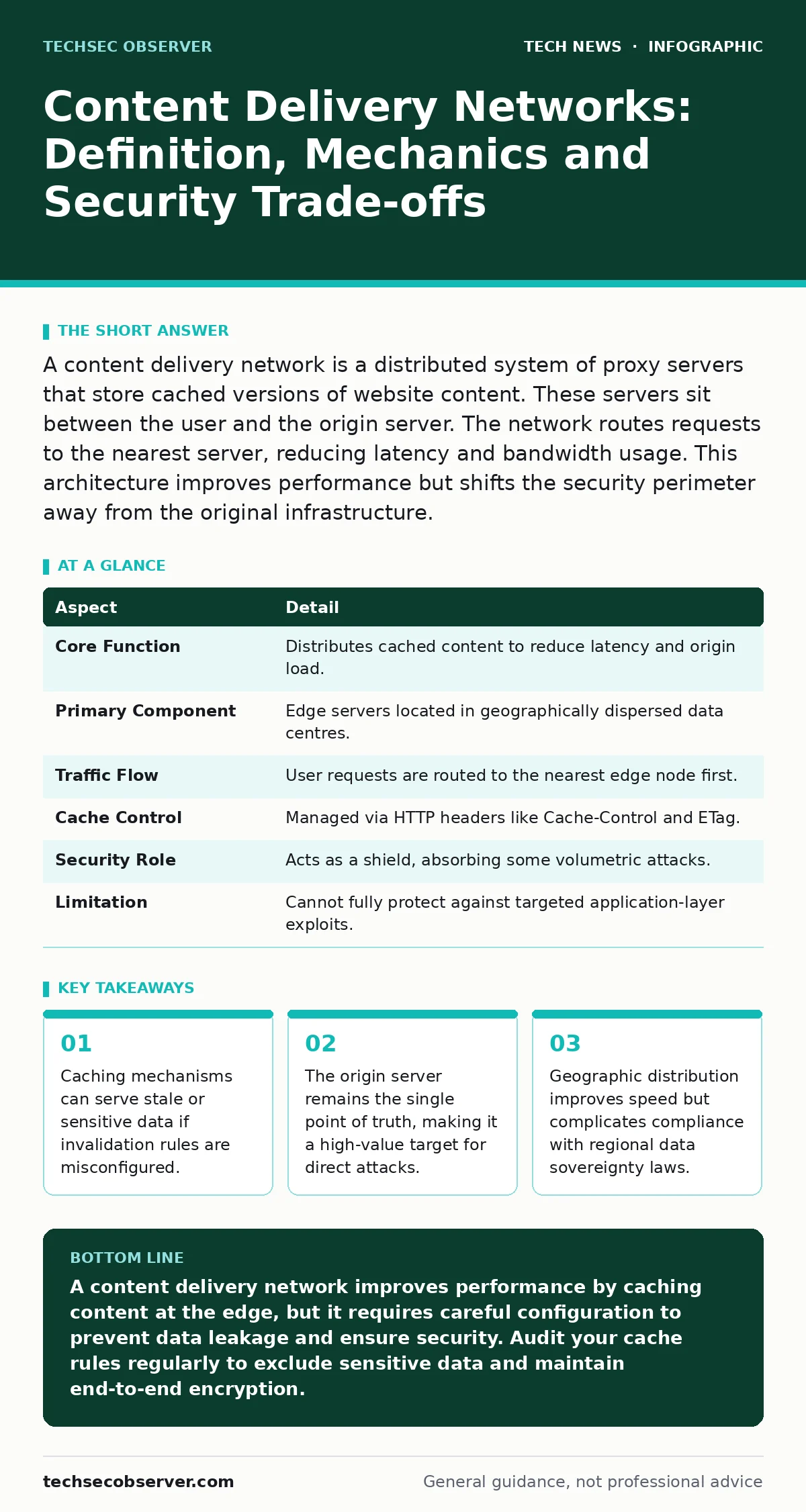
A content delivery network is a distributed system of proxy servers that store cached versions of website content. These servers sit between the user and the origin server. The network routes requests to the nearest server, reducing latency and bandwidth usage. This architecture improves performance but shifts the security perimeter away from the original infrastructure.
How a Content Delivery Network Works in Practice
Imagine you are reading a news article from a server located in London while you sit in Sydney. Without a content delivery network, your request travels thousands of kilometres to fetch the HTML, images and scripts. With a content delivery network, a local server in Sydney holds a copy of that article. Your browser retrieves the content from the nearby server. This reduces the time to first byte. The term originates from the need to distribute static assets efficiently.
It is not a single server but a mesh of edge nodes. Each node caches content based on rules defined by the origin. The network balances load across these nodes. You benefit from faster load times. The origin server experiences less strain. This separation of concerns allows the origin to focus on dynamic logic. The edge handles static delivery. This division is fundamental to modern web architecture.
| Aspect | Detail |
|---|---|
| Core Function | Distributes cached content to reduce latency and origin load. |
| Primary Component | Edge servers located in geographically dispersed data centres. |
| Traffic Flow | User requests are routed to the nearest edge node first. |
| Cache Control | Managed via HTTP headers like Cache-Control and ETag. |
| Security Role | Acts as a shield, absorbing some volumetric attacks. |
| Limitation | Cannot fully protect against targeted application-layer exploits. |
The Mechanics of Edge Caching
The heart of a content delivery network is the cache. When a user requests a resource, the edge server checks its local storage. If the resource exists and is fresh, the server returns it immediately. This is a cache hit. If the resource is missing or expired, the server requests it from the origin. This is a cache miss. The origin sends the data, and the edge stores a copy for future requests. The freshness duration is dictated by cache-control headers. Developers must set these headers carefully.
A long duration improves performance but risks serving outdated content. A short duration ensures accuracy but increases origin load. You must balance speed against consistency. Static files like images and stylesheets benefit from long durations. Dynamic content often requires short durations or no caching. Misconfigured headers can lead to security issues. Sensitive data might be cached and served to unauthorised users. Always validate cache behaviour for each asset type.
Origin Shielding and Traffic Routing
A content delivery network does not just store files. It manages traffic flow. When a user makes a request, the network uses global server load balancing to determine the best edge node. This decision considers geographic proximity, server health and current load. The request travels to that edge node. If the node cannot serve the content, it connects to the origin. Many networks offer an origin shield feature. This feature consolidates requests from multiple edge nodes to a single intermediate server.
This reduces the number of connections to the origin. It protects the origin from sudden spikes in traffic. The shield acts as a buffer. It absorbs the noise from the edge layer. This is particularly useful during traffic surges. It prevents the origin from being overwhelmed by redundant requests. The shield also simplifies caching logic. You configure cache rules once at the shield level. This reduces configuration complexity across the entire network.
Common Misconfigurations and Security Pitfalls
Developers often assume that placing a content delivery network in front of an application provides automatic security. This assumption is dangerous. A content delivery network is primarily a performance tool. It is not a firewall. It can mitigate volumetric attacks by absorbing traffic. It cannot stop sophisticated application-layer attacks. These attacks mimic legitimate user behaviour. They bypass simple rate limiting. You must configure the content delivery network to enforce strict rules. One common mistake is caching sensitive data.
If an API endpoint returns user-specific information, the cache might store it. Another user could then request the same endpoint. The edge server might return the cached, sensitive data. This leads to data leakage. You must exclude sensitive paths from caching. Use private headers or no-store directives for dynamic content. Another pitfall is ignoring certificate management. The content delivery network terminates TLS connections. You must ensure valid certificates are installed at the edge. Expired certificates cause service outages. They also erode user trust. Regularly audit your certificate status.
The Hidden Cost of Distributed Architecture
Using a content delivery network introduces complexity in debugging. When a user reports an error, the issue might lie at the edge, the origin or the network in between. Tracing the request path requires coordinated logging. You need visibility into both edge and origin logs. Correlating these logs can be difficult. Different systems use different formats and timestamps. This fragmentation slows down incident response. You must establish a unified logging strategy. Ensure that request IDs are passed through the entire chain.
This allows you to trace a single request from user to origin. Without this, diagnosing issues becomes a guessing game. Another hidden cost is the potential for configuration drift. As the application evolves, cache rules might become outdated. Old rules might cache new, sensitive endpoints. Regular reviews are necessary. Automate these reviews where possible. Integrate configuration checks into your deployment pipeline. This prevents accidental misconfigurations from reaching production.
See also: Insecure Deserialization Explained: How Broken Data Becomes Code
Integrating with Modern Security Frameworks
A content delivery network works best when integrated with other security measures. It complements web application firewalls. The firewall inspects traffic before it reaches the origin. The content delivery network delivers the response. This combination provides layered defence. You can also integrate with APIs securely. Many content delivery networks offer dedicated endpoints for API acceleration. These endpoints handle caching and compression efficiently. Ensure that your API keys are not exposed in cached responses.
Use authentication headers that are not cached. This prevents unauthorised access. Additionally, consider how the content delivery network interacts with operating system hardening practices. The origin servers must be secure. If the origin is compromised, the cache will serve malicious content. The content delivery network will amplify the impact of the breach. Secure the origin as if it is directly exposed. Apply patches and updates regularly. Monitor for unusual activity. The content delivery network is a multiplier. It multiplies both performance and risk.
What People Usually Get Wrong
Many believe that a content delivery network replaces the need for secure coding. This is incorrect. The content delivery network does not validate input. It does not sanitise output. If your application is vulnerable to injection attacks, the content delivery network will cache and serve the malicious payload. It will distribute the attack to many users. You must secure the application logic itself. Another misconception is that all traffic should be cached. Caching everything reduces origin load but increases security risk.
Some data must always come from the origin. This includes authentication tokens and personal information. You must define clear boundaries. Determine what is static and what is dynamic. Apply cache rules accordingly. Do not rely on defaults. Customise your configuration to match your application's needs. Understand the trade-offs. Performance gains must not come at the cost of security. Balance is key. Regular testing ensures that your configuration remains effective. Test cache behaviour with different user roles. Verify that sensitive data is not exposed.
Practical Steps for Secure Implementation
Start by auditing your current caching rules. Identify any endpoints that serve sensitive data. Remove them from the cache. Next, review your certificate management process. Ensure that certificates are renewed automatically. Set up alerts for upcoming expirations. Then, implement request tracing. Add unique identifiers to each request. Pass these identifiers through the content delivery network to the origin. This enables effective debugging. Finally, integrate security tools.
Use a web application firewall in conjunction with the content delivery network. Configure rate limiting to protect against abuse. Monitor traffic patterns for anomalies. Adjust rules as needed. Security is an ongoing process. Regular reviews keep your configuration aligned with your application's evolution. Do not set and forget. Continuously validate your setup. Test for common misconfigurations. Ensure that your security posture remains strong. This approach balances performance and security. It provides a resilient foundation for your application.
Key takeaways
- Caching mechanisms can serve stale or sensitive data if invalidation rules are misconfigured.
- The origin server remains the single point of truth, making it a high-value target for direct attacks.
- Geographic distribution improves speed but complicates compliance with regional data sovereignty laws.
A content delivery network improves performance by caching content at the edge, but it requires careful configuration to prevent data leakage and ensure security. Audit your cache rules regularly to exclude sensitive data and maintain end-to-end encryption.
Frequently asked questions
Does a content delivery network protect against DDoS attacks?
It can mitigate volumetric DDoS attacks by absorbing traffic at the edge, but it does not stop application-layer attacks that mimic legitimate user behaviour.
Can I cache dynamic content on a content delivery network?
You can cache dynamic content for short durations, but you must ensure that personalised or sensitive data is not stored to prevent leakage to other users.
How do I debug issues with a content delivery network?
Implement request tracing by passing unique identifiers through the network to the origin, allowing you to correlate logs and identify where the issue occurs.
Is the origin server still vulnerable if I use a content delivery network?
Yes, the origin server remains vulnerable to direct attacks. The content delivery network shields it from some traffic but does not replace the need for secure coding and hardening.
How this guide was produced: written by the TechSec Observer editorial team with AI assistance, checked against the public references listed below, and reviewed when the facts change. See our editorial policy or report an error.