Stop People-Search Sites From Aggregating Your Personal Data
Most people-search sites scrape public records, not hacked databases, meaning data minimisation at the source is far more effective than removal requests.

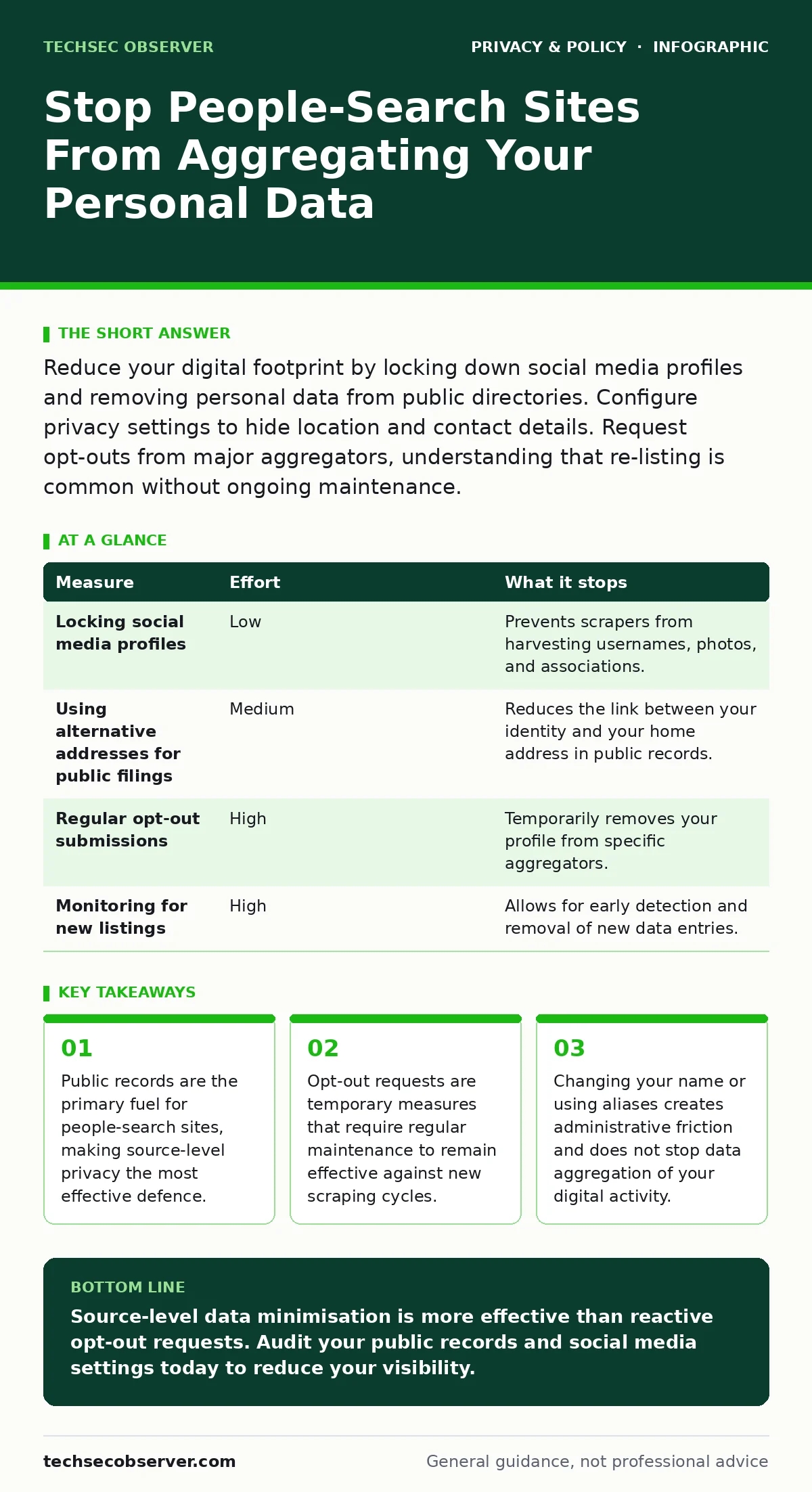
Reduce your digital footprint by locking down social media profiles and removing personal data from public directories. Configure privacy settings to hide location and contact details. Request opt-outs from major aggregators, understanding that re-listing is common without ongoing maintenance.
The Mechanics of Data Aggregation
People-search sites do not typically steal data from breached databases. Instead, they aggregate information from sources that are legally public or semi-public. This includes court records, property deeds, voter registration lists, and professional licensing boards. These sites use automated scrapers to harvest this data, cross-referencing names, addresses, and phone numbers to build comprehensive profiles.
The result is a searchable database that connects disparate pieces of information. A name found in a voter register is linked to an address from a property record. That address is then matched to a phone number listed in a public business directory. This process creates a detailed picture of your life without your explicit consent.
Understanding this mechanism is vital for prevention. If the data is public, hiding it from one site is insufficient. You must control the flow of information at the source. This approach aligns with the principles of privacy by design, where data protection is integrated into the development of systems and processes from the outset, rather than added as an afterthought.
Minimising Public Exposure
The most effective way to prevent data aggregation is to reduce the amount of personal information available in public records. While you cannot always remove historical records, you can control new entries. When registering for professional licenses or attending public meetings, consider whether providing your full home address is necessary. Many jurisdictions allow you to use a PO Box or a work address for public filings.
Social media profiles are another significant source of data. People-search sites scrape social networks for usernames, locations, and associations. Even if your social media accounts are private, metadata and public interactions can reveal sensitive details. Review your settings to ensure your profile is visible only to approved contacts. Disable location tagging and remove any posts that reveal your routine or home address.
For a deeper understanding of these risks, consult the guide on social media privacy risks. This resource details how seemingly harmless posts can be pieced together to reveal your identity and habits. By treating your social media presence as a public broadcast, you can avoid leaking data that aggregators will inevitably harvest.
The Limits of Opt-Out Requests
Most people-search sites offer an opt-out mechanism. This usually involves submitting a request to remove your profile, often requiring you to verify your identity. While this can remove your data from the site immediately, it is not a permanent solution. Aggregators regularly re-scrape public sources. If your data remains in a public record, it will reappear on the site during the next scraping cycle.
This creates a maintenance burden. You must periodically check these sites and submit new opt-out requests. The effort required can be significant, especially if you have multiple aliases or have moved residences. Some sites make the opt-out process deliberately difficult, requiring multiple steps or phone calls.
What Does Not Work
Many popular advice columns suggest using pseudonyms or changing your name to escape data aggregation. This approach fails because it does not address the underlying issue. Aggregators link identities through multiple data points, such as phone numbers, email addresses, and IP addresses. Even if you change your name, your digital footprint remains consistent across these other identifiers.
Another ineffective strategy is using a VPN to block scrapers. People-search sites do not collect data in real-time through your browser. They harvest data from public records and other websites. A Virtual Private Network protects your browsing privacy but does not prevent your data from being scraped from a court website or a business directory.
Similarly, cookie consent management tools do not stop data aggregation. Cookies manage tracking on specific websites, but they do not control the data published in public records. Focusing on cookie banners distracts from the more significant risk of public record exposure.
Practical Prevention Measures
To effectively mitigate the risk of data aggregation, you should prioritise measures that reduce your digital footprint at the source. The table below ranks these measures by their effectiveness in removing risk.
| Measure | Effort | What it stops |
|---|---|---|
| Locking social media profiles | Low | Prevents scrapers from harvesting usernames, photos, and associations. |
| Using alternative addresses for public filings | Medium | Reduces the link between your identity and your home address in public records. |
| Regular opt-out submissions | High | Temporarily removes your profile from specific aggregators. |
| Monitoring for new listings | High | Allows for early detection and removal of new data entries. |
Start with the low-effort, high-impact measures. Secure your social media accounts and review your privacy settings. Then, assess your public record exposure. If you have a professional license or have participated in public meetings, check if your home address is listed. If it is, explore options to use an alternative address for future filings.
See also: Pseudonymization of Data: How to Reduce Risk Without Losing Utility · How Data Exfiltration Works: The Silent Stages of Theft
Maintaining Your Privacy Posture
Privacy is not a one-time setup. It requires ongoing maintenance. As you interact with the world, new data points are created. A new job, a marriage, or a home purchase can all result in public records that aggregators will harvest.
Set a calendar reminder to review your online presence every six months. Search for your name on major people-search sites. If your profile appears, submit an opt-out request. This proactive approach ensures that your data does not accumulate over time.
For a broader perspective on this topic, refer to the guide on reducing your digital footprint. This resource provides strategies for minimising the amount of personal data you leave behind in your daily digital interactions. By combining source-level minimisation with regular opt-out maintenance, you can significantly reduce your visibility on people-search sites.
The Role of Privacy-Focused Tools
While they do not stop data aggregation, privacy-focused browsers can help protect you from tracking scripts that might be embedded in people-search sites. These browsers block third-party cookies and fingerprinting techniques, making it harder for advertisers and analytics firms to build a profile of your browsing behaviour.
However, remember that these tools do not remove your data from public records. They only protect your current browsing session. Use them as part of a layered defence strategy, but do not rely on them as a primary method for preventing data aggregation.
Similarly, metadata exposure in documents and photos can reveal sensitive information. Before sharing any files online, strip the metadata. This prevents accidental leakage of location data or device information that could be used to link your identity to your digital activities.
Closing Checklist
To start improving your privacy posture today, complete these three tasks. They are low-effort but provide immediate protection against common data harvesting techniques.
- Audit your social media privacy settings. Ensure your profile is visible only to friends or connections. Remove any posts that reveal your home address or workplace.
- Search for your name on a major people-search site. If you find a profile, submit an opt-out request immediately. Note the date for future follow-up.
- Review your public record exposure. Check if your home address is listed in any professional licenses or public filings. If it is, explore options to use an alternative address for future records.
Key takeaways
- Public records are the primary fuel for people-search sites, making source-level privacy the most effective defence.
- Opt-out requests are temporary measures that require regular maintenance to remain effective against new scraping cycles.
- Changing your name or using aliases creates administrative friction and does not stop data aggregation of your digital activity.
Source-level data minimisation is more effective than reactive opt-out requests. Audit your public records and social media settings today to reduce your visibility.
Frequently asked questions
Can I sue people-search sites for listing my data?
Legal action is rarely effective because these sites use publicly available information. Most jurisdictions protect the publication of public records, making lawsuits difficult to win and expensive to pursue.
Do privacy services automatically remove my data?
Some services offer automated opt-out submissions. However, they cannot prevent new data from appearing if it is added to public records. They reduce the maintenance burden but do not eliminate the risk.
Is it legal for these sites to collect my data?
In many jurisdictions, collecting and publishing public records is legal. The concept of **legitimate interest under the GDPR** may apply in Europe, but it does not grant absolute rights to publish all public data. Laws vary significantly by region.
Can I block scrapers from my personal website?
You can use robots.txt files to discourage scrapers, but this is not legally binding. Determined scrapers will ignore these instructions. It is more effective to limit the personal data you publish on your own site.
How this guide was produced: written by the TechSec Observer editorial team with AI assistance, checked against the public references listed below, and reviewed when the facts change. See our editorial policy or report an error.