Endpoint Protection vs Antivirus: Why Signature Scanning Fails
Traditional antivirus relies on known file signatures, whereas modern endpoint protection uses behavioural analysis to stop attacks that have never been seen before.

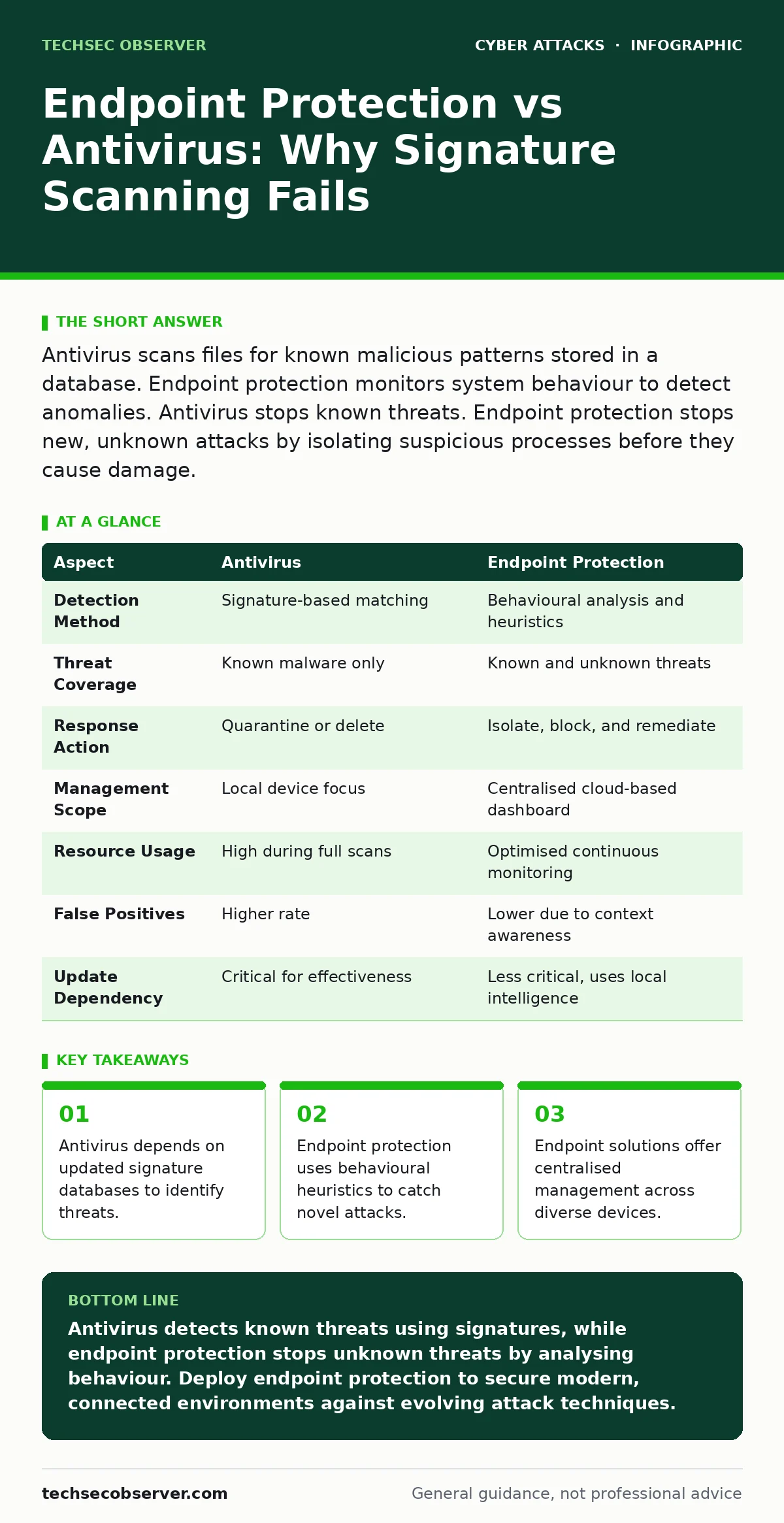
Antivirus scans files for known malicious patterns stored in a database. Endpoint protection monitors system behaviour to detect anomalies. Antivirus stops known threats. Endpoint protection stops new, unknown attacks by isolating suspicious processes before they cause damage.
The Fundamental Difference Between Endpoint Protection and Antivirus
Antivirus software identifies threats by comparing files against a database of known malicious signatures. It acts like a metal detector at an airport, flagging only items that match a predefined list of dangerous objects. Endpoint protection extends this concept by monitoring system behaviour in real time. It does not just check what a file is; it checks what the file does. This behavioural approach allows the system to detect and block attacks that have no known signature, providing a layer of security that traditional scanning cannot achieve.
What Is Antivirus Software?
Antivirus software operates on a reactive model. When a file is created, modified, or executed, the antivirus engine scans its binary code. If the code matches a pattern stored in its signature database, the software quarantines or deletes the file. This method is effective against widespread, known malware variants. It requires regular updates to remain effective, as new malware emerges constantly. The primary limitation is that it cannot detect zero-day exploits or polymorphic malware that changes its signature to avoid detection. It protects against what is already known, leaving gaps for novel threats.
What Is Endpoint Protection?
Endpoint protection platforms (EPP) use a proactive, multi-layered approach. They combine traditional scanning with behavioural analysis, application control, and data loss prevention. The system establishes a baseline of normal activity for each device. When an application behaves outside this baseline, such as an untrusted process attempting to modify system files, the platform intervenes. It may isolate the process, terminate it, or alert an administrator. This allows the system to stop attacks in progress, even if the malicious code has never been seen before. It treats every device as a potential entry point for an attacker.
Endpoint Protection vs Antivirus: A Point-by-Point Comparison
| Aspect | Antivirus | Endpoint Protection |
|---|---|---|
| Detection Method | Signature-based matching | Behavioural analysis and heuristics |
| Threat Coverage | Known malware only | Known and unknown threats |
| Response Action | Quarantine or delete | Isolate, block, and remediate |
| Management Scope | Local device focus | Centralised cloud-based dashboard |
| Resource Usage | High during full scans | Optimised continuous monitoring |
| False Positives | Higher rate | Lower due to context awareness |
| Update Dependency | Critical for effectiveness | Less critical, uses local intelligence |
The table above highlights the structural differences between the two approaches. Antivirus relies heavily on the speed and accuracy of signature updates. Endpoint protection relies on the accuracy of its behavioural models. A well-tuned endpoint protection system can identify malicious intent even when the specific tool is new. This reduces the window of vulnerability between an attack occurring and a signature being published.
When To Choose Antivirus Software
Choose traditional antivirus when your environment consists of isolated, low-risk devices. Small offices with limited internet exposure may find basic signature scanning sufficient. The cost is lower, and the resource overhead is predictable. It works well for preventing common, widespread viruses that have been circulating for months. It is suitable for users who primarily download content from trusted sources. The simplicity of management is a benefit for teams without dedicated security personnel. However, it provides no defence against sophisticated, targeted attacks that do not rely on known malicious binaries.
See also: Cryptojacking: How to Detect and Stop Silent Resource Theft
When To Choose Endpoint Protection
Choose endpoint protection when your organisation handles sensitive data or operates in a high-threat environment. Centralised management allows security teams to monitor all devices from a single pane of glass. This is vital for remote workforces where devices connect to untrusted networks. The ability to isolate a compromised device instantly prevents lateral movement across the network. Endpoint protection integrates with other security tools, providing context that antivirus alone cannot offer. It is the standard for organisations that need to comply with strict security frameworks. The initial setup is complex, but the long-term security posture is significantly stronger.
Where The Two Approaches Overlap
Modern endpoint protection platforms often include antivirus capabilities as a baseline feature. They use signature scanning as one of many detection layers. This ensures that known threats are caught quickly without consuming excessive resources for behavioural analysis. The overlap means you do not need to install separate antivirus software when using a modern EPP. Doing so can cause conflicts and performance degradation. The endpoint protection system manages the antivirus component automatically. This unified approach simplifies maintenance and ensures consistent security policies across all devices. It eliminates the gaps that occur when multiple security tools operate independently.
Implementation Considerations For Developers
Developers must understand that endpoint protection monitors application behaviour. Debugging tools and custom scripts may trigger false positives if they perform unusual system calls. You should configure allow-lists for development environments to prevent blocking legitimate work. Testing applications in an environment with endpoint protection active reveals potential security issues early. This includes checking how your application handles permissions and data access. Understanding the behavioural baselines helps in designing applications that are less likely to be flagged as suspicious. It also aids in creating more secure code that adheres to least privilege principles.
Key takeaways
- Antivirus depends on updated signature databases to identify threats.
- Endpoint protection uses behavioural heuristics to catch novel attacks.
- Endpoint solutions offer centralised management across diverse devices.
Antivirus detects known threats using signatures, while endpoint protection stops unknown threats by analysing behaviour. Deploy endpoint protection to secure modern, connected environments against evolving attack techniques.
Frequently asked questions
Does endpoint protection replace antivirus software?
Yes, modern endpoint protection platforms include antivirus scanning as a base layer. You do not need separate antivirus software when using a comprehensive EPP.
Can endpoint protection stop ransomware?
Endpoint protection can detect ransomware behaviour, such as rapid file encryption, and block it. It also isolates the device to prevent spread across the network.
Is endpoint protection too resource-heavy for old computers?
Modern endpoint protection is optimised for efficiency. However, very old hardware may struggle with continuous behavioural monitoring. Consider upgrading hardware if performance suffers significantly.
How does endpoint protection handle false positives?
Administrators can review alerts and adjust behavioural baselines. This reduces false positives over time as the system learns normal application behaviour in your specific environment.
How this guide was produced: written by the TechSec Observer editorial team with AI assistance, checked against the public references listed below, and reviewed when the facts change. See our editorial policy or report an error.