Cryptojacking: How to Detect and Stop Silent Resource Theft
Cryptojacking hides in plain sight by mimicking legitimate background processes, making standard antivirus tools blind to its subtle resource consumption patterns.

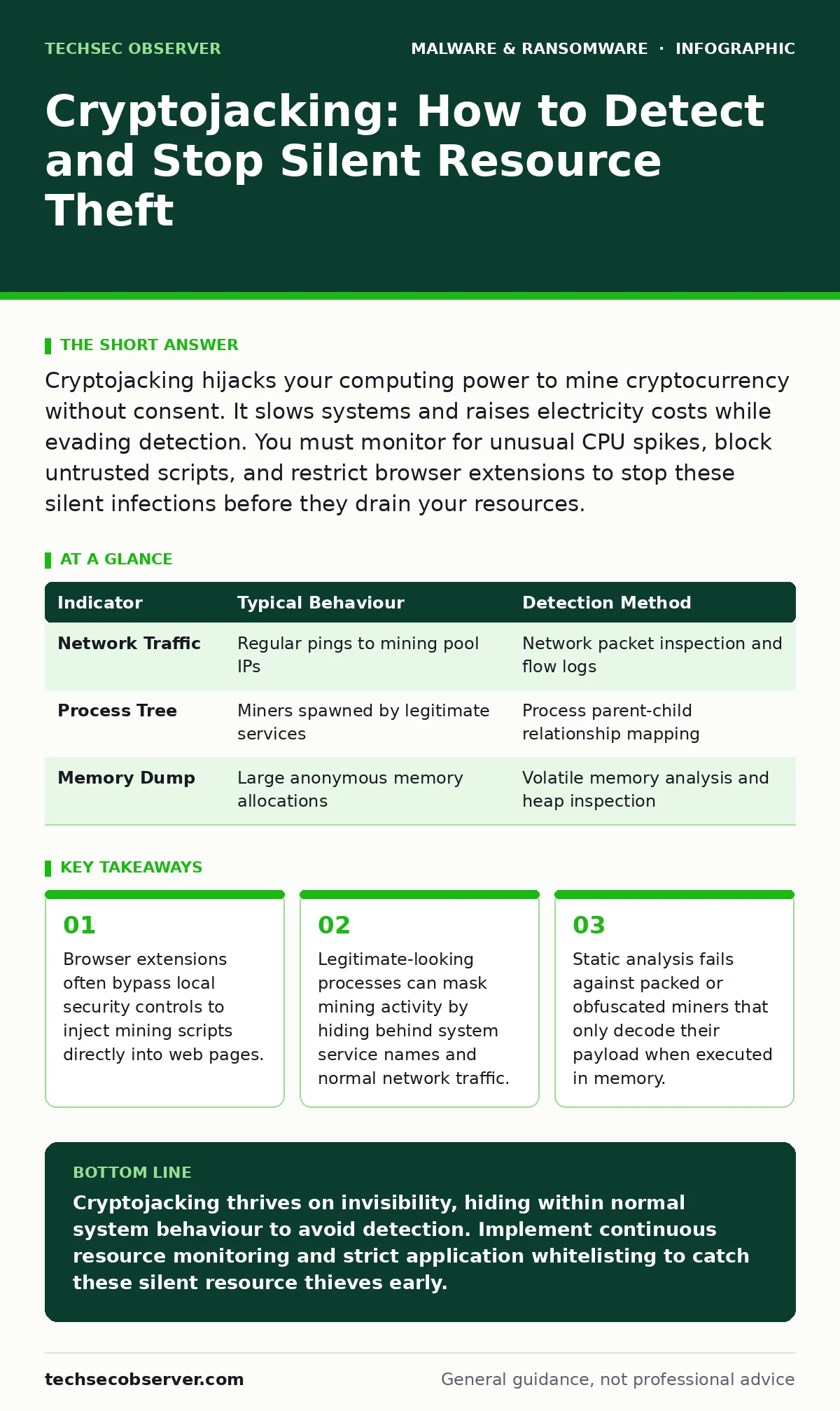
Cryptojacking hijacks your computing power to mine cryptocurrency without consent. It slows systems and raises electricity costs while evading detection. You must monitor for unusual CPU spikes, block untrusted scripts, and restrict browser extensions to stop these silent infections before they drain your resources.
What exactly is cryptojacking and how does it differ from ransomware?
Cryptojacking is the unauthorised use of a victim's computing resources to mine cryptocurrency, whereas ransomware encrypts data to demand payment. Unlike ransomware, which creates immediate chaos and alerts users to a breach, cryptojacking operates silently to avoid detection. The attacker wants the system to remain online and functional for as long as possible to generate maximum profit. This stealth approach means victims often discover the infection only through performance degradation or unexpectedly high electricity bills rather than a ransom note.
How do attackers initially gain access to a system for mining?
Attackers typically gain access through supply chain compromises, malicious browser extensions, or compromised web advertisements. They rarely rely on brute-force hacking of secure servers. Instead, they exploit trust. A user might install a seemingly harmless browser extension that injects mining scripts into every visited webpage. Alternatively, an attacker might compromise a popular open-source library. When developers update their projects, they inadvertently pull in the malicious code, which then executes on thousands of machines simultaneously.
Why does standard antivirus software often fail to detect cryptojacking?
Standard antivirus software relies heavily on signature-based detection, which compares files against a database of known malicious hashes. Cryptojacking tools are often custom-built, heavily obfuscated, or delivered as scripts that change slightly with each deployment. Because the underlying code structure differs from known samples, the signature match fails. Furthermore, many miners operate entirely in memory without writing a persistent executable to the disk. If there is no file to scan, the antivirus engine has nothing to analyse, allowing the process to run unchecked.
What are the primary indicators of a cryptojacking infection on a server?
You will observe sustained high CPU or GPU utilisation even during off-peak hours when no legitimate workloads are running. Network traffic analysis reveals consistent outbound connections to known cryptocurrency mining pools or peer-to-peer networks. These connections often use standard ports like HTTP or HTTPS to blend in with normal web traffic. Additionally, you may notice new processes spawning from legitimate system binaries, a technique known as process hollowing. The parent process appears benign, but the child process executes the mining payload.
| Indicator | Typical Behaviour | Detection Method |
|---|---|---|
| Network Traffic | Regular pings to mining pool IPs | Network packet inspection and flow logs |
| Process Tree | Miners spawned by legitimate services | Process parent-child relationship mapping |
| Memory Dump | Large anonymous memory allocations | Volatile memory analysis and heap inspection |
How does browser-based cryptojacking evade endpoint security controls?
Browser-based cryptojacking runs within the sandboxed environment of the web browser, isolating it from the host operating system's file system. Endpoint detection tools often lack visibility into browser internal processes or JavaScript execution contexts. The mining script executes as part of the web page content. To the operating system, it looks like a standard browser tab consuming resources. Unless the endpoint protection specifically inspects memory contents or blocks known mining domains at the DNS level, the activity remains invisible to traditional host-based defences.
See also: Endpoint Protection vs Antivirus: Why Signature Scanning Fails · Email Attachment Scanning: How Gatekeepers Filter Digital Mail
Can cryptojacking hide inside legitimate system services or drivers?
Yes, advanced attackers often replace or modify legitimate system drivers to gain kernel-level access. This allows the miner to hide its processes from standard task managers and operating system utilities. The driver might masquerade as a graphics driver or a hardware monitor. Because the operating system trusts these signed drivers, it grants them elevated privileges. This makes removal difficult, as deleting the malicious driver can crash the system. You must verify driver signatures and monitor for unexpected driver installations to catch this technique.
Why is static malware analysis insufficient for identifying modern miners?
Static malware analysis examines the code without executing it, looking for known patterns or strings. Modern cryptojacking malware uses packing and encryption to conceal its true payload. The file on disk is a small loader that decrypts the actual mining engine only in memory when run. Static analysis sees only the encrypted blob, which contains no identifiable strings or functions. To detect this, you must use dynamic analysis, observing the process behaviour in a sandbox. However, sophisticated miners may detect virtualised environments and refuse to run, hiding their true nature.
How can you prevent cryptojacking in a cloud infrastructure environment?
You must enforce strict resource quotas and monitor for anomalous compute usage patterns. Cloud providers offer tools to alert when a virtual machine exceeds baseline CPU or network thresholds. Implement least-privilege access controls to prevent compromised instances from communicating with external mining pools. Regularly audit container images for known vulnerabilities that could allow container escape. If a container is compromised, the attacker might pivot to the host system. Use extended detection and response (XDR) solutions to correlate alerts across compute, network, and identity layers for a holistic view of threats.
What is the long-term financial impact of undetected cryptojacking?
The financial impact extends beyond wasted electricity and reduced hardware lifespan. Undetected cryptojacking degrades application performance, leading to slower response times and potential service-level agreement violations. In a cloud environment, you pay for the compute resources the miner consumes. This can result in significant, unexplained spikes in monthly bills. Furthermore, the distraction of dealing with a compromised system diverts engineering resources from productive work. The cumulative cost of downtime, remediation, and lost productivity often far exceeds the value of the cryptocurrency mined by the attacker.
Key takeaways
- Browser extensions often bypass local security controls to inject mining scripts directly into web pages.
- Legitimate-looking processes can mask mining activity by hiding behind system service names and normal network traffic.
- Static analysis fails against packed or obfuscated miners that only decode their payload when executed in memory.
Cryptojacking thrives on invisibility, hiding within normal system behaviour to avoid detection. Implement continuous resource monitoring and strict application whitelisting to catch these silent resource thieves early.
Frequently asked questions
Does blocking port 3333 stop all cryptojacking?
No, modern miners use standard ports like 80 and 443 to mimic web traffic, making port blocking an ineffective defence against determined attackers.
Can a smartphone be infected with cryptojacking malware?
Yes, malicious mobile apps can run mining code in the background, draining the battery and heating the device, though mobile operating systems limit this more than desktop systems.
Is PowerShell logging useful for detecting cryptojacking?
Yes, enabling PowerShell logging captures command-line arguments and script execution, helping you identify if a miner was deployed via a script or encoded command.
How does email attachment scanning help prevent cryptojacking?
Email attachment scanning blocks malicious files delivered via phishing, which is a common initial vector for dropping cryptojacking payloads onto a user's machine.
How this guide was produced: written by the TechSec Observer editorial team with AI assistance, checked against the public references listed below, and reviewed when the facts change. See our editorial policy or report an error.