Extended Detection and Response: Real Benefits and Hidden Costs
XDR correlates data across endpoints, networks and clouds to reveal attacks that single-point tools miss, but it demands rigorous data hygiene to function correctly.

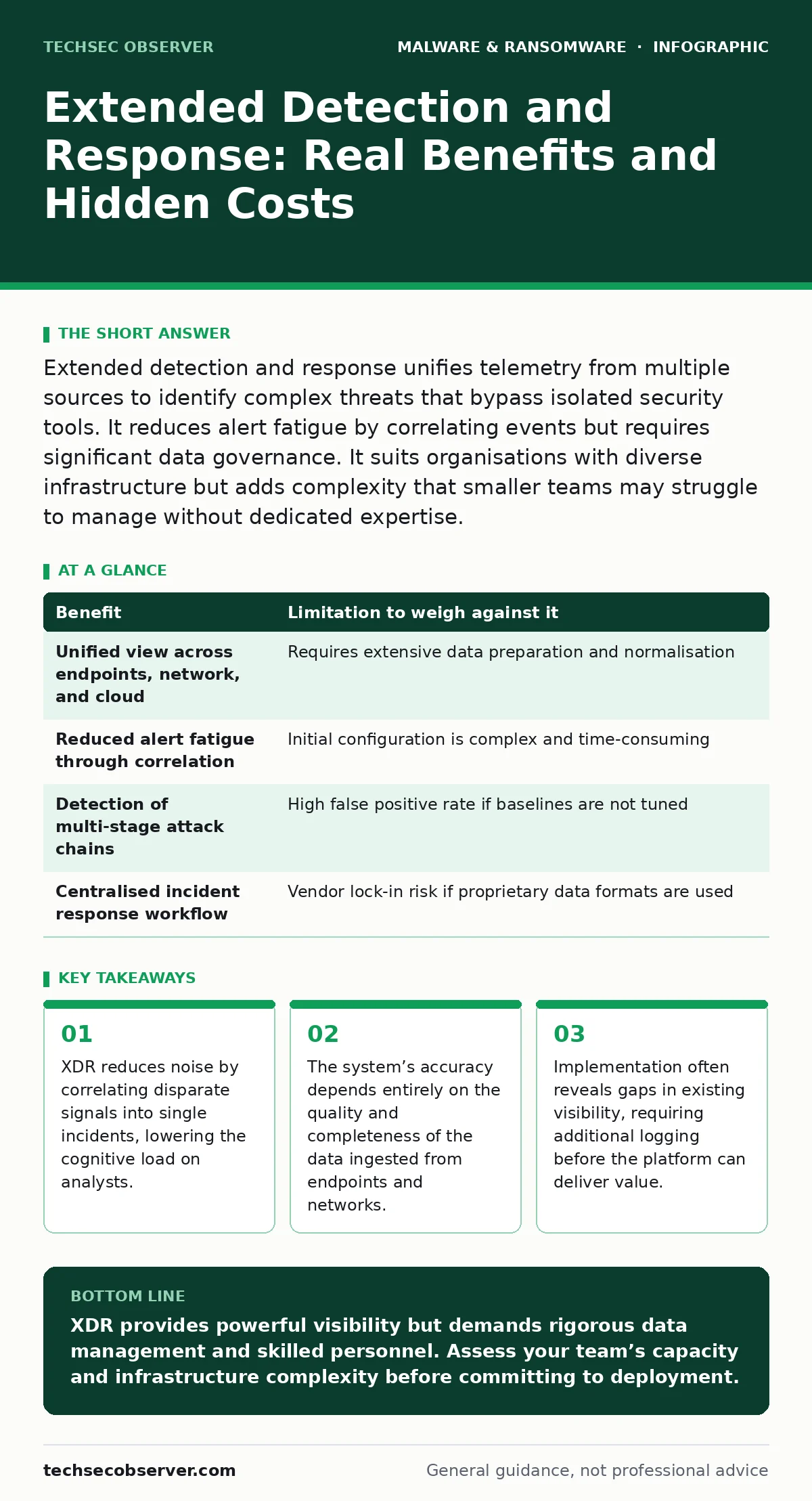
Extended detection and response unifies telemetry from multiple sources to identify complex threats that bypass isolated security tools. It reduces alert fatigue by correlating events but requires significant data governance. It suits organisations with diverse infrastructure but adds complexity that smaller teams may struggle to manage without dedicated expertise.
The Promise of Unified Telemetry
Traditional security tools operate in silos. An endpoint detection platform sees activity on a laptop, while a firewall monitors network traffic. Attackers exploit this fragmentation by moving laterally, staying below the detection threshold of any single tool. Extended detection and response, or XDR, aggregates data from endpoints, networks, servers, and cloud workspaces. It uses a unified data model to correlate these streams.
This correlation allows the system to identify attack chains that span multiple layers. For example, a suspicious login followed by unusual data exfiltration might look benign in isolation. XDR links these events, revealing the full context. This approach addresses a core limitation of signature-based detection, which struggles with novel threats that do not match known patterns.
The Cost of Complexity
The primary benefit of XDR is visibility, but this comes with a steep operational cost. The system ingests massive volumes of telemetry. If the underlying data is noisy or irrelevant, the XDR platform generates more alerts, not fewer. You must configure data ingestion carefully. Ingesting every possible log entry creates a data swamp that obscures genuine threats.
Configuration is not a one-time task. As your infrastructure changes, so must your data collection strategies. This requires ongoing maintenance and expertise. You are not just buying a tool; you are adopting a data management discipline. The platform cannot distinguish between a misconfigured application and a sophisticated attack if the baseline behaviour is not clearly defined.
Correlation Versus Context
XDR excels at finding patterns, but it lacks human intuition. It relies on predefined rules and machine learning models to flag anomalies. These models can produce false positives if they are not tuned to your specific environment. A legitimate administrative task might trigger an alert if it deviates from the established norm.
This is where behavior-based detection shines, but it also introduces friction. Analysts must investigate every correlation. If the platform lacks sufficient context, the investigation becomes a waste of time. You must provide the system with accurate asset information and user roles. Without this metadata, the XDR cannot determine if an action is authorised or malicious.
Integration With Existing Defences
XDR does not replace existing security controls; it enhances them. It works alongside email attachment scanning to detect threats that bypass initial filters. If a malicious file reaches an endpoint, XDR can trace its execution and lateral movement. It also complements USB device control by monitoring data flow from removable media.
However, integration depth varies. Some XDR platforms offer native connectors for popular services, while others require custom scripts. You must verify that your critical systems can send data to the XDR platform in real time. Delayed data ingestion creates blind spots. An attacker can complete their objectives before the system receives the necessary telemetry.
| Benefit | Limitation to weigh against it |
|---|---|
| Unified view across endpoints, network, and cloud | Requires extensive data preparation and normalisation |
| Reduced alert fatigue through correlation | Initial configuration is complex and time-consuming |
| Detection of multi-stage attack chains | High false positive rate if baselines are not tuned |
| Centralised incident response workflow | Vendor lock-in risk if proprietary data formats are used |
The Data Hygiene Requirement
XDR is only as good as the data it processes. Many organisations underestimate the effort required to clean and normalise logs. Inconsistent timestamps, missing fields, and duplicate entries degrade the system’s performance. You must establish strict data governance policies before deployment.
This includes defining what data is collected, how it is stored, and who has access. Poor data hygiene leads to inaccurate alerts and missed detections. It also increases storage costs. You are paying for data that provides no value. Regular audits of data sources are necessary to maintain the integrity of the XDR platform.
See also: Cryptojacking: How to Detect and Stop Silent Resource Theft · PowerShell Logging Misconceptions: What Actually Gets Recorded
When It Is Worth It
Extended detection and response is valuable for organisations with complex, hybrid environments. If you manage endpoints, cloud instances, and network infrastructure across multiple locations, XDR provides the necessary visibility. It helps you understand how threats move across these boundaries.
It is also worth it if you have a dedicated security operations team. These teams have the expertise to tune the platform, investigate alerts, and refine detection rules. The reduction in manual work pays off over time. For large organisations, the cost of a breach far exceeds the cost of implementing and maintaining an XDR platform.
When It Is Not
XDR is not suitable for small organisations with limited resources. The complexity of configuration and maintenance outweighs the benefits if you lack dedicated staff. You may end up with a powerful tool that sits idle because no one knows how to use it.
It is also not worth it if your infrastructure is simple and static. If you have a small number of endpoints and limited cloud usage, traditional endpoint protection may suffice. Adding XDR introduces unnecessary overhead. Focus on fundamental controls like mobile malware protection and smart home security if those are your primary concerns.
Implementation Strategy
Start with a pilot. Select a subset of your infrastructure to test the XDR platform. Evaluate the quality of alerts and the ease of investigation. Identify gaps in data coverage. Use this feedback to refine your configuration before a full rollout.
Train your team thoroughly. They must understand how the platform works, how to interpret alerts, and how to respond to incidents. Document your processes. This ensures consistency and aids in troubleshooting. Regularly review and update your detection rules to keep pace with evolving threats.
Key takeaways
- XDR reduces noise by correlating disparate signals into single incidents, lowering the cognitive load on analysts.
- The system’s accuracy depends entirely on the quality and completeness of the data ingested from endpoints and networks.
- Implementation often reveals gaps in existing visibility, requiring additional logging before the platform can deliver value.
XDR provides powerful visibility but demands rigorous data management and skilled personnel. Assess your team’s capacity and infrastructure complexity before committing to deployment.
Frequently asked questions
Does XDR replace antivirus software?
No, XDR complements antivirus by providing broader context. Antivirus blocks known threats, while XDR detects suspicious behaviour across multiple systems.
How long does it take to implement XDR?
Implementation varies based on infrastructure size. A pilot may take weeks, but full deployment and tuning can take months.
Can XDR detect insider threats?
Yes, by correlating user behaviour with network and endpoint activity. However, it requires accurate user identity and role data to function correctly.
Is XDR suitable for cloud-only environments?
Yes, but you must ensure the platform supports cloud-native telemetry. Traditional endpoint-focused XDR may miss cloud-specific threats.
How this guide was produced: written by the TechSec Observer editorial team with AI assistance, checked against the public references listed below, and reviewed when the facts change. See our editorial policy or report an error.