Signature-Based Detection: Answers to Your Most Pressing Questions
Signature-based detection offers instant recognition of known threats but fails entirely against new, unrecognised code variants.

Signature-based detection identifies malware by matching file characteristics against a database of known threats. It provides high accuracy for established threats but cannot detect new or modified malware. You must pair it with behaviour-based detection to catch unknown variants.
What exactly is signature-based detection?
Signature-based detection is a security method that identifies malicious software by comparing its unique characteristics against a database of known threat profiles. These profiles, or signatures, are digital fingerprints derived from specific sequences of bytes, hashes, or structural elements within a file. When an antivirus engine scans a file, it looks for an exact match with these stored patterns. If a match occurs, the system flags the file as malicious. This method relies entirely on prior knowledge of the threat, meaning it cannot identify anything that has not been seen and catalogued before.
How does the signature creation process work?
Security researchers analyse confirmed malicious samples to extract unique, stable identifiers that distinguish them from legitimate software. They isolate sequences of code that are unlikely to appear in benign applications, creating a compact representation of the threat. This process requires careful selection to avoid generic patterns that might trigger false positives on standard system files. The resulting signature is then distributed to endpoints for inclusion in their local databases. This manual curation ensures high precision but introduces a delay between the discovery of a new threat and its recognisable signature.
Why does this method fail against new malware?
The fundamental limitation of signature-based detection is its reliance on historical data, rendering it blind to novel threats. If an attacker creates a new piece of malware, it possesses no signature in the existing database until researchers analyse and catalogue it. This window of vulnerability allows zero-day exploits and newly crafted ransomware to execute freely on infected systems. Even if the malware is based on an existing family, minor code alterations can break the signature match. Consequently, this method alone provides no defence against the leading edge of an attack campaign.
Can attackers easily bypass signature detection?
Attackers routinely evade signature-based systems through a technique known as polymorphism, where the malware’s code structure changes with each infection while maintaining the same underlying functionality. By encrypting the payload and using a randomised decryption routine, the resulting file bytes differ from any known signature. Another common evasion method is packing, which compresses or encrypts the executable to hide the actual malicious code from static analysis. These techniques render the file unrecognisable to traditional scanners until the malware unpacks itself in memory. This is why behaviour-based detection is necessary to monitor actions rather than just file contents.
What is the performance impact on my system?
Scanning every file for pattern matches consumes significant processing power and disk input-output resources. As the signature database grows to include millions of known threats, the computational cost of comparing each file against this list increases. This overhead can slow down file access, application launches, and system boot times, particularly on older hardware. Users often notice lag when working with large directories or during full system scans. The trade-off is between security coverage and system responsiveness, requiring careful tuning of scan schedules and exclusions.
See also: Endpoint Protection vs Antivirus: Why Signature Scanning Fails · Email Attachment Scanning: How Gatekeepers Filter Digital Mail
How do false positives occur in this model?
False positives happen when a legitimate file contains byte sequences that coincidentally match a malicious signature. This often occurs with software that uses common code libraries or similar encryption routines found in malware. If a signature is too broad, it may flag benign applications, leading to unnecessary quarantines and user frustration. Developers must refine signatures to target unique, malicious-specific patterns, but this precision can sometimes miss variant threats. Managing these errors requires a feedback loop where users report incorrect detections for analysis and correction.
How does it compare to other detection methods?
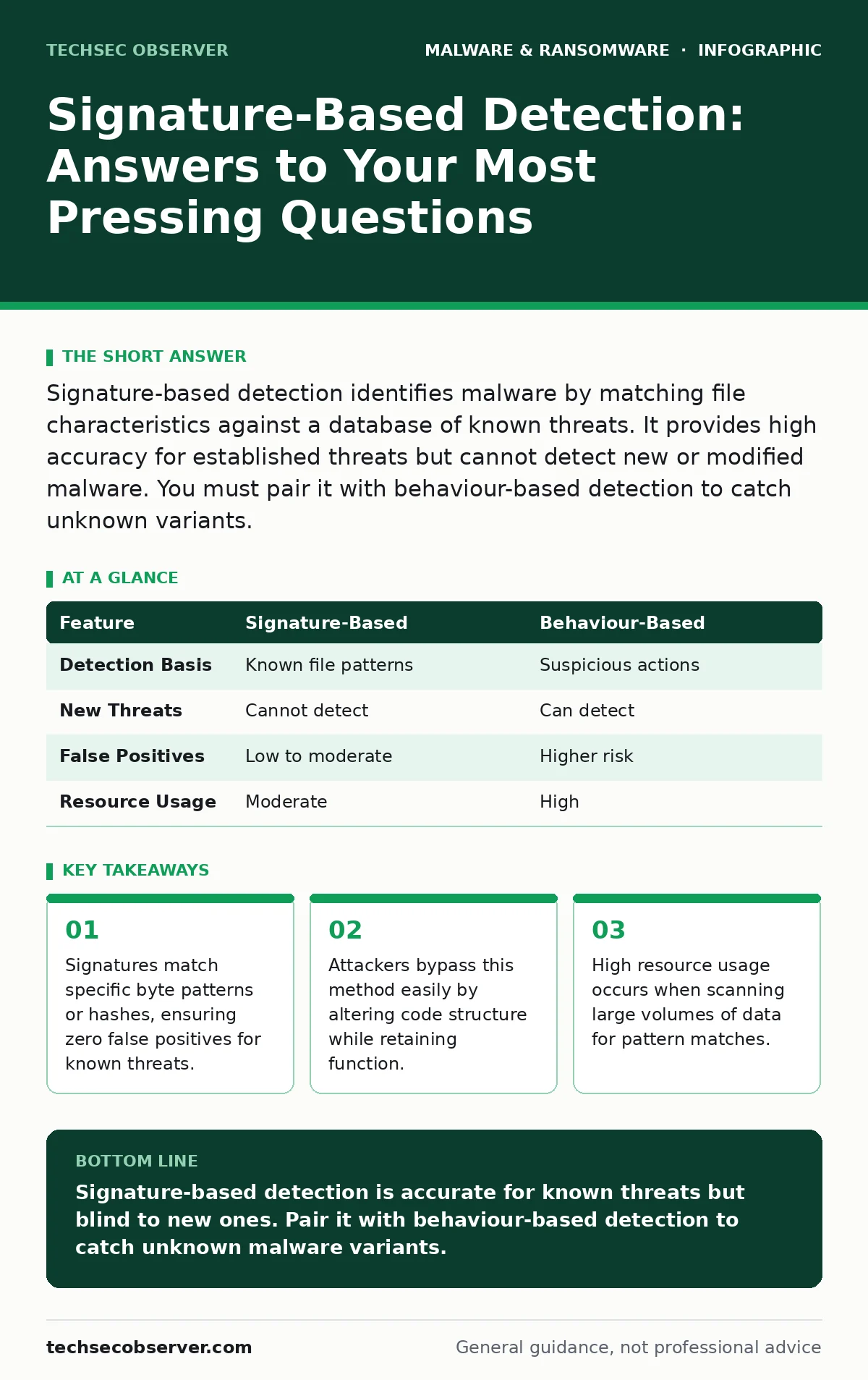
Unlike behaviour-based detection, which monitors actions for suspicious activity, signature-based detection looks only at static file properties. Extended detection and response (XDR) platforms combine multiple data sources to provide broader visibility, whereas traditional antivirus relies heavily on signatures. The following table illustrates the key differences between these approaches.
| Feature | Signature-Based | Behaviour-Based |
|---|---|---|
| Detection Basis | Known file patterns | Suspicious actions |
| New Threats | Cannot detect | Can detect |
| False Positives | Low to moderate | Higher risk |
| Resource Usage | Moderate | High |
Is it still relevant in modern security?
Despite its limitations, signature-based detection remains a foundational layer of defence due to its high accuracy and low false-positive rate for known threats. It efficiently filters out the vast majority of common malware that has already been identified and catalogued. Removing it would leave systems vulnerable to widespread, established threats that behaviour-based systems might miss or flag incorrectly.
However, it must not be used in isolation. For comprehensive protection, you should integrate it with advanced methods, as discussed in our guide to extended detection and response (XDR). This layered approach ensures that known threats are blocked immediately while unknown ones are scrutinised for malicious intent.
Key takeaways
- Signatures match specific byte patterns or hashes, ensuring zero false positives for known threats.
- Attackers bypass this method easily by altering code structure while retaining function.
- High resource usage occurs when scanning large volumes of data for pattern matches.
Signature-based detection is accurate for known threats but blind to new ones. Pair it with behaviour-based detection to catch unknown malware variants.
Frequently asked questions
Does signature-based detection protect against ransomware?
It protects against known ransomware strains that have been catalogued. It fails to stop new or modified ransomware variants until their signatures are created and distributed.
How often are signature databases updated?
Updates occur frequently, often multiple times daily, to include new threat intelligence. Ensuring your software allows automatic updates is critical for maintaining effectiveness.
Can I use signature detection for email security?
Yes, email attachment scanning often uses signatures to block known malicious files. However, sophisticated attacks may use encoded or obfuscated attachments that evade static signature checks.
Does this method work on mobile devices?
It works similarly on mobile platforms, scanning installed apps and downloaded files. Mobile malware often relies on social engineering, making user awareness as important as technical detection.
How this guide was produced: written by the TechSec Observer editorial team with AI assistance, checked against the public references listed below, and reviewed when the facts change. See our editorial policy or report an error.