Supply chain attacks in cyber security: how they work and how to stop them
Attackers bypass your defences by compromising the trusted tools and libraries you rely on, turning your own dependencies into delivery mechanisms.

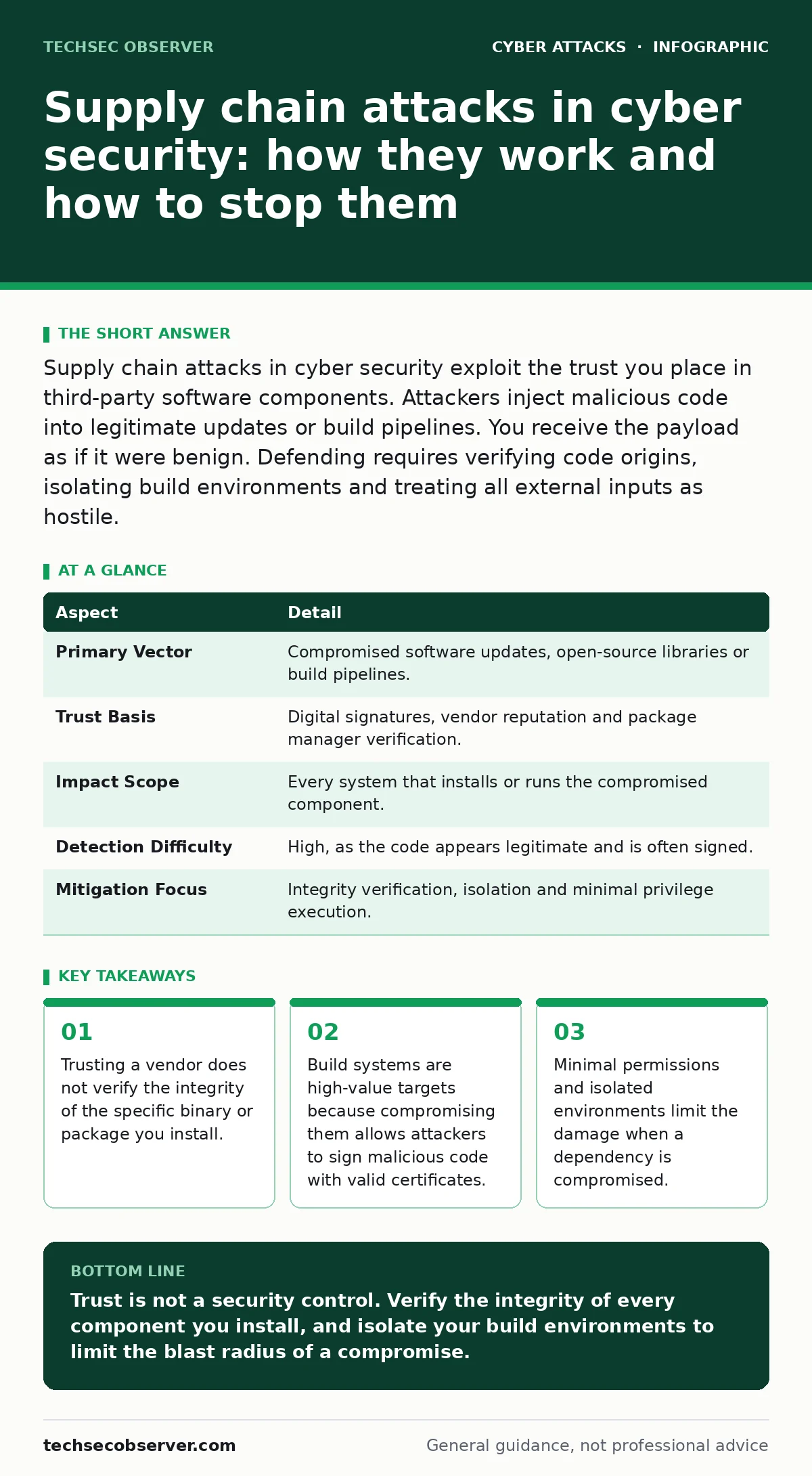
Supply chain attacks in cyber security exploit the trust you place in third-party software components. Attackers inject malicious code into legitimate updates or build pipelines. You receive the payload as if it were benign. Defending requires verifying code origins, isolating build environments and treating all external inputs as hostile.
Understanding the mechanics of trust
Imagine you bake a cake using a premix from a brand you trust. You follow the instructions precisely. You do not suspect the mix is poisoned. The danger lies not in your technique, but in the ingredient itself. Supply chain attacks in cyber security operate on this exact principle. An attacker does not break into your system directly. Instead, they compromise a component that your system already trusts and uses.
This approach shifts the burden of security from the end user to the provider. You assume that because a library or tool is widely used, it has been scrutinised. The attacker exploits this assumption. They inject malicious logic into a legitimate update. When you apply the update, you execute the attack yourself. The mechanism relies entirely on the chain of trust that connects your infrastructure to external dependencies.
| Aspect | Detail |
|---|---|
| Primary Vector | Compromised software updates, open-source libraries or build pipelines. |
| Trust Basis | Digital signatures, vendor reputation and package manager verification. |
| Impact Scope | Every system that installs or runs the compromised component. |
| Detection Difficulty | High, as the code appears legitimate and is often signed. |
| Mitigation Focus | Integrity verification, isolation and minimal privilege execution. |
How attackers bypass perimeter defences
Traditional defences focus on the perimeter. Firewalls block unknown traffic. Intrusion detection systems look for suspicious patterns. Supply chain attacks circumvent these controls entirely. The malicious code arrives via authorised channels. It carries valid digital signatures. It comes from a known repository. Your security tools see a routine software update. They allow it through.
The attacker targets the weakest link in the production chain. This might be a maintainer of an open-source library who falls for a sophisticated social engineering attempt. It might be a build server with weak access controls. Once the attacker gains access, they modify the source code or the binary. They release the update. Thousands of users install it automatically. The attack scales instantly. The cost of entry is low, but the reach is global.
Who bears the risk
You might assume that only large enterprises are targets. This is incorrect. Any organisation that uses third-party software is at risk. Small startups rely on open-source frameworks to build quickly. They often lack resources for deep security audits. Large corporations have complex dependencies. They use hundreds of libraries from multiple vendors. Both are vulnerable.
The risk extends to individuals. Home users install drivers, plugins and utilities. If a driver is compromised, every computer that installs it becomes infected. The attacker does not need to target you specifically. They need to target the software you use. This makes supply chain attacks a volume game. The attacker casts a wide net. The more people who use the compromised component, the higher the chance of finding valuable data.
The impact varies by sector. Financial institutions hold sensitive data. Healthcare providers manage patient records. Government agencies store classified information. Attackers choose targets based on the value of the data they can extract. However, the initial compromise is often indiscriminate. The malicious code runs everywhere. The attacker then filters the results to find high-value targets.
Common misconceptions about vendor trust
Many teams believe that purchasing software from a reputable vendor guarantees safety. This is a dangerous assumption. Reputable vendors have been compromised. Their build systems have been breached. Their employees have been tricked. Trust is not a technical control. It is a social assumption. It does not stop code from executing.
Another common error is relying solely on version numbers. You might pin your dependencies to specific versions to avoid surprises. This helps, but it does not solve the problem. If the specific version you pinned is compromised, you are still at risk. You need to verify the integrity of the code, not just its identity. Checking hashes and signatures is necessary, but it is not sufficient if the signing key is stolen.
Technical controls for mitigation
You must treat all external code as hostile. This requires a shift in engineering practices. Start by implementing strict dependency management. Use a software bill of materials to track every component in your application. Know what you are running. If you do not know it, remove it.
Next, enforce code signing and verification. Ensure that every package is signed by a trusted key. Verify these signatures before installation. Use tools that check for known vulnerabilities in your dependencies. Automate this process in your build pipeline. Do not let developers bypass these checks for convenience.
Isolate your build environments. Build systems should have minimal access to production secrets. They should not be able to push code directly to production without human approval. This limits the damage if a build server is compromised. Use ephemeral environments that are destroyed after each build. This prevents persistent malware from hiding in the infrastructure.
See also: Software Composition Analysis: Benefits, Limits and Real-World Trade-offs
The hidden cost of convenience
Developers value speed and convenience. They want to use the latest libraries. They want automated updates. This desire for convenience is the attacker’s greatest ally. Automated update mechanisms reduce friction for users. They also reduce friction for attackers. If your system automatically installs updates, it will automatically install malicious ones.
You must balance security with usability. Disabling all automatic updates is impractical. It leaves you vulnerable to known exploits. The solution is to verify before installing. Use staged rollouts. Deploy updates to a small group of users first. Monitor for anomalies. If nothing breaks, roll out to the rest. This adds time to the process. It also adds a layer of defence.
Consider the long-term cost of a breach. Recovering from a supply chain attack is expensive. You must identify every affected system. You must rebuild from clean sources. You must notify users. The reputational damage can be lasting. Investing in preventive controls is cheaper than responding to an incident.
Integrating with broader security strategies
Supply chain security does not exist in a vacuum. It must work with other controls. For instance, endpoint protection can detect malicious behaviour after installation. However, it is reactive. You want to prevent the installation in the first place. Combine this with phishing-resistant authentication to protect the accounts that manage your build systems. If an attacker cannot access the maintainer’s account, they cannot inject malicious code.
You should also consider security awareness training for your development team. They need to understand the risks of third-party dependencies. They should know how to verify sources. They should be trained to spot unusual requests for access to build systems. Human error remains a significant factor. Education reduces the likelihood of a maintainer falling for a trick.
Finally, integrate with bot protection to secure your public-facing repositories. Attackers often use bots to scan for vulnerable projects. They look for unmaintained libraries or projects with weak access controls. Protecting these entry points reduces the surface area for attack. A layered approach ensures that if one control fails, another catches the threat.
Key takeaways
- Trusting a vendor does not verify the integrity of the specific binary or package you install.
- Build systems are high-value targets because compromising them allows attackers to sign malicious code with valid certificates.
- Minimal permissions and isolated environments limit the damage when a dependency is compromised.
Trust is not a security control. Verify the integrity of every component you install, and isolate your build environments to limit the blast radius of a compromise.
Frequently asked questions
How do I know if a library has been compromised?
Monitor security advisories from the maintainers and use automated tools that scan for known vulnerabilities. Check for sudden changes in repository ownership or unusual commit patterns.
Is open-source software more vulnerable than commercial software?
Open-source code is visible, which allows for community review, but it also allows attackers to study it for weaknesses. Commercial software is opaque, making reverse engineering harder, but it also hides potential flaws. Both carry risks.
Can digital signatures prevent supply chain attacks?
Digital signatures verify that the code has not been altered since it was signed. They do not verify that the code is safe. If the attacker steals the signing key, they can sign malicious code. You must protect the keys.
What is a software bill of materials?
A software bill of materials is a formal record of the components used to build software. It includes libraries, frameworks and their versions. It helps you track dependencies and respond quickly if a component is found to be vulnerable.
How this guide was produced: written by the TechSec Observer editorial team with AI assistance, checked against the public references listed below, and reviewed when the facts change. See our editorial policy or report an error.