Software Composition Analysis: Benefits, Limits and Real-World Trade-offs
Software composition analysis maps your dependencies but cannot verify how those components interact within your specific runtime environment.

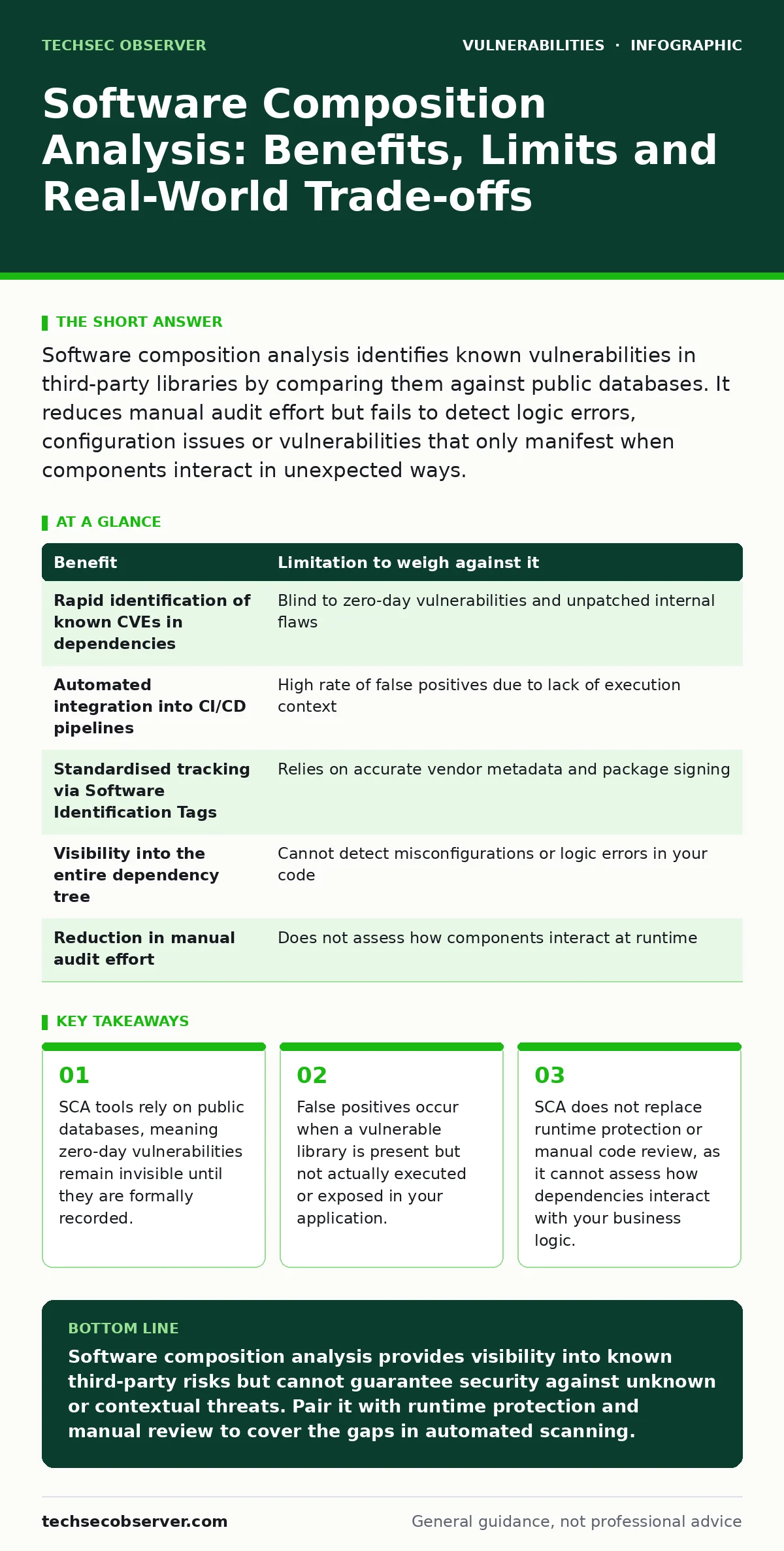
Software composition analysis identifies known vulnerabilities in third-party libraries by comparing them against public databases. It reduces manual audit effort but fails to detect logic errors, configuration issues or vulnerabilities that only manifest when components interact in unexpected ways.
The Mechanics of Dependency Mapping
Software composition analysis operates by scanning your project’s dependency tree. It extracts identifiers such as package names, versions and hashes, then queries public databases for known weaknesses. This process creates a bill of materials for your software, listing every third-party component included in your build.
The tool does not read your source code. It assumes that if a library contains a flaw, that flaw exists in your application regardless of how you use it. This assumption drives both the speed of the tool and its primary limitation. You gain rapid visibility into your supply chain, but you lose context about how those components are actually deployed.
Concrete Benefits of Automated Scanning
The primary benefit is scale. Manual auditing of hundreds of dependencies is impossible for most teams. SCA automates the discovery of known issues, allowing you to prioritise remediation based on severity. It integrates into continuous integration pipelines, blocking builds that introduce critical risks. This shifts security left, catching issues before they reach production.
Another benefit is standardisation. SCA tools use common identifiers, such as the Software Identification Tag, to map components across ecosystems. This allows you to track a specific library version across multiple services or microservices. You can identify where a vulnerable component is used and determine the blast radius of a potential exploit.
However, this standardisation relies on accurate metadata. If a vendor fails to sign their packages or if the metadata is stripped during compilation, the SCA tool may fail to identify the component correctly. You are only as secure as the integrity of the supply chain data you receive.
Honest Limitations and Blind Spots
The most significant limitation is the reliance on public knowledge. SCA tools cannot detect vulnerabilities that have not been assigned a Common Vulnerabilities and Exposures identifier. If a researcher has not disclosed a flaw, or if a vendor has not acknowledged it, the tool will report a clean bill of health. This creates a false sense of security during the window before public disclosure.
Furthermore, SCA tools struggle with context. They often flag a vulnerability as present even if your code never calls the vulnerable function. This leads to alert fatigue, where developers ignore warnings because too many are irrelevant to their specific usage. For example, a library might contain a buffer overflow in a feature you do not use, yet the tool will still report it as a critical risk.
The Table of Trade-offs
To understand the balance, consider these paired realities. Each benefit comes with a corresponding constraint that affects your security posture.
| Benefit | Limitation to weigh against it |
|---|---|
| Rapid identification of known CVEs in dependencies | Blind to zero-day vulnerabilities and unpatched internal flaws |
| Automated integration into CI/CD pipelines | High rate of false positives due to lack of execution context |
| Standardised tracking via Software Identification Tags | Relies on accurate vendor metadata and package signing |
| Visibility into the entire dependency tree | Cannot detect misconfigurations or logic errors in your code |
| Reduction in manual audit effort | Does not assess how components interact at runtime |
When SCA Is Worth the Investment
Implementing SCA is worthwhile when your application relies heavily on third-party libraries. If you build a web service using a popular framework, you inherit thousands of transitive dependencies. Manual tracking is not feasible. In this scenario, SCA provides the baseline visibility required to manage risk.
It is also valuable when compliance requirements mandate supply chain transparency. Many regulations require organisations to maintain an inventory of software components. SCA tools generate the necessary reports automatically. This reduces the administrative burden and ensures consistent auditing.
For large organisations with multiple teams, SCA centralises security policy. You can enforce rules that block the introduction of libraries with known critical flaws. This prevents individual developers from accidentally introducing high-risk components due to lack of awareness.
See also: IoT Patching Mistakes: 7 Errors That Leave Devices Exposed · Prevent Business Logic Vulnerabilities: 4 Proven Measures
When SCA Is Not the Right Tool
SCA is not worth the effort if your application is largely custom-built with minimal external dependencies. If you write most of your code from scratch, there is little for the tool to scan. In this case, you should focus on static application security testing or dynamic analysis instead.
It is also insufficient if you are trying to detect logic errors or business logic flaws. SCA cannot understand the intent of your code. It will not catch a flaw where a user can escalate privileges by manipulating input parameters in a specific sequence. For these issues, you need methods like fuzz testing or manual penetration testing.
Complementary Security Measures
SCA works best as part of a layered defence strategy. It should be combined with other techniques to cover its blind spots. For instance, while SCA checks for known library flaws, you should use static analysis to find issues in your own code, such as SQL injection or command injection vulnerabilities.
Runtime application self-protection can also help. While SCA identifies potential risks, runtime tools monitor actual behaviour. They can block attacks that exploit vulnerabilities SCA missed or that were introduced after the last scan. This adds a layer of defence that adapts to real-time threats.
Consider also the risk of data poisoning attacks in machine learning pipelines. If your dependencies include models or datasets, SCA may not detect if the underlying data has been manipulated. You need specific validation steps for data integrity that go beyond traditional software composition analysis.
Managing False Positives and Alert Fatigue
To make SCA effective, you must manage the noise. Configure your tool to suppress warnings for vulnerabilities that are not relevant to your usage. This might involve marking certain libraries as safe if they are used in a restricted manner. However, document these decisions so they can be reviewed later.
Regularly update your suppression rules. As libraries are patched or new vulnerabilities are discovered, your previous assumptions may no longer hold. A library that was safe to ignore might become critical after a new exploit is published. Treat your SCA configuration as living documentation, not a one-time setup.
Finally, integrate SCA results into your developer workflow. Provide clear guidance on how to remediate issues. If a developer sees a warning, they should know exactly which version to upgrade to and how to verify the fix. This turns security findings into actionable improvements rather than obstructive blockers.
Key takeaways
- SCA tools rely on public databases, meaning zero-day vulnerabilities remain invisible until they are formally recorded.
- False positives occur when a vulnerable library is present but not actually executed or exposed in your application.
- SCA does not replace runtime protection or manual code review, as it cannot assess how dependencies interact with your business logic.
Software composition analysis provides visibility into known third-party risks but cannot guarantee security against unknown or contextual threats. Pair it with runtime protection and manual review to cover the gaps in automated scanning.
Frequently asked questions
Does SCA detect vulnerabilities in my own source code?
No, SCA only scans third-party dependencies and libraries. It does not analyse your custom source code for logic errors or implementation flaws.
Can SCA prevent zero-day attacks?
No, SCA relies on public databases of known vulnerabilities. It cannot detect zero-day exploits that have not yet been identified or recorded.
How often should I run SCA scans?
Run scans on every commit or pull request in your CI/CD pipeline. This ensures new vulnerabilities are caught before they are merged into your main codebase.
Is SCA enough for compliance requirements?
SCA helps meet supply chain transparency requirements, but compliance often demands additional controls like code signing, runtime monitoring and regular penetration testing.
How this guide was produced: written by the TechSec Observer editorial team with AI assistance, checked against the public references listed below, and reviewed when the facts change. See our editorial policy or report an error.