SQL Injection Response: Containment, Recovery and Prevention Steps
Restoring service before verifying data integrity often re-exposes the system, turning a contained breach into a persistent backdoor that survives standard patches.
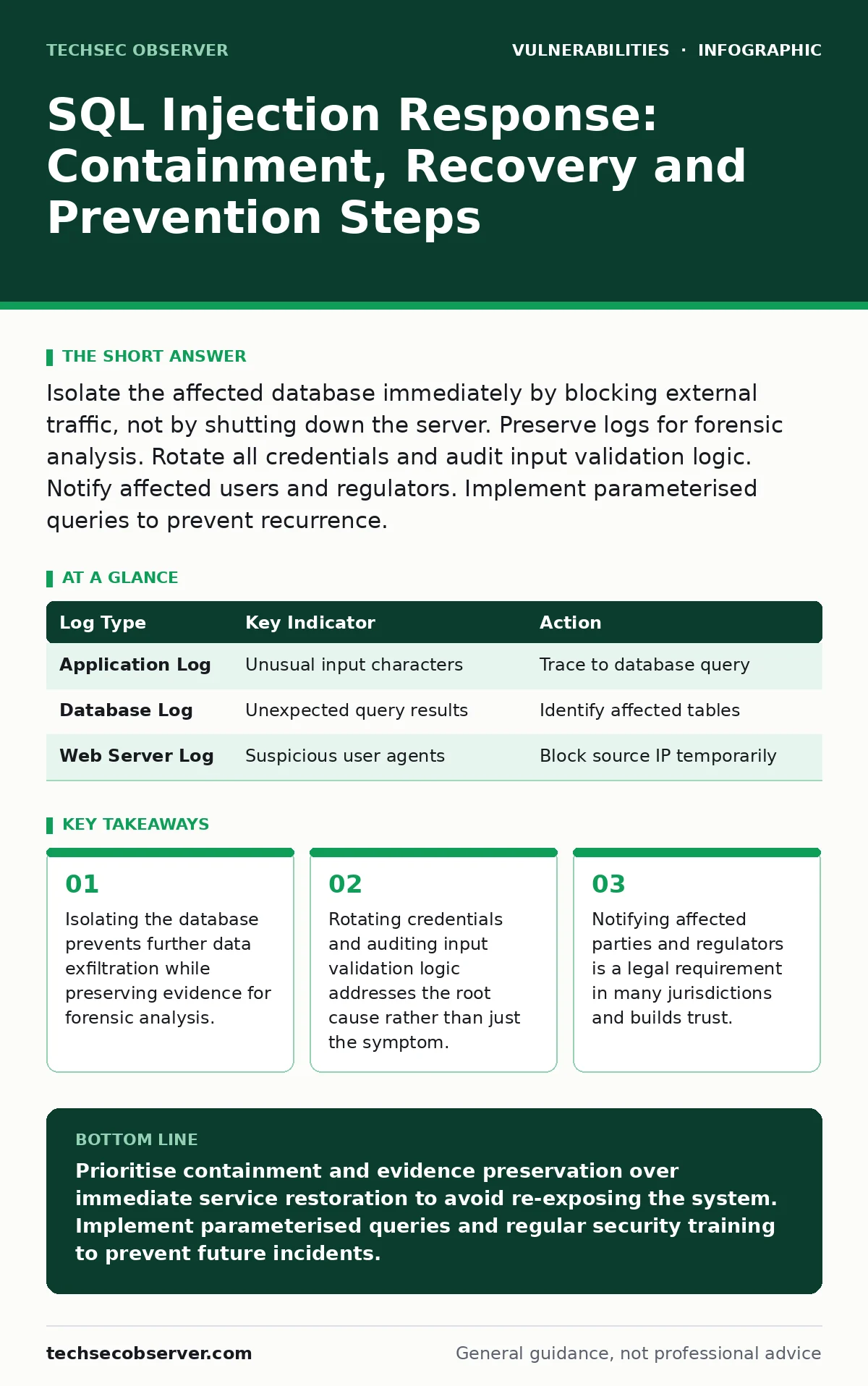
Isolate the affected database immediately by blocking external traffic, not by shutting down the server. Preserve logs for forensic analysis. Rotate all credentials and audit input validation logic. Notify affected users and regulators. Implement parameterised queries to prevent recurrence.
First hour
You have detected anomalous activity in your application logs. The pattern suggests an attacker is manipulating your database queries. Your immediate goal is to stop the bleeding without destroying the evidence. Panic often leads to hasty decisions that compromise the investigation.
- Isolate the network segment: Block all external traffic to the database server. This stops the attacker from continuing their session while keeping the server running for analysis.
- Preserve logs: Copy application logs, database query logs and web server access logs to a secure, offline storage location. These files are your primary source of truth.
- Identify the scope: Determine which endpoints are affected. Look for unusual query patterns or error messages in the application logs.
- Block external traffic to the database
- Securely copy all relevant logs
- Identify affected endpoints and user accounts
First day
With the immediate threat contained, you must understand the extent of the damage. This phase requires careful analysis of the preserved logs. You are looking for the specific input that triggered the injection and the data that was accessed.
Review the application logs for unusual query structures. Look for single quotes, semicolons or comment symbols in input parameters. These characters often indicate an attempt to break out of the intended query structure. Cross-reference these timestamps with the database logs to see what data was actually retrieved.
Imagine a scenario where the attacker used a blind SQL injection technique. The application may not have returned error messages, but the timing of the responses reveals the data. You need to correlate these timing anomalies with the specific queries executed.
| Log Type | Key Indicator | Action |
|---|---|---|
| Application Log | Unusual input characters | Trace to database query |
| Database Log | Unexpected query results | Identify affected tables |
| Web Server Log | Suspicious user agents | Block source IP temporarily |
First week
Now you focus on recovery and prevention. This involves restoring service safely, notifying affected parties and implementing fixes. Rushing this phase can lead to a repeat of the incident.
Rotate all database credentials. This includes application service accounts and administrative accounts. Even if you are certain the attacker did not steal these credentials, it is a necessary precaution. Change them across all systems where they are used.
Notify affected users and regulators. This is a legal requirement in many jurisdictions. Be transparent about what happened and what you are doing to fix it. This builds trust and demonstrates your commitment to security.
Who to tell
Transparency is critical. You need to inform your internal stakeholders, affected users and relevant regulatory bodies. Each group requires different information.
Internal stakeholders need to know the scope of the incident and the impact on business operations. Affected users need to know what data was compromised and what steps they should take to protect themselves. Regulatory bodies need a detailed report on the incident and your remediation plan.
How to stop a repeat
Fixing the immediate vulnerability is not enough. You must address the underlying weaknesses in your development process. This requires a shift in how you handle user input.
Implement parameterised queries. This technique separates the code from the data, ensuring that user input is always treated as data and never as executable code. It is the most effective way to prevent SQL injection.
Consider using software composition analysis to identify vulnerable libraries in your supply chain. Many SQL injection vulnerabilities arise from outdated or poorly maintained third-party components. Regularly updating these components is vital.
Edge cases
Some scenarios are more complex than others. For example, stored procedures can be vulnerable if they are not properly parameterised. Imagine a stored procedure that concatenates user input into a dynamic SQL string. This is just as dangerous as inline SQL.
Another edge case is second-order SQL injection. The malicious input is stored in the database and executed later when another process retrieves it. This can be harder to detect because the initial input may seem harmless.
Long-term resilience
Security is not a one-time fix. It is an ongoing process. You need to integrate security into your development lifecycle from the start.
Conduct regular code reviews with a focus on security. Train your developers on secure coding practices. Use automated testing tools to detect vulnerabilities early.
Consider fuzz testing to identify unexpected input handling issues. This technique involves sending random, malformed data to your application to see how it responds. It can reveal vulnerabilities that manual testing might miss.
Final steps
Document the incident and the lessons learned. Update your incident response plan based on what worked and what did not. This ensures that you are better prepared for the next incident.
Review your threat intelligence reports to understand the latest attack trends. This helps you stay ahead of potential threats.
Remember, no system is completely secure. The goal is to reduce the risk to an acceptable level and respond effectively when things go wrong.
Key takeaways
- Isolating the database prevents further data exfiltration while preserving evidence for forensic analysis.
- Rotating credentials and auditing input validation logic addresses the root cause rather than just the symptom.
- Notifying affected parties and regulators is a legal requirement in many jurisdictions and builds trust.
Prioritise containment and evidence preservation over immediate service restoration to avoid re-exposing the system. Implement parameterised queries and regular security training to prevent future incidents.
Frequently asked questions
How do I know if my data was actually stolen?
Review the database logs for unusual query results and correlate them with the application logs. Look for queries that retrieve sensitive data tables.
Should I change my application code immediately?
Yes, but only after you have isolated the system and preserved the logs. Changing code first can destroy evidence.
What if I am using an ORM?
ORMs can help prevent SQL injection, but they are not immune. Ensure you are using parameterised queries within the ORM.
How often should I review my security practices?
Regularly, especially after any security incident or significant change to your application or infrastructure.
How this guide was produced: written by the TechSec Observer editorial team with AI assistance, checked against the public references listed below, and reviewed when the facts change. See our editorial policy or report an error.