Mistakes That Leave You Open to Deepfake Scams
Synthetic media exploits human trust in sensory evidence, bypassing technical controls by manipulating social verification habits and procedural gaps.
Deepfake scams succeed when you rely solely on sight or sound for verification. Attackers exploit the assumption that digital media is authentic. You remain vulnerable if you skip out-of-band confirmation, ignore subtle audio artifacts, or allow urgency to override standard authorisation protocols.
Mistake 1: Trusting Visual Continuity in Video Calls
Why it hurts:
You assume that a real-time video feed proves the presence of a known individual. Generative models now maintain consistent lighting and facial expressions across frames. The brain processes familiar faces with low cognitive load, skipping detailed analysis. This automatic recognition allows attackers to insert a cloned face into a live stream without triggering immediate suspicion. The visual continuity creates a false sense of security, masking the fact that the audio and video streams may originate from different sources.
The fix:
Implement a challenge-response protocol during high-value interactions. Ask the person on the call to perform a specific, unpredictable physical action. Request that they cover one ear with their hand or rotate their head in a non-standard way. This forces the generative model to render complex geometry in real time, often revealing edge artifacts or temporal inconsistencies. Do not rely on passive observation. Active verification breaks the assumption that the visual input is a direct capture of reality.
Mistake 2: Ignoring Audio Spectral Anomalies
Why it hurts:
Voice cloning technology captures tone, pitch, and cadence with high fidelity. You hear a familiar voice and accept the request. However, synthetic audio often lacks the natural micro-variations of human breath and throat resonance. The spectral content may appear smooth where human speech contains irregular noise. Attackers exploit the human tendency to prioritise semantic content over acoustic texture. You process the words while ignoring the carrier signal, allowing a generated voice to bypass auditory scrutiny.
The fix:
Listen for unnatural consistency in background noise and breath patterns. Real voices exhibit subtle variations in volume and frequency that synthetic models struggle to replicate perfectly. Ask the caller to speak a phrase that is not in their typical vocabulary. Observe how the voice handles unfamiliar phonemes. Synthetic models often degrade in quality when processing out-of-distribution data. Combine this with visual checks to create a multi-modal verification barrier that is harder to spoof simultaneously.
Mistake 3: Accepting Urgency as Justification
Why it hurts:
Scammers inject artificial urgency to trigger a fight-or-flight response. They claim a server is down, a payment is failing, or a security breach is imminent. This pressure reduces your cognitive capacity for critical analysis. You skip standard verification steps because the perceived cost of delay outweighs the risk of error. The attacker relies on your desire to prevent negative outcomes. This psychological manipulation works even when you know about deepfakes, because urgency overrides intellectual caution.
The fix:
Establish a policy that no urgent request bypasses standard verification. Define specific thresholds for what constitutes an emergency and how it must be confirmed. If a request feels rushed, pause the interaction. State clearly that you will verify the request through an alternative channel before proceeding. This pause disrupts the attacker’s timing and allows you to regain analytical control. Urgency is a red flag, not a justification for skipping security procedures.
Mistake 4: Relying on Single-Channel Verification
Why it hurts:
You verify identity through the same channel used for the request. An attacker who has compromised your email can send a fake invoice. If you reply to that email to confirm, you remain within the attacker’s controlled environment. Single-channel verification assumes the channel itself is secure. This assumption fails when the communication medium is compromised or spoofed. The deepfake adds a layer of social engineering, but the underlying failure is the lack of channel diversity.
The fix:
Use out-of-band verification for any request involving data transfer or financial action. Contact the requester using a different communication medium than the one used for the request. If the request comes via video call, call them on a known phone number. If it comes via email, call them directly. This separates the identity claim from the request channel. It ensures that even if one channel is compromised, the other remains a source of truth.
Mistake 5: Neglecting Metadata Analysis in Digital Files
Why it hurts:
You accept received files at face value. Deepfake images and videos often carry metadata that reveals their origin. This data includes timestamps, software signatures, and editing history. Ignoring this information leaves you blind to the technical provenance of the media. Attackers may strip metadata, but incomplete removal can leave traces. Relying solely on content analysis misses these technical indicators. The absence of expected metadata is as telling as its presence.
The fix:
Inspect the metadata of received media files before acting on them. Check for inconsistencies in creation dates, software versions, or editing tools. Look for signs of recent processing or compression artifacts. While attackers can scrub metadata, the effort required increases the complexity of their operation. Combine metadata checks with visual and audio analysis. This technical layer adds friction to the attack process, reducing the likelihood of success.
See also: Social Engineering Response: Containment and Recovery Steps
Mistake 6: Failing to Update Verification Protocols
Why it hurts:
Your verification methods become predictable over time. Attackers adapt to known challenges. If you always ask for a specific hand gesture, attackers train their models to replicate it. Static verification protocols lose effectiveness as synthetic media technology improves. You create a false sense of security by relying on methods that were effective in the past. This stagnation allows attackers to refine their techniques to bypass your specific checks.
The fix:
Rotate your verification challenges regularly. Change the physical actions or verbal phrases used for confirmation. Incorporate unpredictable elements into your verification process. This forces attackers to constantly adapt their models, increasing their resource costs. Review and update your protocols periodically to ensure they remain effective. Treat verification as a dynamic process rather than a static rule. This adaptability maintains the integrity of your identity confirmation procedures.
Mistake 7: Overlooking Contextual Inconsistencies
Why it hurts:
You focus on the face or voice and ignore the surrounding context. The background in a video may not match the person’s known environment. The timing of the request may contradict known schedules. These contextual clues are often overlooked because attention is fixed on the identity claim. Attackers may struggle to replicate complex environmental details or maintain consistent temporal logic. Ignoring these broader cues allows the deepfake to succeed despite obvious environmental discrepancies.
The fix:
Evaluate the entire context of the communication. Check the background, lighting, and timing against known facts. Ask questions that require knowledge of recent events or specific environmental details. This tests the attacker’s ability to maintain a consistent narrative across multiple dimensions. Contextual verification adds a layer of scrutiny that is difficult to automate. It ensures that the identity claim aligns with the broader reality of the situation.
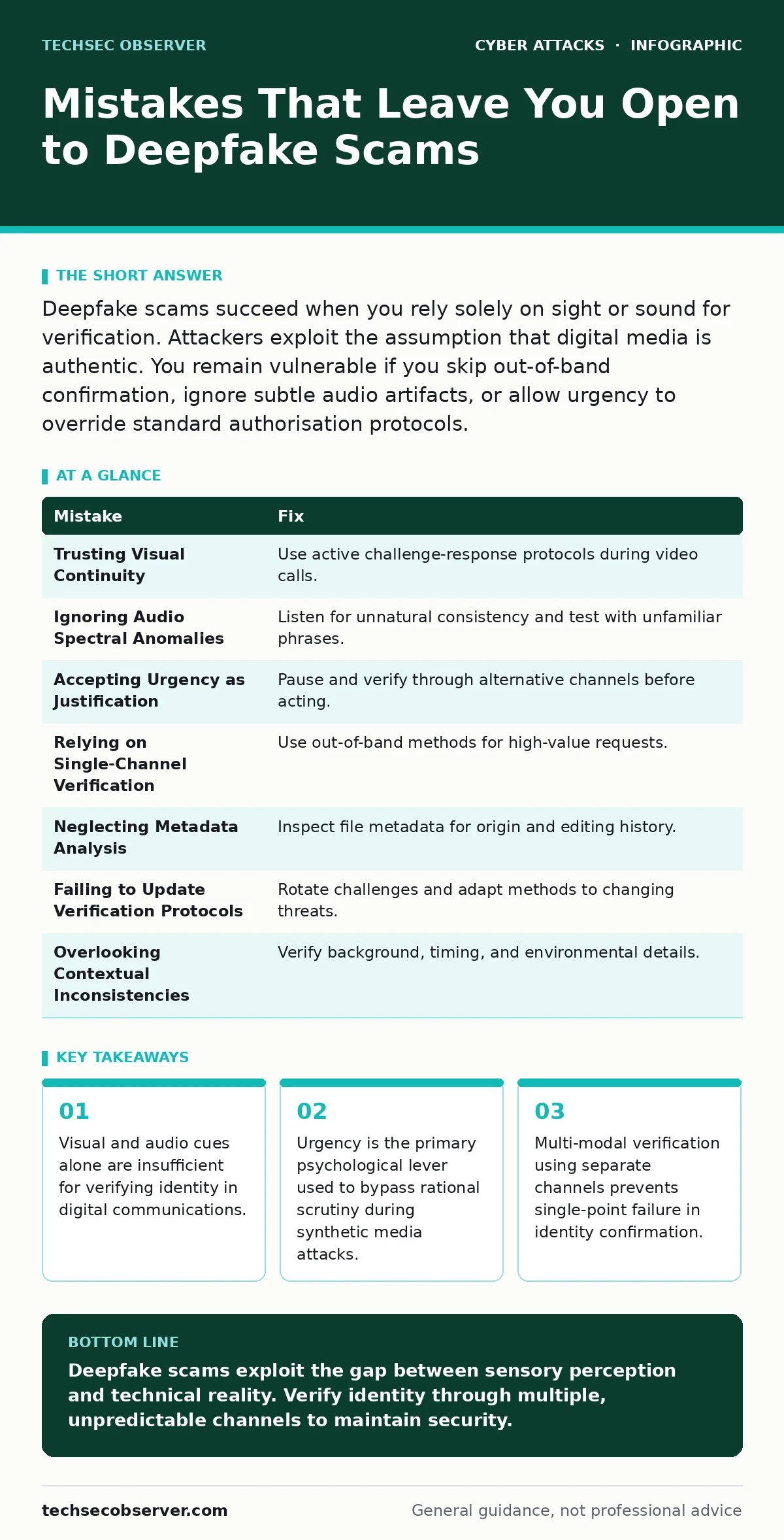
| Mistake | Fix |
|---|---|
| Trusting Visual Continuity | Use active challenge-response protocols during video calls. |
| Ignoring Audio Spectral Anomalies | Listen for unnatural consistency and test with unfamiliar phrases. |
| Accepting Urgency as Justification | Pause and verify through alternative channels before acting. |
| Relying on Single-Channel Verification | Use out-of-band methods for high-value requests. |
| Neglecting Metadata Analysis | Inspect file metadata for origin and editing history. |
| Failing to Update Verification Protocols | Rotate challenges and adapt methods to changing threats. |
| Overlooking Contextual Inconsistencies | Verify background, timing, and environmental details. |
Key takeaways
- Visual and audio cues alone are insufficient for verifying identity in digital communications.
- Urgency is the primary psychological lever used to bypass rational scrutiny during synthetic media attacks.
- Multi-modal verification using separate channels prevents single-point failure in identity confirmation.
Deepfake scams exploit the gap between sensory perception and technical reality. Verify identity through multiple, unpredictable channels to maintain security.
Frequently asked questions
Can browser plugins detect deepfakes in real-time?
Some tools analyse visual and audio artifacts, but they are not foolproof. Always combine technical detection with human verification protocols.
How do deepfakes relate to phishing?
Deepfakes enhance phishing by adding social engineering layers. They make fraudulent requests appear more credible and urgent.
Are deepfake scams limited to video calls?
No. Audio cloning and image generation are also common. Any digital media can be manipulated to deceive.
Does security awareness training prevent deepfake attacks?
Training raises suspicion but does not stop technical attacks. It must be combined with procedural verification steps.
How this guide was produced: written by the TechSec Observer editorial team with AI assistance, checked against the public references listed below, and reviewed when the facts change. See our editorial policy or report an error.