Disinformation Bot Networks: Small Business Defence Strategies
Automated bot networks exploit human trust in small teams, turning routine social interactions into vectors for credential theft and reputational damage.

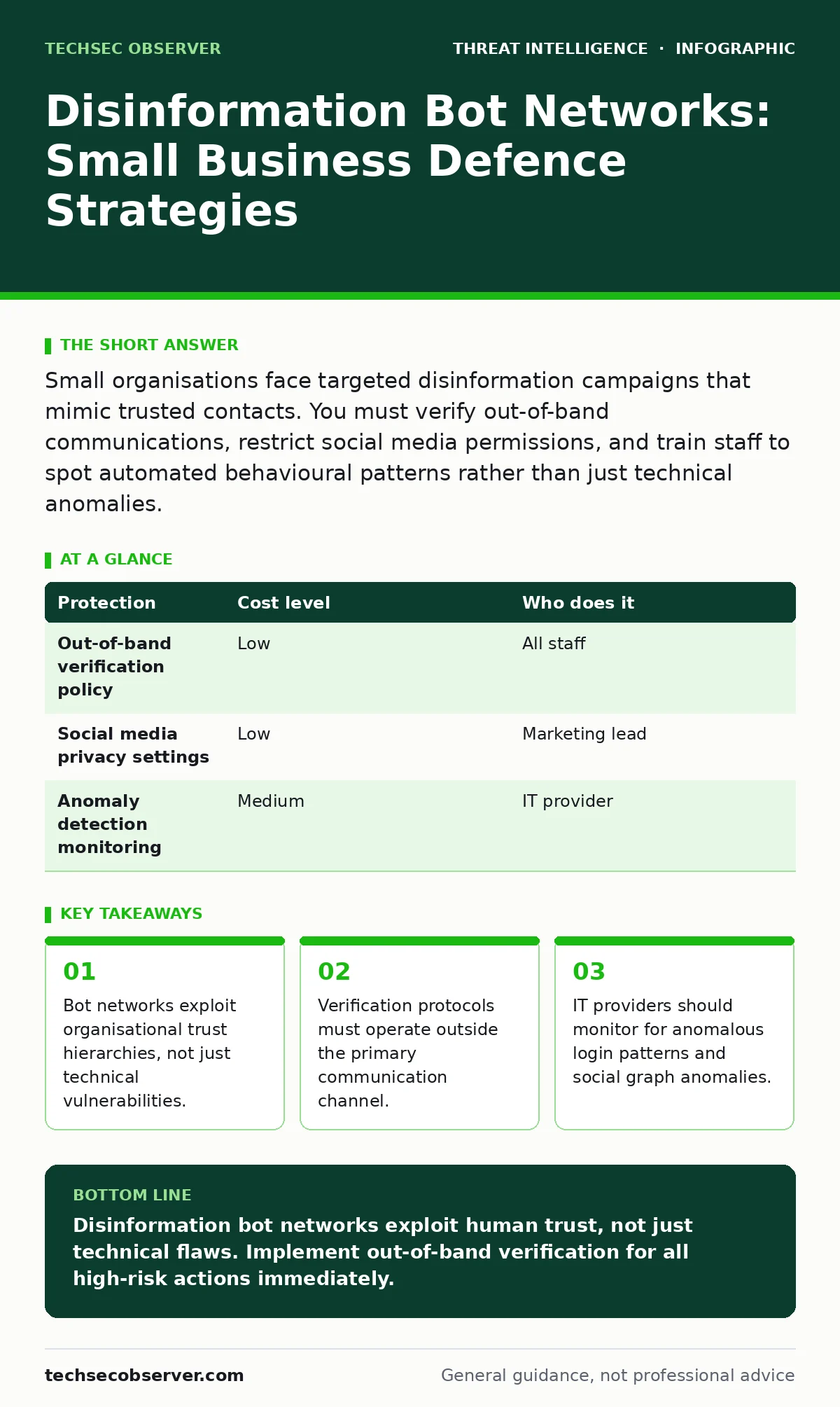
Small organisations face targeted disinformation campaigns that mimic trusted contacts. You must verify out-of-band communications, restrict social media permissions, and train staff to spot automated behavioural patterns rather than just technical anomalies.
The Human Attack Surface
Small businesses possess high-trust networks that bot operators find lucrative. Large corporations have rigid verification procedures that slow down social engineering attempts. Small teams rely on informal communication and rapid decision-making. This speed creates openings for automated accounts to inject disinformation. Bots do not need to hack servers directly. They manipulate the people who hold the keys. The mechanism relies on psychological pressure rather than code execution.
Imagine a scenario where a bot impersonates a long-standing supplier. The account has been active for months, posting harmless industry news. It builds a reputation within your professional network. When the fraud occurs, it appears legitimate because the history is clean. This is known as account warming. The cost to the attacker is time and computational resources, not money. The cost to you is immediate financial loss or data exposure.
Bot Network Mechanics
Disinformation bot networks operate at scale using coordinated behaviour. These are not single malicious accounts. They are clusters of accounts that act in unison to amplify a specific narrative or request. The coordination happens through hidden signalling protocols or shared infrastructure. You cannot detect them by looking at one account in isolation. The danger lies in the collective action.
The bots mimic human interaction patterns to evade basic filters. They pause between messages, use varied sentence structures, and engage in casual conversation. This makes them difficult to distinguish from real users using standard tools. The trade-off for this sophistication is that they require significant maintenance. If the network is disrupted, the accounts may become inactive. However, the damage during the active window can be severe.
Why Scale Matters
You might assume that bot networks target large entities with valuable data. This assumption is incorrect. Small businesses are attractive targets because they lack dedicated security teams. The resource asymmetry works in favour of the attacker. A small team can deploy thousands of bots against a ten-person company without detection. The small business lacks the bandwidth to investigate every unusual contact.
The impact is disproportionate. A large enterprise can absorb a minor breach. A small business may face existential risk from the same incident. Reputational damage spreads quickly in small communities. If your brand is associated with a disinformation campaign, client trust erodes. The recovery process is slow and resource-intensive. The primary defence is reducing the attack surface by limiting public exposure.
Practical Verification Protocols
Verification must happen outside the channel where the request originated. If a message arrives via email, verify it via a phone call using a known number. If a message arrives via instant messaging, verify it via a separate platform. This breaks the chain of trust that the bot has established. The bot controls the digital identity in one channel. It does not control your physical phone or a secondary email address.
Implement a policy for high-risk actions. Financial transfers, password resets, and software installations require secondary confirmation. This adds friction to the process. Friction is the enemy of social engineering. The attacker relies on urgency and fear to bypass rational thought. A mandatory pause allows staff to question the legitimacy of the request.
| Protection | Cost level | Who does it |
|---|---|---|
| Out-of-band verification policy | Low | All staff |
| Social media privacy settings | Low | Marketing lead |
| Anomaly detection monitoring | Medium | IT provider |
Social Media Hygiene
Public social media profiles provide data for bot operators. They use this information to craft personalised disinformation. The more visible your team is, the more realistic the impersonation can be. Restricting profile visibility reduces the data available for account warming. This does not eliminate the risk, but it raises the barrier to entry for the attacker.
Review application permissions regularly. Third-party apps often harvest connection data. This data helps bots map your organisational structure. Understanding who reports to whom allows the attacker to target specific relationships. Revoke permissions for unused applications. This limits the data leakage that fuels sophisticated impersonation attacks.
See also: Social Engineering Response: Containment and Recovery Steps · What is Domain Fronting: Mechanics, Detection and Mitigation
IT Provider Responsibilities
Your IT provider plays a critical role in detecting anomalous behaviour. They should monitor for unusual login patterns. A sudden spike in login attempts from new locations or devices may indicate compromised accounts. This is not always a direct bot attack, but it can be a precursor. The provider must distinguish between legitimate travel and malicious activity.
Ask your provider about their monitoring capabilities. Do they use user and entity behavior analytics to detect deviations from normal patterns? This technology looks at how users interact with systems, not just what they access. It can identify accounts that are behaving like bots, even if they are using stolen credentials. The insight comes from context, not just credentials.
Questions for Your Provider
You need to assess whether your current security posture addresses the human element. Technical controls are insufficient if staff are manipulated. Ask specific questions about how your provider handles social engineering risks. The answers will reveal the depth of their understanding.
- How do you detect accounts that are behaving like bots?
- What is your process for verifying suspicious financial requests?
- Do you monitor for anomalies in social media connection data?
- How do you train staff to recognise coordinated disinformation campaigns?
- What is the response time for a confirmed impersonation incident?
The Hidden Cost of Trust
The most significant cost is the erosion of internal trust. When a disinformation attack succeeds, staff begin to doubt legitimate communications. This leads to analysis paralysis. People hesitate to act on genuine urgent requests because they fear another scam. This slows down operations and reduces productivity. The attacker achieves their goal not just by stealing data, but by breaking the workflow.
Rebuilding trust takes time. It requires transparent communication and consistent verification practices. You must demonstrate that the verification process protects the team, rather than hindering them. The goal is to make verification habitual. When it becomes routine, it no longer feels like a barrier. It becomes a shield.
Long-Term Resilience
Disinformation tactics evolve as detection methods improve. Bots become more human-like, and coordination becomes more subtle. You must stay informed about current techniques. Subscribe to threat intelligence feeds that focus on social engineering. This helps you anticipate new patterns before they target your organisation.
Collaborate with other small businesses in your sector. Sharing anonymised information about attack patterns helps everyone. The attacker relies on isolation. When you share knowledge, you reduce the effectiveness of their campaigns. Collective defence is stronger than individual vigilance. The network effect works in your favour when you coordinate.
Key takeaways
- Bot networks exploit organisational trust hierarchies, not just technical vulnerabilities.
- Verification protocols must operate outside the primary communication channel.
- IT providers should monitor for anomalous login patterns and social graph anomalies.
Disinformation bot networks exploit human trust, not just technical flaws. Implement out-of-band verification for all high-risk actions immediately.
Frequently asked questions
Can I block all bot accounts automatically?
No. Sophisticated bots mimic human behaviour and use legitimate accounts. Automatic blocking often catches real users while missing advanced threats. You need layered detection.
How do I know if a message is from a bot?
Look for urgency, requests for secrecy, and deviations from normal communication patterns. Verify the sender via a different channel. Context matters more than content.
Is multi-factor authentication enough?
MFA protects against credential theft, but not against social engineering. If a user is tricked into approving a login, MFA fails. Combine MFA with verification protocols.
Should I delete my social media accounts?
Deletion is not necessary if you manage privacy settings. Restrict visibility and review app permissions. This reduces the data available for attackers to craft impersonations.
How this guide was produced: written by the TechSec Observer editorial team with AI assistance, checked against the public references listed below, and reviewed when the facts change. See our editorial policy or report an error.