Data Breach Response Plans for Small Businesses: Practical Steps
Small teams fail not from lack of tools, but from ambiguity in decision-making authority during the first hour of an incident.

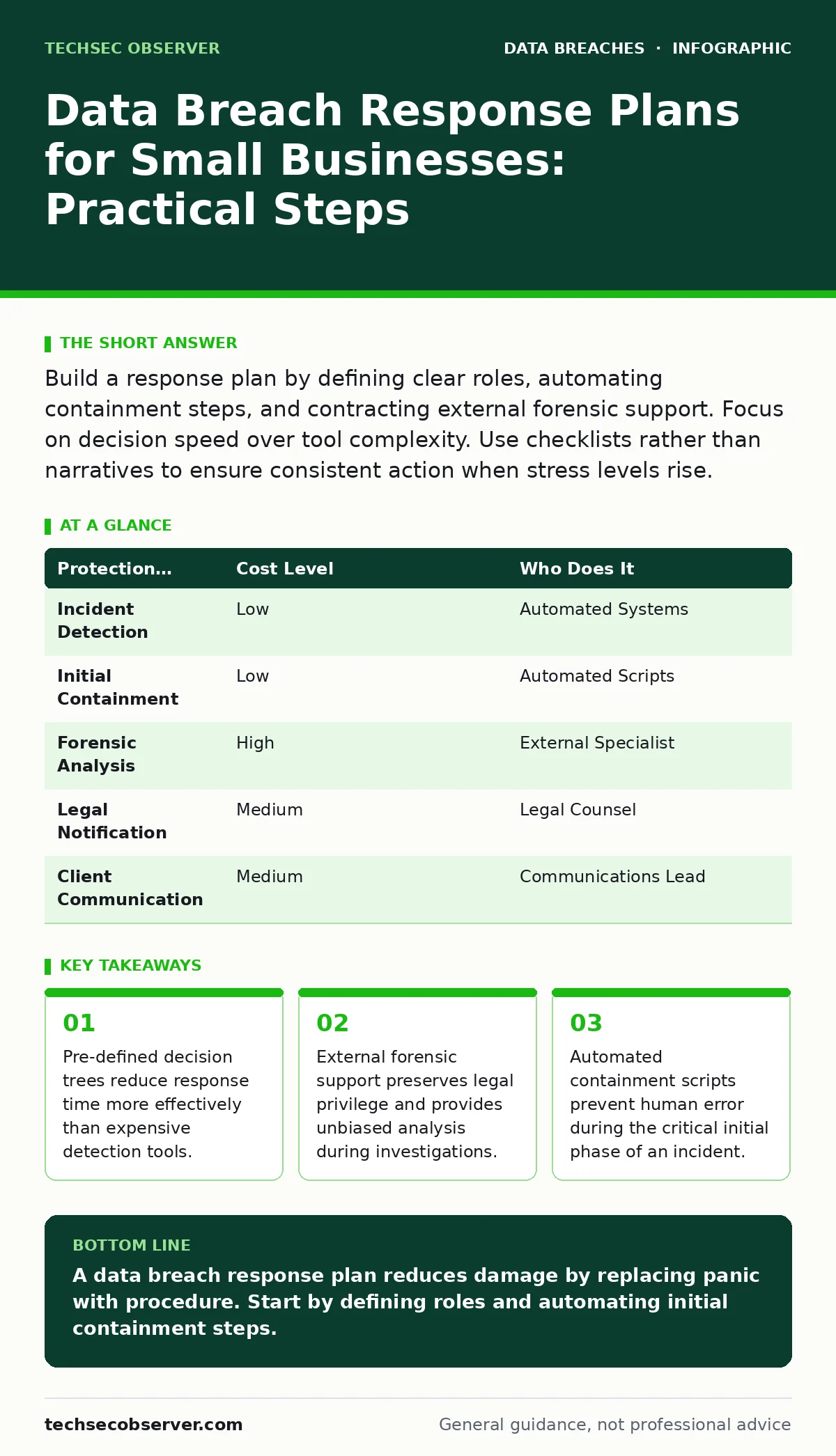
Build a response plan by defining clear roles, automating containment steps, and contracting external forensic support. Focus on decision speed over tool complexity. Use checklists rather than narratives to ensure consistent action when stress levels rise.
The Hidden Cost of Ambiguity
Small organisations often assume that data breach response plans are only necessary for large enterprises with complex infrastructure. This assumption is dangerous. The primary failure point in small teams is not a lack of technical capability, but a lack of procedural clarity. When an incident occurs, cognitive load spikes. Decision-making quality drops significantly under stress.
A plan removes the need to think during a crisis. It replaces deliberation with execution. You do not need a hundred-page document. You need a single page that tells you who does what, in what order. The goal is to reduce the time between detection and containment. This window determines the severity of the damage.
Defining Roles Without Creating Bottlenecks
In a small team, one person often wears multiple hats. This creates a bottleneck if that person is unavailable or overwhelmed. Your plan must define a primary responder and a secondary responder. The primary responder executes the technical steps. The secondary responder handles communication and legal coordination.
Separate these duties even if the same people hold them. This mental separation prevents technical tunnel vision. The primary responder focuses on stopping the bleed. The secondary responder ensures that client notifications and regulatory requirements are met. If you have fewer than five employees, consider appointing an external advisor as the secondary responder. This provides an objective voice when internal panic sets in.
Automating the First Response
Human reaction times are variable. Automated systems are consistent. You should automate the initial containment steps wherever possible. For example, if a login from a new country triggers an alert, the system should automatically disable that session. This does not require complex tools. Many identity providers offer this feature out of the box.
Automation reduces the risk of human error. A tired administrator might forget to revoke a token. A script will not. However, automation has limits. It cannot determine if an alert is a false positive. You must still have a human review process. The automation buys you time for that review. It stops the immediate threat while you assess the situation.
What to Delegate to External Partners
You cannot do everything in-house. Forensic investigation requires specialised skills that most small teams lack. Attempting to conduct your own forensic analysis can destroy evidence. It can also complicate legal proceedings. You should delegate the forensic investigation to a reputable third party.
This delegation serves two purposes. First, it ensures a thorough and unbiased analysis. Second, it may protect your communications under legal privilege. In many jurisdictions, communications with legal counsel and their agents are protected. This protection does not apply to internal IT staff. Check with a lawyer before engaging an external partner. Ensure the engagement letter specifies that the work is for legal purposes.
| Protection Measure | Cost Level | Who Does It |
|---|---|---|
| Incident Detection | Low | Automated Systems |
| Initial Containment | Low | Automated Scripts |
| Forensic Analysis | High | External Specialist |
| Legal Notification | Medium | Legal Counsel |
| Client Communication | Medium | Communications Lead |
Building an Affordable Plan
You do not need expensive software to create a response plan. You need a clear process. Start by mapping your critical assets. Identify where your most sensitive data lives. Then, determine how an attacker could access it. This is a threat model. It helps you prioritise your controls.
Next, write the steps for each scenario. Use simple language. Avoid jargon. Include contact details for key personnel and external partners. Test the plan regularly. Run a tabletop exercise once a year. Simulate a breach and walk through the steps. This reveals gaps in your logic. It also familiarises your team with the process. The cost of this exercise is minimal. The benefit is significant.
Questions for Your IT Provider
If you use an external IT provider, you must clarify their role in your response plan. Many providers offer basic support but do not include incident response in their contracts. You need to know exactly what they will do when a breach occurs. Ask them the following questions:
- What is your response time for a confirmed security incident?
- Do you provide forensic analysis, or do you recommend an external partner?
- Who owns the evidence collected during the investigation?
- How will you communicate with us during the incident?
- Do you have cyber liability insurance that covers your negligence?
Integrating Related Security Practices
A response plan does not exist in isolation. It works best when combined with other security measures. For instance, a strong backup strategy reduces the impact of ransomware. If you follow the 3-2-1 backup rule, you can restore data without paying a ransom. This changes your response from negotiation to recovery.
Similarly, understanding data controllers and data processors helps you determine your legal obligations. If you process data on behalf of another organisation, you may have different notification requirements. Your plan should reflect these distinctions. It should also consider the risk of customer data exposure. If personal data is compromised, you must notify affected individuals. The plan should include templates for these notifications.
The Reality of Insider Threats
Not all breaches come from outside. Insider threats can be accidental or malicious. Your plan must account for both. Accidental leaks often occur through misconfigured access controls. Malicious insiders may abuse their privileges. Both scenarios require different responses.
For accidental leaks, focus on rapid revocation of access. For malicious insiders, focus on preservation of evidence. Do not confront the suspect immediately. This could lead to data destruction. Instead, disable their access quietly and begin an investigation. Consider user and entity behavior analytics to detect unusual activity. These tools can identify deviations from normal behaviour, providing early warning signs.
Maintaining the Plan
A response plan is a living document. It must evolve as your organisation grows. New technologies introduce new risks. New regulations introduce new requirements. Review your plan annually. Update it after any significant change in your infrastructure.
Test your updates. A plan that sits on a shelf is useless. Regular testing ensures that your team knows what to do. It also identifies outdated procedures. For example, if you change your email provider, your containment steps must change. Keep your plan simple. Complexity is the enemy of execution. The goal is not perfection. The goal is speed and accuracy.
Key takeaways
- Pre-defined decision trees reduce response time more effectively than expensive detection tools.
- External forensic support preserves legal privilege and provides unbiased analysis during investigations.
- Automated containment scripts prevent human error during the critical initial phase of an incident.
A data breach response plan reduces damage by replacing panic with procedure. Start by defining roles and automating initial containment steps.
Frequently asked questions
Do I need a formal incident response plan if I have fewer than 10 employees?
Yes. Small teams are often targeted because they lack defences. A simple plan ensures you act quickly and correctly when an incident occurs.
How often should I test my data breach response plan?
Test it at least once a year. Conduct a tabletop exercise to simulate a breach and walk through the steps with your team.
Can I use my regular IT support provider for forensic investigation?
It is not recommended. Forensic investigation requires specialised skills. Use an external specialist to ensure unbiased analysis and preserve legal privilege.
What is the first step in a data breach response?
The first step is containment. Isolate the affected systems to prevent further damage. Follow your pre-defined checklist to ensure consistent action.
How this guide was produced: written by the TechSec Observer editorial team with AI assistance, checked against the public references listed below, and reviewed when the facts change. See our editorial policy or report an error.