Out-of-Bounds Write Myths: 6 False Beliefs About Memory Safety
Memory safety violations persist not because detection is impossible, but because developers misinterpret the scope and severity of unvalidated memory access patterns.

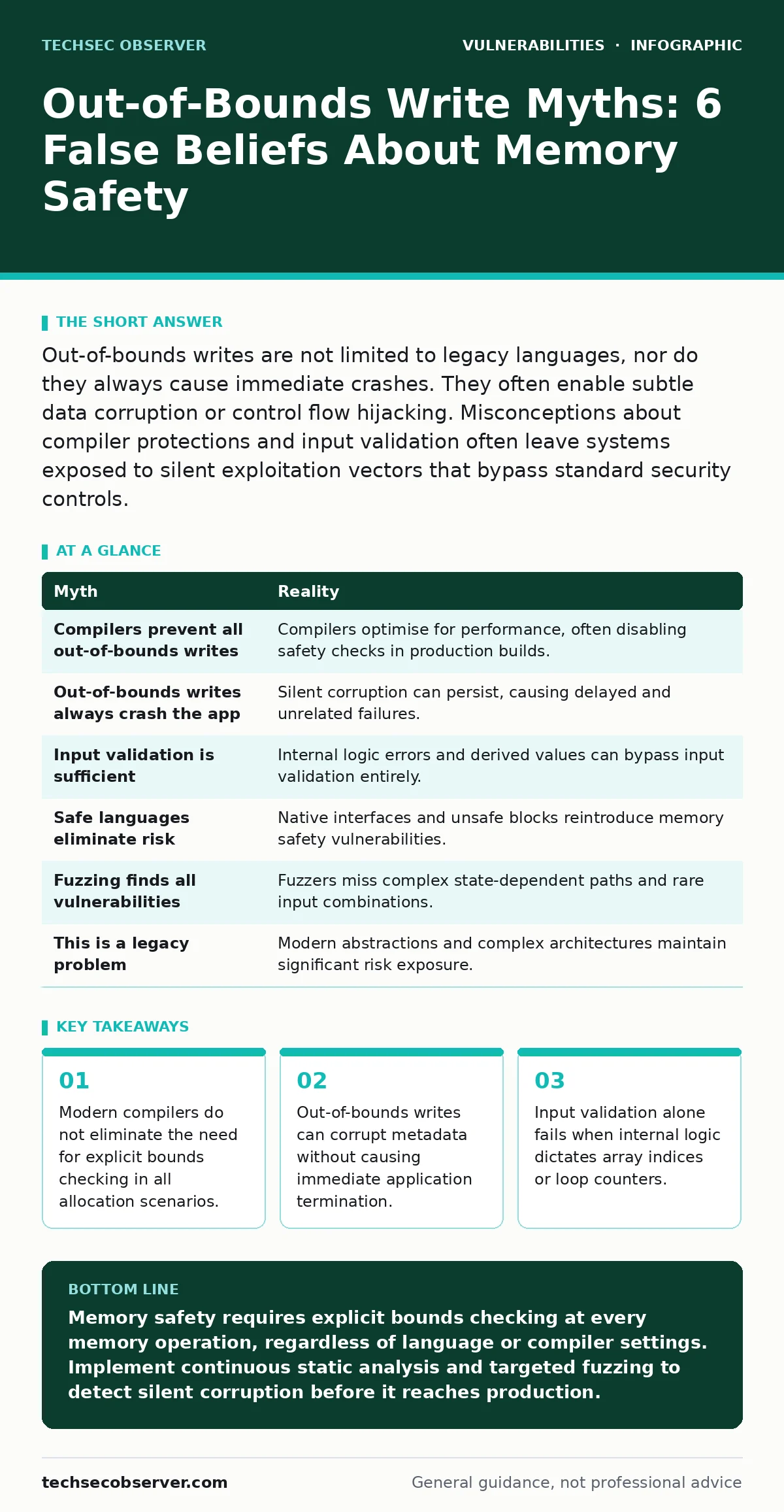
Out-of-bounds writes are not limited to legacy languages, nor do they always cause immediate crashes. They often enable subtle data corruption or control flow hijacking. Misconceptions about compiler protections and input validation often leave systems exposed to silent exploitation vectors that bypass standard security controls.
Myth: Modern Compilers Automatically Prevent Out-of-Bounds Writes
Reality: Compiler optimisations and built-in checks do not guarantee memory safety in every execution path. While modern toolchains offer features like stack canaries and address sanitisation, these mechanisms often operate in specific contexts or build configurations. Release builds frequently disable these checks to improve performance, leaving the binary vulnerable in production environments.
Developers often assume that because code compiles without warnings, it is safe from memory corruption. This assumption ignores the distinction between syntax correctness and runtime safety. A compiler validates that the code adheres to language rules, not that the runtime values remain within allocated boundaries.
Imagine a high-performance server process that relies on aggressive optimisation flags. The compiler may reorder instructions or eliminate what it perceives as redundant checks. If the logic for calculating an array index depends on dynamic input, the compiler cannot predict whether that index will exceed the buffer size at runtime.
Myth: Out-of-Bounds Writes Always Cause Immediate Crashes
Reality: An out-of-bounds write does not necessarily trigger a segmentation fault or application crash. Memory layouts vary, and writing to adjacent memory regions may simply corrupt unrelated data structures. This silent corruption can persist for hours or days, making root cause analysis exceptionally difficult during incident response.
The operating system manages memory in pages, and a write operation might land in a valid page that belongs to a different variable. If the corrupted data is not accessed immediately, the application continues functioning. When the corrupted data is eventually used, the resulting behaviour may appear unrelated to the initial write error.
Suppose a logging module writes slightly beyond its buffer, overwriting a flag that controls connection timeouts. The application does not crash. Instead, connections remain open longer than intended, leading to resource exhaustion. The security team investigates the resource leak, missing the underlying memory safety violation entirely.
This delayed manifestation distinguishes out-of-bounds writes from many other vulnerability classes. The lack of immediate failure signals creates a false sense of stability. Security teams must treat memory safety as a continuous concern, not just a debugging issue.
Myth: Input Validation Alone Prevents These Vulnerabilities
Reality: Validating external input does not protect against out-of-bounds writes caused by internal logic errors. Attackers can manipulate internal state through complex interactions, even when all external inputs are strictly sanitised. The index or length value used in a write operation may be derived from internal calculations, not direct user input.
Consider a scenario where an application processes a file format. The parser validates the file header and rejects malformed data. However, the parser calculates the size of an internal structure based on fields within the validated data. If the calculation logic contains an integer overflow, the resulting size may be smaller than the actual data copied.
This internal miscalculation leads to a buffer overflow, despite perfect input validation. The vulnerability exists in the transformation logic, not the input gate. Relying solely on input validation ignores the complexity of state management within the application.
Developers must validate not just the data entering the system, but also the derived values used for memory operations. Every index, length, and pointer must be checked against its bounds before use. This principle applies regardless of where the original data originated.
Myth: Safe Languages Eliminate the Risk Entirely
Reality: Managed languages and memory-safe runtimes reduce the likelihood of out-of-bounds writes, but they do not eliminate the risk in all cases. Interfacing with native code, unsafe blocks, or low-level libraries reintroduces memory safety concerns. Many applications use mixed-language architectures for performance-critical components.
Imagine a web application written in a safe language that calls a native library for image processing. The safe language handles HTTP requests and business logic, but the native library processes pixel data. If the native library has a bounds checking error, the safe runtime cannot prevent the memory corruption.
The boundary between safe and unsafe code is a common attack surface. Developers often assume that because the primary language is memory-safe, the entire application is secure. This oversight neglects the dependencies and external libraries that operate outside the runtime's safety guarantees.
Myth: Fuzzing Finds All Out-of-Bounds Write Vulnerabilities
Reality: Fuzz testing is a powerful discovery tool, but it does not guarantee the detection of all memory safety issues. Fuzzers rely on coverage and randomness, meaning they may miss paths that require specific state sequences or rare input combinations. Complex logic branches often remain untested by automated fuzzing campaigns.
A fuzzer generates random or mutated inputs to trigger unexpected behaviour. While effective for finding simple overflow conditions, it struggles with vulnerabilities that require precise ordering of events or specific environmental states. The fuzzer may never generate the exact sequence of inputs needed to trigger a subtle out-of-bounds write.
Suppose a vulnerability exists only when a specific configuration flag is set and a particular network packet arrives within a narrow time window. A standard fuzzer targeting the network interface may never encounter this precise combination. The vulnerability remains hidden until manual analysis or a targeted attack reveals it.
Fuzzing should complement, not replace, other security practices. Static analysis, code review, and formal verification provide different perspectives on code safety. Combining these methods increases the likelihood of detecting complex memory safety issues before deployment.
See also: Prevent Business Logic Vulnerabilities: 4 Proven Measures · Regular Expression Denial of Service Prevention Checklist
Myth: Out-of-Bounds Writes Are Only a Legacy Concern
Reality: Out-of-bounds write vulnerabilities remain prevalent in modern software ecosystems, including web applications and cloud-native services. The shift towards microservices and containerised environments has not removed the need for memory safety. High-level abstractions often hide low-level memory operations, creating new opportunities for errors.
Modern frameworks may abstract memory management, but they still rely on underlying system libraries and operating system interfaces. Errors in these lower layers can propagate up to the application level. Additionally, the complexity of modern applications increases the attack surface, providing more vectors for exploitation.
Developers working with high-level languages often lose visibility into memory operations. This abstraction can lead to complacency regarding memory safety practices. The belief that modern tools handle all memory concerns is dangerous, as it discourages rigorous code review and testing.
| Myth | Reality |
|---|---|
| Compilers prevent all out-of-bounds writes | Compilers optimise for performance, often disabling safety checks in production builds. |
| Out-of-bounds writes always crash the app | Silent corruption can persist, causing delayed and unrelated failures. |
| Input validation is sufficient | Internal logic errors and derived values can bypass input validation entirely. |
| Safe languages eliminate risk | Native interfaces and unsafe blocks reintroduce memory safety vulnerabilities. |
| Fuzzing finds all vulnerabilities | Fuzzers miss complex state-dependent paths and rare input combinations. |
| This is a legacy problem | Modern abstractions and complex architectures maintain significant risk exposure. |
Key takeaways
- Modern compilers do not eliminate the need for explicit bounds checking in all allocation scenarios.
- Out-of-bounds writes can corrupt metadata without causing immediate application termination.
- Input validation alone fails when internal logic dictates array indices or loop counters.
Memory safety requires explicit bounds checking at every memory operation, regardless of language or compiler settings. Implement continuous static analysis and targeted fuzzing to detect silent corruption before it reaches production.
Frequently asked questions
How do I detect out-of-bounds writes in a running application?
Use AddressSanitiser or similar runtime detection tools in staging environments to identify memory violations before deployment.
Does using a framework prevent these vulnerabilities?
Frameworks reduce boilerplate code but do not eliminate the risk of logic errors in memory management or third-party dependencies.
What is the difference between a read and a write out-of-bounds error?
Write errors corrupt memory and can be exploited for control flow hijacking, while read errors typically leak sensitive information.
Should I focus on CVE monitoring for these issues?
CVE monitoring helps identify known vulnerabilities in dependencies, but it does not detect custom logic errors in your own codebase.
How this guide was produced: written by the TechSec Observer editorial team with AI assistance, checked against the public references listed below, and reviewed when the facts change. See our editorial policy or report an error.